What should you look for when buying?
Compact mini oven
Suitable when: you’re baking one cake and can confirm that the tin fits in the oven. Rommelsbacher specifies a capacity of 10 litres and a maximum tin diameter of 20 cm for the BG 950.
Worth noting: according to Rommelsbacher, this model has no listed fan setting and has a 30-minute timer, with a continuous setting for longer baking.
Mini oven with multiple settings
Suitable when: you want to choose between conventional heating and fan-assisted cooking for a cake. Inventum lists these settings for the 20-litre OV207B.
Worth noting: a 20-litre capacity doesn’t confirm that your tin will fit; check the internal dimensions and the model’s manual.
Larger freestanding oven
Suitable when: you need more oven space and have room for the external dimensions at your workshop. Inventum lists a capacity of 30 litres for the OV307B and Princess lists 45 litres for the 112754.
Worth noting: a larger capacity doesn’t automatically mean better baking results, and the oven will take up more worktop space.
A recipe from Heel Holland Bakt uses a springform tin of around 20 cm; treat this as an example, not a standard size for every workshop. Measure your own tin and compare it with the usable internal dimensions and instructions for the exact model.
| What to consider |
What should you check? |
Who should pay particular attention? |
| Will the cake tin fit? |
Measure the outside of the tin and compare it with the usable internal dimensions and the model’s instructions. |
I want to know in advance whether my regular tin will fit in the oven, rather than relying on the capacity in litres alone. Around 36% of consumers prioritise making sure their tin will fit. |
| Can you follow the recipe? |
Check the oven setting, temperature and baking time required by the recipe and the manual. |
If I want to follow a recipe precisely, I look at the available settings and timer. Around 29% of consumers prioritise the setting and timing needed for their recipe. |
| Will the setup work? |
Check the external dimensions, specified clearance and electrical connection, including when other appliances are in use. |
At a shared workshop, I want to know whether the oven can be positioned and connected safely. Around 21% of consumers prioritise the setup and electrical connection. |
| Will it be practical to use and clean? |
Choose a suitable size and check how crumbs and baking residue are removed from the model. |
If I plan to use the oven again in future, I also consider its size, energy use and how easy it is to clean. Around 14% of consumers prioritise running costs and maintenance. |
Ovens at Joybuy
This Joybuy selection includes mini ovens and larger freestanding ovens for chocolate cake and use at a workshop. Check for each model whether your tin will fit and how much space is needed for installation.
 No image available
Wiggo WMO-E456(W), mini oven, 45 litres, 2000 W, white
An option if you’re looking for a larger oven setup; the capacity alone doesn’t confirm whether your cake tin will fit. Place the oven on a flat, heat-resistant surface and keep the ventilation openings clear.
View at Joybuy
 No image available
Wiggo WMO-E353(X), oven, 35 litres, 1800 W, stainless steel
This larger oven is an option if its size suits your workspace. Compare the dimensions of your cake tin with the usable internal space and follow the model’s ventilation instructions.
View at Joybuy
 No image available
Rommelsbacher BGS 1400 mini oven
A mini oven for anyone looking for a more compact model. Check the permitted tin size and oven settings for this exact model before comparing it with your recipe.
View at Joybuy
 No image available
Rommelsbacher mini oven BG 950
The manufacturer specifies baking tins up to 20 cm and conventional heating for the BG 950. The timer runs for up to 30 minutes, with a continuous setting; keep a close eye on the baking time for longer recipes.
View at Joybuy
 No image available
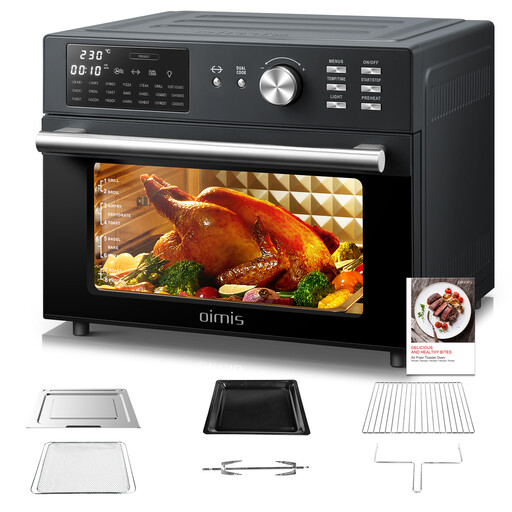
OIMIS air fryer toaster oven, 30 litres, 1800 W, grey
The product name describes it as an air fryer toaster oven. Check the specific product page to see which oven settings and tin sizes are suitable for this model before choosing it for a recipe.
View at Joybuy
Frequently asked questions
Which oven setting should you use for chocolate cake?
Follow the oven setting in the workshop recipe and check that your chosen model has it. When converting from conventional heating to fan-assisted cooking, Heel Holland Bakt advises reducing the set temperature by 20%; this isn’t guaranteed to work for every oven model.
Should you preheat a compact oven?
Follow the recipe and the manual for the exact model. Rommelsbacher specifically advises preheating the BG 950, as otherwise the food may receive too much direct radiant heat during the initial heating phase.
Where should you place and plug in the oven during a workshop?
Follow the positioning and connection instructions for the exact model. An Inventum manual for a different OV series specifies a sturdy, flat, heat-resistant surface and 10 cm of clearance all around; don’t automatically apply this instruction to other ovens. Brandweer Nederland advises plugging high-power appliances directly into a socket where possible and fully unwinding any cable reel in use.
What product regulations apply to an electric mini oven in the Netherlands?
According to the Netherlands Food and Consumer Product Safety Authority, CE marking is compulsory for electrical consumer products placed on the Dutch market. This doesn’t confirm that a specific oven model carries the mark, nor does it tell you whether the oven will fit your tin.
Does a baking workshop need to provide allergen information?
If the organiser sells or supplies food or drink to customers, the Netherlands Food and Consumer Product Safety Authority says allergen information requirements apply, including to unpackaged products. Whether this applies to a particular workshop depends on whether the organiser sells or supplies food or drink.


