
Baking for guests
You want to bake enough cheese scones before your guests arrive, so check the usable baking tray size and how many batches you’ll need first, rather than focusing only on the capacity in litres.


Start by checking the usable baking tray size and the space available for the oven: its capacity in litres won’t tell you how many scones will fit with room between them. Then check that the oven has the right settings and temperature for your recipe, and allow for preheating and any extra batches. Lidl Recipes uses a preheated oven at 220 °C and a baking time of around 15 minutes for eight savoury mini scones. This is not a test of the mini ovens mentioned here.
You want to bake enough cheese scones before your guests arrive, so check the usable baking tray size and how many batches you’ll need first, rather than focusing only on the capacity in litres.
You’re looking for a compact, freestanding oven. As well as its external dimensions, allow space for heat to escape and for the door to open fully.
You want to be able to set the temperature and choose top and bottom heat. You might also consider fan-assisted cooking if you’d like to use the oven for other baking tasks.
The Lidl Recipes recipe makes eight savoury mini scones and calls for a preheated oven at 220 °C and a baking time of around 15 minutes. Use this as a recipe reference, not as a guarantee of a mini oven’s baking time or capacity.
| What to consider | What to look for | Who is this most important for? |
|---|---|---|
| Space per batch | Check the usable size of the supplied baking tray and compare it with the number of scones and the spacing required by your recipe. Don’t estimate capacity from the number of litres alone. | If I want to bake all the scones in one batch before guests arrive, I need to know how many will fit on the tray with space between them. Around 36% of consumers prioritise baking space per batch. |
| Settings and planning | Compare the temperature and oven setting in your recipe with the model’s settings. Allow separately for preheating, baking time and any additional batches. | I want to be able to select the settings in my recipe and leave enough time for preheating and baking. Around 29% of consumers prioritise baking settings and planning. |
| Space for the oven | Measure the available width, depth and height, and follow the positioning and ventilation instructions in the manual. Remember to allow space for the door to open. | With limited worktop space, I want to know in advance whether the oven will fit and leave room for the door and heat to escape. Around 21% of consumers prioritise the space available for the oven. |
| Cleaning | Check whether the oven has a removable crumb tray, and follow the model-specific cleaning instructions for the baking tray and wire rack. | After guests leave, I want to be able to clear up crumbs and residue easily and know how to clean the parts. Around 14% of consumers prioritise clearing up. |
The stated oven capacity doesn’t tell you how many scones will fit with space between them on the supplied baking tray. You may need an extra batch to make enough for your guests.
An extra batch can take more time, so plan for the scones to come out of the oven at different times.
Check the usable tray size and compare it with the dimensions and spacing required by your recipe.
A temperature setting of up to 230 °C doesn’t tell you how long the oven takes to preheat, its actual temperature or how it will bake scones.
Compare your recipe’s settings with the manual and keep an eye on how things are progressing during the first batch.
The external dimensions don’t show how much room you’ll need to open the door and let heat escape.
Measure the space and check the positioning instructions for the exact model before buying.
You may need more space than the oven’s dimensions alone suggest.
The OV207B is a freestanding fan oven with a 20-litre capacity.
The OV-3650 is a freestanding oven with a 20-litre capacity and top and bottom heat that can be set separately or together.
The TO 2067 is a baking and toast oven with a capacity of around 20 litres. It’s for anyone who wants to combine top and bottom heat without needing fan-assisted cooking.
The 112751 is a 32-litre freestanding oven with convection, for anyone considering a larger model.
The BG 950 is a compact 10-litre oven designed for small baking tins and small portions.
This selection includes Joybuy products with an oven or baking function that may suit baking cheese scones. Check the settings and specifications of each model to make sure they work with your recipe.
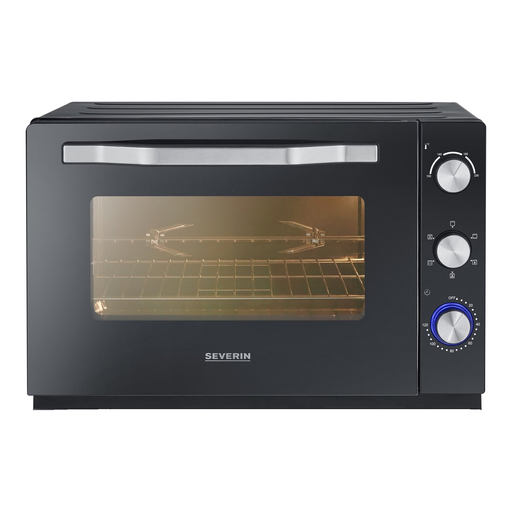 No image available
Suitable if you’re looking for an oven function and a choice of settings for baking cheese scones.
18 l; 2,000 W.
 No image available
An option to compare if you’re looking for a toaster oven with a baking function.
4-in-1; 1,200 W.
 No image available
Worth comparing if you’re looking for a mini oven with top and bottom heat and fan-assisted cooking for cheese scones.
 No image available
Suitable if you’re looking for a compact oven for small portions. Check that the baking tray has enough room for your scones.
 No image available
An option to compare if you want to bake cheese scones using an oven function with air circulation.
30 l; 21 presets; for 13-inch pizzas; rotisserie and dehydrator; 1,800 W.
Follow your own recipe. Lidl Recipes calls for a preheated oven at 220 °C and around 15 minutes of baking for eight savoury mini scones. This baking time hasn’t been tested with the mini ovens in this article.
Don’t rely on the external dimensions alone. Follow the positioning and ventilation instructions in the manual for the exact model, and check that the door can open safely in that spot. Brandweer Nederland points out that heat from an oven needs somewhere to escape.
Let the oven cool as instructed in the manual, and follow the cleaning instructions for the interior and accessories. Inventum lists a crumb tray and dishwasher-safe removable parts for the OV207B. Check the cleaning instructions for each other model separately.
No. According to the Dutch government, there is no fixed legal guarantee period in the Netherlands: what you can expect from a product depends on factors including the circumstances and its expected lifespan. If a product is faulty, contact the retailer; a manufacturer’s guarantee may provide additional cover.
The European Commission states that the Low Voltage Directive applies to electrical equipment designed for 50–1,000 V AC. According to the Dutch government, many consumer products placed on the EU market must carry a CE marking. The requirements for a specific model depend on the product rules that apply to it.