
Batch baker
You want to make enough biscuits during one weekend baking session, so you’re mainly comparing the usable baking tray and how many batches you’ll need.


Choose a mini oven based on the usable baking tray, how many biscuits you want to bake at a time and the space you have available. The capacity in litres alone won’t tell you how many biscuits will fit. A compact model is better suited to small batches and limited worktop space, while a larger oven may offer more baking space but will take up more room. Also check the heating settings, the tray supplied and the placement instructions for the exact model.
You want to make enough biscuits during one weekend baking session, so you’re mainly comparing the usable baking tray and how many batches you’ll need.
You make small batches and weigh up the oven’s external dimensions against the space it needs to release heat safely.
You’re looking for straightforward controls and want to check whether the oven suits small batches, your cleaning routine and how often you bake.
| What to consider | What to look for | Who should pay extra attention? |
|---|---|---|
| Baking tray and batches | Compare the dimensions of the supplied tray with the number of biscuits you want to bake at a time. Remember to leave space between them. | If I want to make several batches during one weekend baking session, I first check how many biscuits will fit on the tray. Around 40% of consumers prioritise baking space and fewer batches. |
| Worktop and placement | Measure the available width, depth and height, and follow the model’s placement instructions. | With a small worktop, I want to know whether the oven will fit and still have enough space around it. Around 30% of consumers prioritise safe placement and worktop space. |
| Heating settings | Check which settings the exact model has and compare them with the setting and temperature in your recipe. | If I want to follow the method in my recipe, I check the available oven settings first. Around 20% of consumers choose mainly according to their preferred heating setting. |
| Ease of use | Check the timer, supplied tray and cleaning instructions. Only compare energy-use figures on the same basis. | For the occasional small batch, I don’t want to choose features I’ll hardly use. Around 10% of consumers prioritise a straightforward purchase that suits their needs. |
The oven’s capacity doesn’t tell you how many biscuits will fit on the supplied tray with enough space between them. A smaller tray may mean you need to bake more batches.
Compare the tray dimensions with the batch size you want to bake.
The oven needs to fit on the worktop, but it also needs enough space for heat to escape.
Measure the space again and check the placement instructions for the exact model.
Milieu Centraal recommends comparing ovens by their electricity use per use or per year. The number of batches also affects how you use the oven.
Compare energy-use figures on the same basis and check how many batches you’ll need for your portion.
For the Rommelsbacher BG 1055/E, the manufacturer lists a capacity of 18 litres and a 60-minute timer, while a Joybuy product description states 10 litres and 30 minutes.
When considering a specific listing, check the full model number and compare the product specifications with the manufacturer’s details.
According to Inventum, the OV207B is a 20-litre freestanding oven with six programmes and a baking tray included.
According to Tristar, the OV-3610 has a capacity of 10 litres and top and bottom heat.
The manufacturer lists a capacity of 10 litres for the BG 950 and 18 litres for the BG 1055/E, with different heating options.
According to Severin, the TO 2058 has a capacity of 42 litres. Top and bottom heat and convection can be used separately or together.
According to Princess, the 112754 is a 45-litre freestanding oven with convection and top and bottom heat.
This selection includes freestanding ovens for baking biscuits, from a compact 10-litre oven to larger models with a range of heating settings. Compare the baking tray, the oven setting you need and the space you have available before choosing a model.
 No image available
An option to compare if you’d like the listed grill and toast functions as well as baking.
Capacity: 30 litres. The product description lists top and bottom heat, convection and an adjustable temperature of 100–230 °C.
 No image available
Compare this model if you’re looking for a larger oven with a baking tray included.
The product description lists top and bottom heat, a 90-minute timer and four shelf positions. According to the product information, allow 10 cm of space at the sides and 30 cm above when positioning the oven.
 No image available
A model to compare if you’re looking for several oven settings and a baking tray.
Capacity: 22 litres. The product description lists five heating settings and a temperature setting of up to 230 °C. The baking tin is suitable for sizes up to 25 cm; check that this size suits your preferred portion.
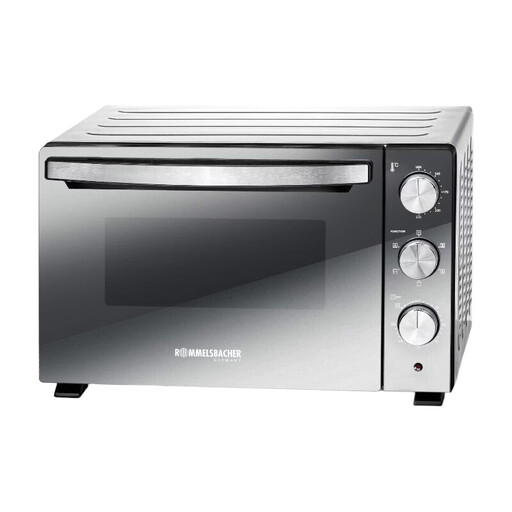 No image available
May suit anyone comparing larger ovens with top and bottom heat and fan-assisted circulation.
Capacity: 30 litres. The product description lists a maximum temperature of 250 °C and manual cleaning.
 No image available
A compact option to compare if you bake small batches and have limited space.
Capacity: 10 litres. The product description lists a baking tray up to 20 cm, top and bottom heat, an adjustable temperature of 80–230 °C and a 30-minute timer. Check that the tray size suits your preferred portion.
First decide how many biscuits you want to bake at once, then compare this with the usable dimensions of the supplied baking tray. The capacity in litres won’t tell you how many biscuits will fit on it.
Follow the placement instructions for the exact model, rather than relying on its external dimensions alone. The Fire Service advises that heat from appliances such as ovens needs room to escape.
Follow your recipe and the oven manual. As a recipe example, the Voedingscentrum recommends a preheated oven at 180 °C and a baking time of 15–18 minutes for oat and date biscuits; this timing isn’t guaranteed to work for every mini oven or recipe.
According to ACM ConsuWijzer, you have a legal guarantee in addition to any seller’s guarantee. If the product breaks sooner than you could reasonably expect, the seller must offer an appropriate solution free of charge, such as a repair, replacement or refund.
Electric mini ovens that fall within the scope of EU low-voltage rules must meet the applicable EU requirements. Dutch government information explains that, in this case, the manufacturer must apply the CE marking and draw up an EU declaration of conformity, among other things. A marking isn’t a baking test of a specific model.