
Baking one or a few lunchbox portions
You want to bake one or a few small pear galettes. Focus on finding a suitable baking tray and adjustable oven heat. Jumbo’s recipe for small pear galettes shapes them on a baking tray.


Choose a mini oven with a usable baking tray large enough for your galettes, including their folded-over edges. Then compare the oven settings and the clearance required on your worktop. Jumbo’s recipe for small pear galettes uses 200 °C, but that temperature alone won’t guarantee the same baking results in every mini oven.
You want to bake one or a few small pear galettes. Focus on finding a suitable baking tray and adjustable oven heat. Jumbo’s recipe for small pear galettes shapes them on a baking tray.
The worktop space you have available will help determine which oven is right for you. Check the external dimensions as well as the clearance specified by the manufacturer.
You may want to bake several galettes at once or use the oven for larger bakes too. Compare the usable tray size with the dimensions of your portions.
First, measure your pastry circles with the edges folded over and compare them with the usable baking tray. Then check that the heat settings you need and the recommended clearance suit your kitchen and how you plan to use the oven.
| What to consider | What to look for | Who should pay particular attention? |
|---|---|---|
| Baking tray and portion size | Compare the usable tray size with your pastry circles, allowing space between the galettes. | If I want to bake several small galettes at once, there needs to be room on the tray for their folded-over edges. Around 31% of consumers say having enough baking tray space is their main buying concern. |
| Heat settings | Check that the oven offers the temperature and heating settings you need; an extra setting doesn’t guarantee a particular baking result. | If I want to choose the temperature or heat distribution for my recipe, the available settings are crucial. Around 25% of consumers say adjustable baking settings are their main concern. |
| Worktop space | Measure the space for the appliance and allow for the clearance stated in the manual. | In a small kitchen, the oven needs to fit with the recommended clearance around it. Around 25% of consumers put the available space for setting up the appliance first. |
| Safe use and storage | Check the instructions for handling hot trays and the storage advice for your galette ingredients. | If I want to remove the galette safely and take it with me, I’ll check both the instructions for use and the filling. Around 19% of consumers say safe use and storage are their main buying concern. |
The oven’s capacity doesn’t tell you how many pastry circles with folded-over edges will fit on the baking tray.
Compare the usable tray size with the portions you want to bake. Tristar lists a baking surface of 29.5 × 25.0 cm for the OV-3620SU.
An oven may physically fit, but still not have enough room for the ventilation clearance specified by the manufacturer.
Include the positioning instructions for the exact model in your measurements. Inventum specifies 10 cm of clearance on all sides for the OV207B.
Severin’s product page for the TO 2056 mentions fan-assisted cooking in the description, but says in the technical details that it doesn’t have this function.
If fan-assisted cooking matters to you, ask for confirmation for this exact model in its manual or product specifications.
Inventum describes the OV207B as a 20-litre oven with a baking tray, fan-assisted cooking and separate bottom heat.
Tristar states that the OV-3620SU has a capacity of 19 litres and a specified baking surface you can compare with the size of your pastry circles.
Princess describes the 112741 as a 20-litre convection oven with a baking tray and crumb tray.
Rommelsbacher describes the BG 950 as a compact 10-litre oven for small baking jobs.
Severin states that the TO 2056 has a capacity of 30 litres, making it an option if you’re considering larger bakes too.
This selection includes oven and air fryer oven models for baking smaller portions. Compare the listed version with your recipe, the size of your portions and the space you have available.
 No image available
For anyone considering an oven model with multiple zones; the product name specifies a dual-zone version.
The product name lists a capacity of 23 litres and 15 programmes.
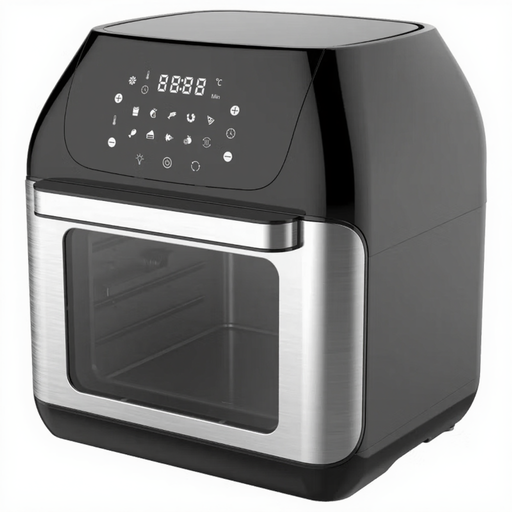 No image available
For anyone considering an air fryer oven with a stated capacity of 12 litres; compare the capacity with the portions you want to bake.
The product name lists 1500W and No Flip.
 No image available
For anyone considering an air fryer oven with a stated capacity of 6.5L; check that it suits the portions you plan to bake.
The product name lists a viewing window, classic dial controls and No-Turn Baking.
 No image available
For anyone considering a toaster oven for different cooking methods; the product name describes this model as 4-in-1.
The product name lists 1200W.
 No image available
For anyone considering a larger oven as well as one for lunchbox portions; compare the stated capacity with the space on your worktop.
The product name lists 2000 W and 45L. The description specifies 10 cm of clearance on all sides and 30 cm above the oven.
No. Jumbo’s recipe for small pear galettes specifies 200 °C and 15–20 minutes. Follow the instructions for your own recipe and check that the pastry is cooked through; that cooking time isn’t a test of every mini oven.
Follow the manual for the exact model and keep the ventilation openings clear. Inventum specifies 10 cm of clearance on all sides for the OV207B; don’t assume this model-specific measurement applies to other ovens.
That depends on the ingredients. Let the galette cool and check the storage advice for the filling you’ve used. The Netherlands Nutrition Centre recommends storing highly perishable food at 4 °C and not leaving it out of the fridge for more than 2 hours.
According to the Dutch government, consumers buying from a business at a distance are often entitled to a 14-day cooling-off period. Whether this applies to a particular sale depends on the circumstances.
For electrical equipment covered by the relevant EU requirements, the manufacturer must apply a CE marking after completing the conformity assessment and draw up an EU declaration of conformity. Check the documentation for the exact model; a product listing alone doesn’t confirm compliance.