
Student with their own small oven dish
Wants to make vegetable lasagne for one or two meals and needs to compare the dish, including its handles, with the oven’s usable space.


First, measure your oven dish, including the handles, and check that it fits inside the oven with enough space around the heating elements. Also choose a spot where the oven can ventilate safely, as set out in the instruction manual. More capacity can be useful for larger portions, but it also takes up more worktop space.
Wants to make vegetable lasagne for one or two meals and needs to compare the dish, including its handles, with the oven’s usable space.
Often makes a larger dish or several portions and weighs up the extra oven space against the room available on the worktop.
Has little worktop space and needs to consider ventilation, heat dissipation and the correct connection, as well as the oven’s external dimensions.
Start by checking that your dish fits and that there’s a safe place for the oven. Then compare the cooking settings, size and cleaning options.
| Consideration | What to look for when buying | Who is this important for? |
|---|---|---|
| Will the lasagne dish fit? | Measure the dish, including its handles, and compare its dimensions with the usable interior, shelf height and space around the heating elements. | If I want to use my own dish for vegetable lasagne, I need to know that it will fit properly; around 36% of consumers put dish size first. |
| A safe spot on the worktop | Measure the available space and check the ventilation clearances in the instruction manual for the exact model. | With limited worktop space, I need to know that heat can escape and enough space will remain clear; around 29% of consumers prioritise safe positioning. |
| Cooking settings you need | Check whether the exact model has top and bottom heat, whether it includes a fan-assisted setting, and what temperature and timer settings are available. | If I want to compare cooking settings for different dishes, I focus on the features of the exact model; around 21% of consumers compare cooking settings first. |
| Use and cleaning | Compare the size, any stated energy consumption figures measured on the same basis, and the removable parts; don’t work out energy use from the wattage alone. | If I use the oven regularly, I need to consider electricity use and cleaning; around 14% of consumers prioritise running costs and maintenance. |
Capacity doesn’t tell you whether a rectangular dish with handles will fit. For example, Rommelsbacher lists baking tins up to 20 cm in diameter for the BG 950; that doesn’t confirm whether a dish with projecting handles will fit.
Measure the whole dish first, then check the usable interior and the position of the shelf.
The external dimensions aren’t the same as the total space needed for positioning. The oven needs room to release heat, and flammable items should be kept away.
Read the ventilation instructions for your chosen model before deciding where to put it.
You may need to find another spot on the worktop to maintain the required clearance.
Heating settings vary between models. A feature listed for a similar model number won’t necessarily be available on the model you’re looking at.
Check the full model number and confirm any essential feature in the relevant instruction manual or with the manufacturer.
Actual energy use also depends on what you’re cooking and how long you use the oven. Milieu Centraal advises comparing ovens by energy use per cooking session or per year where possible.
Choose a size that suits the dishes you make, and only compare energy figures measured on the same basis.
These brands and models can help you compare possible sizes and features; their characteristics aren’t a verdict on the brand as a whole.
The OV207B is a compact option for anyone who wants a choice of cooking settings, as long as their dish fits.
The OV-3620 is a compact basic oven for anyone looking for top and bottom heat.
The TO 2068 is a compact option with several heating settings for anyone who also wants to cook other dishes.
The 112754 is designed for anyone who often cooks larger dishes or several portions and has enough worktop space.
The BG 950 is a very small oven for a suitably sized small baking tin, rather than a standard rectangular lasagne dish.
This selection includes mini ovens and countertop ovens for baking, from compact models to roomier options. For each model, check that your dish fits and that you can leave enough space for ventilation.
 No image available
An option for anyone looking for a mini oven for baking and wanting to use two cooking zones; check that your oven dish will fit.
The product description lists a capacity of 23 litres, two cooking zones that can be synchronised and 15 programmes.
 No image available
This very small oven may suit a small dish, but the stated baking tin size doesn’t automatically make it suitable for a rectangular lasagne dish.
The product details list a 10-litre capacity, top and bottom heat, a temperature range of 80–230 °C and baking tins up to 20 cm in diameter. Check the shape and dimensions of your own dish.
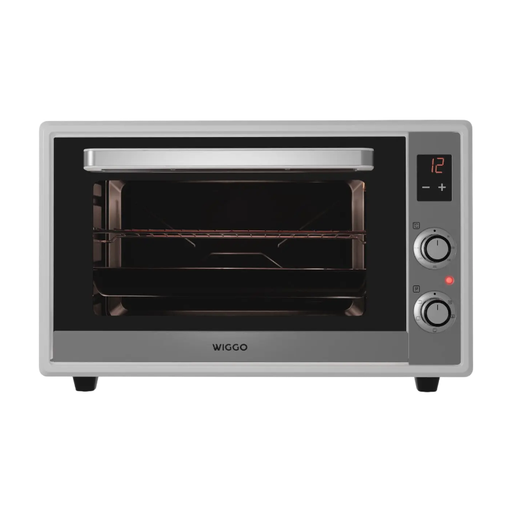 No image available
This roomier option is designed for larger dishes; measure your worktop and leave the required ventilation space clear too.
The product details list a 65-litre capacity, six cooking functions and a turbo fan. The external dimensions are 60 × 49 × 40 cm.
 No image available
An option for anyone who wants to use hotplates as well as oven space; allow for the whole appliance when planning where to put it on the worktop.
The product details list a 30-litre capacity, top and bottom heat, fan-assisted cooking, a grill and two hotplates. The stated external dimensions are 50 × 42 × 35 cm; the instructions call for sufficient ventilation around the appliance.
 No image available
This roomier oven may suit you if you cook larger dishes; remember that the appliance takes up more worktop space.
The product details list a 45-litre capacity, six functions, top and bottom heat, convection and a grill.
You can’t tell from the capacity alone. Measure your dish, including its handles, and compare its dimensions with the usable interior and shelf position of the exact model. Also leave space between the filled dish and the heating elements.
Only if the setup meets the clearance and ventilation requirements in the instruction manual for your model. Brandweer Nederland advises allowing heat from appliances such as ovens to escape; keep flammable items away too.
No. The size alone doesn’t tell you how much a cooking session will cost. Milieu Centraal advises choosing an oven that suits the dishes you make and, where possible, comparing models by energy use per cooking session or per year. Wattage alone doesn’t measure the cost of cooking one lasagne.
No. According to ACM ConsuWijzer, you have a statutory guarantee as well as any manufacturer’s guarantee. If a product breaks under normal use sooner than you could reasonably expect, the seller must offer an appropriate solution; there isn’t simply a fixed two-year period for every oven.
The Dutch government states that electronic appliances placed on the market in the EU must have a CE marking, and that safety warnings should be included in the instruction manual. Check the marking, the manual and the seller’s identity; a CE marking isn’t a test of baking performance.