
Bakers making larger batches at the weekend
If you want to spend less time baking batch after batch, compare the usable baking tray with your own portions of dough rather than looking only at the oven capacity.


Start with the usable baking tray: the capacity in litres won’t tell you how many portions of dough will fit with enough space between them. Then compare the oven settings with your recipe and check that the oven, including the clearance specified in the manual, will fit on your worktop. Before buying, also check the CE marking on the specific appliance.
If you want to spend less time baking batch after batch, compare the usable baking tray with your own portions of dough rather than looking only at the oven capacity.
If you want to put a freestanding oven on a small worktop, take account of its external dimensions as well as the clearance required in the manual.
If you want to match the settings to your recipe, check which settings each model offers, such as top and bottom heat or fan-assisted cooking.
| What to consider | What should you check? | Who is this important for? |
|---|---|---|
| Biscuits per batch | Check the baking tray dimensions and plan how your portions of dough will fit, allowing for the spacing specified in your recipe. A King Arthur Baking recipe uses a gap of around 2 inches between portions of dough; follow the instructions in your own recipe. | I want to bake as few batches as possible over a baking weekend, so I check whether my portions of dough will fit on the tray. Around 36% of consumers put baking tray capacity first. |
| Oven settings | Check the full model number to see whether it offers the top and bottom heat, fan-assisted setting and temperature control required by your recipe. | If I want to match the oven settings to my recipe, I first check which settings the specific model offers. Around 29% of consumers prioritise the available oven settings. |
| Worktop space | Measure the space and check the positioning instructions for the exact model you’re considering. The Inventum OV-series manual consulted specifies 10 cm of clearance all around; don’t assume this applies to other ovens without checking. | With limited worktop space, I want to know whether the oven will really fit with the required clearance. Around 21% of consumers put fit first. |
| Running costs and maintenance | Where possible, compare the electricity used per use and check which parts are included and how they should be cleaned. | I want to weigh up in advance how much energy use and cleaning will influence my choice. Around 14% of consumers prioritise running costs and maintenance. |
An oven’s capacity doesn’t tell you directly how many portions of dough will fit on the baking tray. Biscuits need space between them, so a smaller tray may mean baking more batches.
Check the baking tray dimensions and sketch out the portions from your recipe to scale, leaving space between them.
Allow for extra batches if all your portions of dough won’t fit on the tray at once.
According to the manufacturer, the Severin TO 2067 doesn’t have a fan-assisted setting, while the Princess 112754 does. The name of a function alone won’t tell you how your recipe will turn out.
Check the settings on the exact model and follow the temperature and instructions in your recipe.
The oven may fit within the dimensions of your worktop, but the manual may also specify clearance around it.
Measure the space available, taking account of the positioning requirements in the manual for your chosen model.
The OV-3620 is a compact baking and toast oven worth considering for smaller batches.
The TO 2067 is a compact option if you want top and bottom heat that can be switched on separately.
The OV307B is a freestanding fan-assisted oven to compare if you’re considering a larger oven cavity.
The 112754 is a larger freestanding oven to consider if you have more room inside and on your worktop.
These models are options to compare for baking chocolate biscuits, from a compact oven to larger models with a range of heating settings. Assess the baking tray, available settings and required clearance for each model. When buying, also check the CE marking on the specific appliance. The NVWA states that electrical appliances covered by the Dutch Commodities Act Decree on Electrical Equipment must carry this marking.
 No image available
An option to compare if you’re looking for a larger mini oven for baking.
The product information lists a capacity of 45 litres, 2000 W and six functions, including fan-assisted cooking, top heat and bottom heat.
 No image available
This oven is an option to compare if you’re looking for a model that comes with a baking tray and offers several heating options.
The product information lists a capacity of 35 litres, 1800 W, three heating options, a temperature setting of up to 250 °C, and a baking tray and rack. According to the product information, leave at least 10 cm of clearance on all sides and 30 cm above the oven.
 No image available
An option to compare if you want to match the oven settings to your recipe and use a baking tin.
The product information lists a capacity of 22 litres, five heating settings including top and bottom heat and fan-assisted cooking, and a baking tray. Baking tins up to 25 cm in diameter are listed.
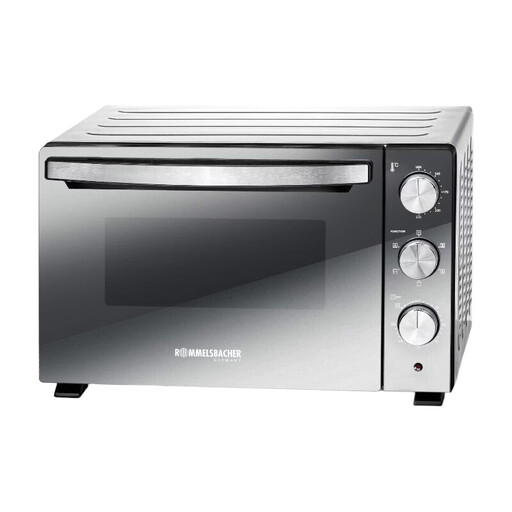 No image available
A model to compare if you’re considering an oven with top and bottom heat and fan-assisted cooking.
The product information lists a capacity of 30 litres and an adjustable temperature of up to 250 °C. It must be cleaned by hand.
 No image available
A compact option to compare for smaller batches.
The product information lists a capacity of 10 litres, top and bottom heat, an adjustable temperature from 80 °C to 230 °C, and baking trays up to 20 cm.
Plan your layout using the usable baking tray and the portion size in your recipe. A King Arthur Baking recipe leaves around 2 inches between portions of dough; if your recipe specifies a different gap, follow that instead.
Measure the available space and follow the positioning instructions for the exact model. The Inventum OV-series manual consulted specifies a flat, heat-resistant surface and 10 cm of clearance all around; don’t assume this measurement applies to other mini ovens.
Yes, if the oven is covered by the Dutch Commodities Act Decree on Electrical Equipment. The NVWA states that appliances covered by this decree must carry a CE marking. Check the marking on the specific appliance.
Compare the settings for the full model number with the instructions in your recipe. Some models have top and bottom heat, while others also offer fan-assisted cooking. An extra setting alone doesn’t prove that biscuits will bake better.
Where possible, compare the electricity used per use rather than looking only at the stated wattage. Milieu Centraal recommends comparing ovens by their energy use per use or per year.