
Baking larger batches
You need to prepare lots of beetroot wedges before the sale and want to know how many will actually fit on the baking tray.


Choose a mini oven based on the usable baking tray size and how many batches you can fit in before the sale, rather than litres alone. A larger fan oven may suit bigger planned batches, while a smaller model takes up less worktop space. In either case, check the installation instructions and plan how you’ll store the beetroot wedges hygienically.
You need to prepare lots of beetroot wedges before the sale and want to know how many will actually fit on the baking tray.
You can bake smaller batches, but the oven’s external dimensions and safe positioning will determine whether it fits in your kitchen.
You’d like to use the oven for other dishes too, so you’re considering its heating settings, cleaning and after-sales service.
Start with the usable baking tray size and the number of batches you’ll need. Then check that the oven fits safely and that its cooking settings suit the way you plan to use it.
| What to consider | What to look for | Who this matters to |
|---|---|---|
| Portions per batch | Measure the usable area of the baking tray and decide how many wedges you want to cook per batch. | If I need to prepare lots of wedges before the sale, I want to know how many will actually fit side by side on the tray. Around 36% of consumers say batch capacity is their main concern. |
| Cooking settings | Check which settings the exact model offers and test your recipe with a small batch first. | If you want to tailor the cooking method to the dish, check which oven settings are available. Around 29% of consumers prioritise control over how food is cooked. |
| Safe positioning | Compare the external dimensions and follow the positioning and ventilation instructions in the manual. | If worktop space is limited, I want to know in advance whether the oven will fit safely where I plan to put it. Around 21% of consumers say lack of space is their main constraint. |
| Use and aftercare | Read the cleaning instructions and compare energy consumption only when figures are stated on the same basis. | If you plan to use the oven regularly after the sale, consider how easy it is to clean and what help is available if it develops a fault. Around 14% of consumers give greatest weight to running costs and aftercare. |
An oven’s capacity doesn’t tell you how many beetroot wedges will fit on the supplied baking tray.
Compare the usable tray size and test your planned batch before the sale.
A smaller baking tray may mean more batches and a longer preparation time.
The Voedingscentrum recipe parboils the beetroot before the wedges go into the oven, so the oven time won’t necessarily apply to raw beetroot.
Decide on your cooking method in advance and test it with the appliance you’ve chosen.
Parboiling the beetroot adds an extra step to your preparation.
A model name on its own doesn’t confirm that the version being sold matches the specifications you need.
Before buying, check the full model reference and compare key features, such as capacity and timer, with the manufacturer’s product information.
For sales at markets and events, the NVWA also sets requirements for safe, hygienic preparation, storage and sale.
Plan storage and allergen information alongside your baking batches. Check separately whether you need to register, based on how often you sell food.
Organising hygienic storage and customer information takes time too.
The features listed apply to the specific models below; they aren’t a general assessment of the entire brand.
The OV-3610 and OV-3660 offer a choice between a very compact oven and a larger fan-assisted model.
The 20-litre OV207B and 30-litre OV307B are medium-sized fan ovens.
The TO 2058 is a larger baking and toast oven with convection.
Rommelsbacher describes the BG 1055/E as an 18-litre mini oven with several settings, including circulating air.
The Optimo OF4448 is a 19-litre oven with a fan setting among its features.
These models are freestanding mini ovens and air fryer ovens for baking or roasting. Check the usable cooking space and positioning instructions for each version before planning your batches.
 No image available
May suit you if you want to use two cooking zones at once. Check that each compartment has enough room for your planned batch.
The product name states a capacity of 23 litres. The product description mentions two compartments and 15 programmes, including baking and roasting.
 No image available
An option to consider if you’re looking for a fan oven. Check that the usable space is large enough for the quantity of beetroot wedges you want to cook.
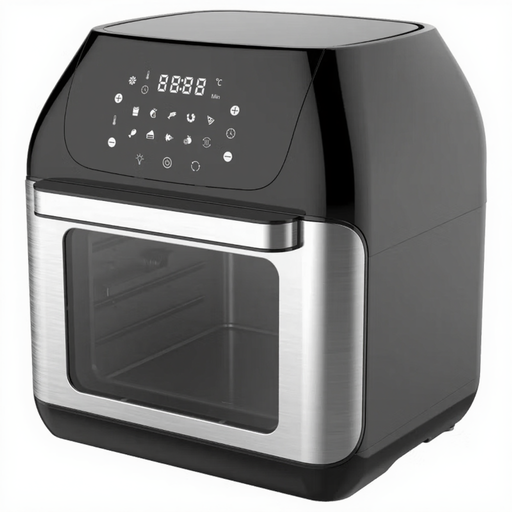
The product name states a capacity of 12 litres and 1500 W. The product description mentions a timer of up to 90 minutes, hot-air cooking and a rotisserie.
 No image available
May suit you if you’re looking for an air fryer oven with a viewing window. Check that the basket has room for the quantity you want to cook.
The product description lists a 6.5-litre capacity, hot-air circulation, a viewing window and an interior light. It has rotary controls and a timer of up to 60 minutes.
Don’t overfill the basket: according to the product description, this can affect air circulation and cooking.
 No image available
An option to consider if you’d like to use two hotplates as well as an oven. Check that this combination will fit in the space available.
The product description lists a 30-litre capacity, two hotplates, top and bottom heat, and a fan setting. The model name mentions baking, toasting and grilling functions.
Place the appliance on a stable, heat-resistant surface, leave space around it for ventilation and take care around hot surfaces during use.
 No image available
May suit you if you’re looking for an oven with a larger stated capacity. Measure the available space and check the ventilation instructions.
The product name states a capacity of 45 litres and 2000 W. The product description mentions baking, top and bottom heat, a fan function and an integrated hotplate.
Place the appliance on a stable, heat-resistant surface, keep the ventilation openings clear and don’t leave it unattended while in use.
Measure the usable baking tray on the exact model and test the portion you plan to make before the sale. The oven’s capacity in litres and number of shelf positions don’t, on their own, tell you how many wedges will fit on the tray.
Only if you follow the same preparation steps. The Voedingscentrum recipe parboils the beetroot first, then roasts the wedges with other vegetables. So test raw wedges or a different quantity separately.
Prepare food hygienically and make sure it’s stored appropriately during the sale. The Voedingscentrum advises putting leftovers in the fridge or freezer, covered and cooled, within two hours of cooking. A mini oven is no substitute for suitable storage during the sale.
According to the NVWA’s step-by-step guide, you don’t need to register if you sell food once a year. If you sell food several times a year, you must register and follow a food safety plan or hygiene code. You still need to handle food safely and hygienically, even for a one-off sale.
According to the NVWA, sellers must tell customers about allergens in unpackaged food before purchase, for example on a card. You can provide the information verbally if you clearly indicate that customers can ask for it. Check all ingredients used and any risk of cross-contamination before providing information.