
Bakers with limited storage space
You want to put the oven away after use. Check both its storage dimensions and the clear space it needs while in use. Fire Service Netherlands stresses that heat from electrical appliances needs room to escape.


Choose a mini oven based on the safe space where it can stand while in use and the usable size of its baking tray, not just its capacity or how easy it is to store. A smaller model is easier to put away, but may mean baking in more batches. A larger model may offer more tray space or settings, provided it fits in your kitchen and you can leave the ventilation space specified in the manual. Albert Heijn Allerhande uses two baking trays for ten apple turnovers, so don’t assume they’ll all fit on a mini oven’s tray at once.
You want to put the oven away after use. Check both its storage dimensions and the clear space it needs while in use. Fire Service Netherlands stresses that heat from electrical appliances needs room to escape.
You want to keep the number of baking batches down. Compare the usable baking tray area and the space needed for the pastry, not just the capacity in litres. Albert Heijn Allerhande divides ten apple turnovers between two baking trays.
You want a choice of heating settings. Check the features of the exact model code: conventional heat and fan-assisted cooking are not the same.
Best for: when easy storage is your priority and you’re happy to make small portions or bake in extra batches. Tristar lists a 10-litre capacity for the OV-3615; Severin lists 9 litres for the TO 2052.
The trade-off: capacity doesn’t tell you how many apple turnovers will fit on the tray. Severin doesn’t list a fan-assisted setting for the TO 2052.
Best for: when you want to explore models with a larger baking tray and have room for a bigger appliance. Princess lists a 20-litre capacity and top and bottom heat for the 112713.
The trade-off: more litres don’t guarantee a suitable tray or two usable shelf levels. Princess doesn’t list a convection function for the 112713.
Best for: when you want to use other baking settings as well as making apple turnovers, and the appliance will fit on your worktop. Inventum lists features including fan-assisted cooking and top and bottom heat for the OV207B.
The trade-off: an extra setting doesn’t prove that it will bake puff pastry better. Check the tray size and manual; a feature alone doesn’t guarantee a particular baking result.
| What to consider | What should you check? | Who is this important for? |
|---|---|---|
| Safe placement and storage | Compare the external dimensions with the space where you’ll use the oven, and follow the clearance requirements in the manual. Only then measure your storage space. | If I have limited worktop space, I want to know whether the oven can stand safely while in use and be put away afterwards. Around 31% of consumers prioritise safe placement and storage. |
| Baking tray and portions | Check the usable dimensions of the tray and how many shaped apple turnovers will fit on it. Don’t assume you can use multiple levels at the same time unless this is confirmed for the model. | I want to fit the portion I need on the tray and know whether I’ll have to bake in extra batches. Around 31% of consumers prioritise tray size and portion size. |
| Heating settings | Check that the exact model has the setting and temperature you want. The Albert Heijn Allerhande recipe starts at 200 °C; this isn’t a test of any specific mini oven model. | If I also use the oven for other baking, I want to know which settings are available. Around 23% of consumers prioritise heating settings. |
| Use and aftercare | Compare energy consumption only on a like-for-like basis per cooking session. Also check the cleaning instructions and any additional warranty terms. | I want to know in advance how everyday use, cleaning and after-sales support fit with my choice. Around 15% of consumers prioritise running costs and aftercare. |
The place where you store a cooled oven isn’t automatically suitable for baking. Heat needs room to escape while the oven is in use.
Measure the space where you’ll use it, including the clearance specified in the manual for the exact model. Then check whether the oven will fit in the cupboard once it has cooled down.
The oven’s capacity doesn’t tell you how many shaped turnovers will fit on the supplied tray. The Albert Heijn Allerhande recipe divides ten apple turnovers between two baking trays.
Check the tray size and plan a portion that will actually fit on it. Allow for extra batches if everything won’t fit at once.
In the Netherlands, the Dutch government says the retailer is the point of contact if a product is faulty and you need a remedy. An additional manufacturer’s warranty is separate from this.
Check exactly what an additional warranty covers and keep your proof of purchase.
The OV-3615 is an example of a very compact oven for small portions and limited storage space.
The TO 2052 is an example of a small baking and toasting oven with top and bottom heat.
The 112713 and 112741 illustrate different heating configurations in the 20-litre capacity class.
The OV207B is an example for anyone looking to compare several heating settings.
The Optimo OX444810 is an example of a compact oven with both a fan-assisted setting and a conventional setting.
The freestanding ovens below vary in capacity and features. Compare the baking tray and required clearance with your kitchen space and portion size.
 No image available
A compact option if you’re looking for a small baking tray; check whether a tray up to 20 cm is large enough for your apple turnovers.
The description lists a 10-litre capacity, a baking tray up to 20 cm, top and bottom heat, a 30-minute timer and a temperature range of 80–230 °C.
The instructions specify a flat, heat-resistant surface and say to let the oven cool completely before moving it.
 No image available
This oven is an option if you want to use different heating settings as well as bake; check that its larger casing will fit in your kitchen.
The description lists a 22-litre capacity, a baking tin up to 25 cm, a maximum temperature setting of 230 °C and five settings, including top and bottom heat, fan-assisted cooking and defrosting.
The instructions call for a flat, heat-resistant space with adequate ventilation.
 No image available
A larger option if you want to use other heating settings as well as bake; bear the stated external dimensions and required clearance in mind.
The description lists a 30-litre capacity and a temperature setting up to 230 °C. The stated functions include top and bottom heat, fan-assisted cooking and grilling.
The stated external dimensions are 50 × 42 × 35 cm. The instructions call for a stable, heat-resistant space with adequate ventilation.
 No image available
An oven with multiple shelf positions could suit you if you want more baking tray space, but it needs a large, well-ventilated area while in use.
The description lists a 35-litre capacity, 1800 W power, three heating functions, four shelf positions and a temperature setting up to 250 °C. A baking tray is included.
The instructions require at least 10 cm of clearance around the oven and 30 cm above it, and prohibit use in an enclosed cupboard.
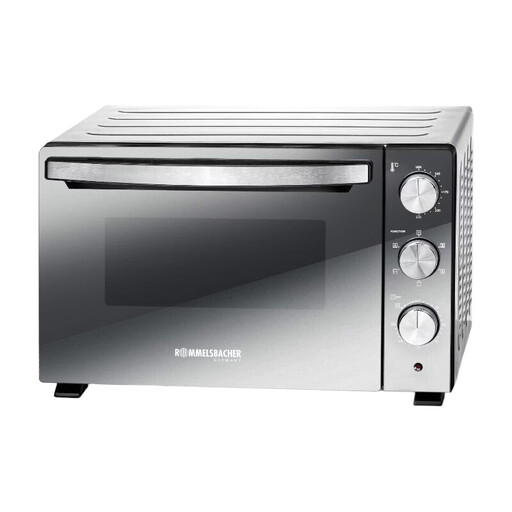 No image available
This larger oven is an option if you want to compare several baking functions; check in advance that it can stand safely in the space you have in mind.
The description lists a 30-litre capacity and fan-assisted, top and bottom heat, and grill functions.
The description specifies manual cleaning. The instructions warn you to keep the appliance away from flammable materials and walls.
Don’t assume you can. Check the placement instructions and clearance requirements in the manual for the exact model, so heat has room to escape. The fact that an oven fits in a cupboard once it has cooled down doesn’t mean you can use it in there.
First check the baking tray and setting. Albert Heijn Allerhande preheats the oven to 200 °C and divides ten apple turnovers between two trays, swapping them halfway through. Check how many will fit on your tray and use the recipe’s cooking time as a guide, not a guaranteed baking time for your mini oven.
No. Where possible, compare energy consumption per cooking session on a like-for-like basis. The rated power alone won’t tell you how much energy a batch uses, how long it takes or how many extra batches you’ll need.
In the Netherlands, the retailer is the point of contact for a remedy under the statutory guarantee. According to the Dutch government, there is no fixed statutory time limit; a separately stated manufacturer’s warranty doesn’t replace this right.
According to the Netherlands Food and Consumer Product Safety Authority, CE marking is required for electrical products offered for sale on the Dutch market. The marking isn’t proof that every individual product on offer has been independently tested.