
Cook with limited worktop space
You’re looking for an oven for small portions, but you also need to leave space around it so heat can escape. The Fire Service advises allowing heat from appliances to escape.


Start by checking the oven’s external dimensions and the clearance it needs to let heat escape. Then check how many apple slices will fit side by side on the baking tray. If you want to dry them using the Netherlands Nutrition Centre’s recipe, check that the oven can be set to 100 °C: the recipe calls for 50–60 minutes in the oven, turning the slices every 10 minutes. A larger oven may give you more cooking options, but it will also take up more space.
You’re looking for an oven for small portions, but you also need to leave space around it so heat can escape. The Fire Service advises allowing heat from appliances to escape.
You want to cook thin slices at a low temperature, so you’re paying attention to the adjustable temperature range and timer. The Netherlands Nutrition Centre recommends 100 °C for drying fruit in the oven.
You want to make other dishes as well as apple slices, and are weighing up the extra cooking space and features against the space the oven takes up.
First, measure the space and allow for the clearance needed to let heat escape. Then assess the temperature settings and usable baking surface based on what you want to cook.
| What to consider | What to look for | Who should pay extra attention? |
|---|---|---|
| Space and positioning | Measure the external dimensions and check the manual to see how much clearance your chosen model needs. | If my worktop is small, I want to know whether the oven will fit with the required space around it. Around 36% of consumers pay the most attention to whether it can be positioned safely. |
| Low temperature | Check that the oven can be set to 100 °C and that the timer is suitable for a cooking time of 50–60 minutes. | If I want to dry apple slices, being able to set the oven to 100 °C matters more to me than simply having a high maximum temperature. Around 29% of consumers prioritise low-temperature drying. |
| Baking tray and portion size | Check the usable dimensions of the included tray; the oven’s capacity in litres doesn’t tell you how many slices will fit on it. | If I want to cook more slices at once, I look at the surface area available to lay them side by side. Around 21% of consumers focus mainly on portion size per batch. |
| Other uses and energy consumption | Check which functions and accessories are included. Only compare energy consumption on a like-for-like basis, for example per cooking session or per year. | If I also use the oven for other dishes, I weigh up the extra features against the space they need. Around 14% of consumers prioritise versatility and running costs. |
For its dried fruit recipe, the Netherlands Nutrition Centre recommends laying the slices side by side, cooking them at 100 °C for 50–60 minutes and turning them every 10 minutes. This recipe is not a test of the drying results achieved by specific mini ovens.
An oven also needs space to let heat escape. The Fire Service advises allowing heat from appliances such as ovens to escape.
Measure the space and check the positioning requirements in the manual for the exact model before you buy.
A stated maximum temperature doesn’t tell you whether you can set the oven to the temperature required by the drying recipe. The Netherlands Nutrition Centre recommends 100 °C for dried fruit.
Check the full adjustable temperature range of the model you’re considering.
The recipe calls for the slices to be laid side by side; the oven’s capacity doesn’t tell you how many will fit on the included tray.
Compare the usable tray dimensions and check which tray is actually included. If the slices won’t fit side by side, you may need to cook them in more batches.
A lower rated power on its own doesn’t prove that an oven uses less electricity per cooking session.
Milieu Centraal recommends comparing ovens by their energy consumption per use or per year; use figures based on the same criteria.
The Tristar OV-3610 is a compact 10-litre oven. The manufacturer states that it has an adjustable temperature range of 90–230 °C.
According to the manufacturer, the Inventum OV207B is a fan-assisted oven with a capacity of 20 litres.
The static Ariete Vintage 3919/24 has a capacity of 10 litres and external dimensions of 37 × 31 × 21 cm, according to the product specifications.
The Severin TO 2052 is a mini baking and toast oven with a capacity of 9 litres.
This selection includes compact ovens and larger oven and air fryer combinations for baking. Check the dimensions and features you need to find an option that suits your worktop and how you plan to use it.
 No image available
A spacious option if you want to cook a range of portions and other dishes as well as apple slices.
45 litres; 2000 W; six functions; convection; top and bottom heat; grill and rotisserie.
Allow for the space and ventilation required; the external dimensions aren’t listed here.
 No image available
Worth considering if you want to make other baked dishes as well as apple slices, and are looking for several heating settings.
22 litres; five heating settings, including top and bottom heat with fan; baking and roasting tray; 60-minute timer with audible signal.
Check that the dimensions and required ventilation space will fit on your worktop.
 No image available
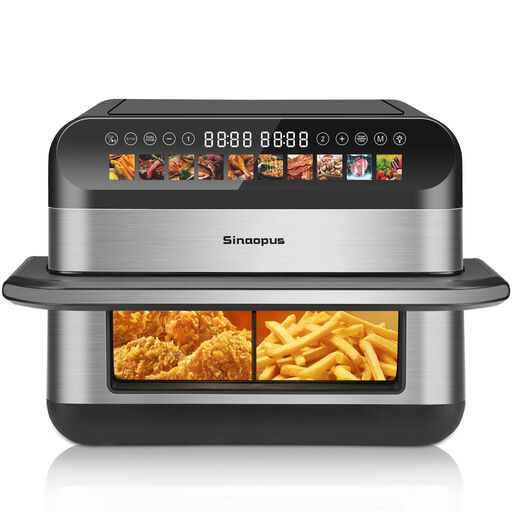
Its width and capacity make this a spacious combination appliance, so only consider it if you have room for it.
45 litres; 2400 W; integrated hob; convection and grill.
The stated width is 59 cm; measure the rest of the space needed for positioning too.
 No image available
The stated drying function and 100 °C setting are useful if you want to cook fruit at a low temperature; they don’t guarantee any specific drying result.
30 litres; 1800 W; 21 programmes; temperature range of 30–230 °C; dehydration function for up to four layers of fruit.
The dimensions are 456 × 430 × 365 mm. Check that this size will fit on your worktop with enough clearance around it.
 No image available
A compact option for small portions: its stated temperature range includes 100 °C, the temperature required by the Netherlands Nutrition Centre’s drying recipe.
10 litres; top and bottom heat; adjustable temperature from 80–230 °C; baking tray up to 20 cm; external dimensions 38,5 × 27 × 23 cm.
The timer runs for a maximum of 30 minutes. For the 50–60-minute recipe, you’ll need to reset the timer.
For thin slices of fruit that have been patted dry, the Netherlands Nutrition Centre recommends 100 °C for 50–60 minutes in the oven, turning them every 10 minutes. Check that your oven can be set to 100 °C; the recipe isn’t a comparative test of mini ovens.
Don’t assume that it can without checking. The Fire Service advises allowing heat from appliances such as ovens to escape; follow the manual for your chosen model to find out how much clearance it needs.
Check the usable dimensions of the included tray and lay the slices side by side for the drying recipe. The capacity in litres alone doesn’t tell you how many slices will fit on the tray.
No. Wattage alone doesn’t tell you how much electricity an oven uses per batch. Milieu Centraal recommends comparing ovens by their energy consumption per use or per year; to work out the cost per batch, you’ll also need comparable consumption figures and your electricity tariff.
According to the Netherlands Food and Consumer Product Safety Authority, CE marking is required for electrical consumer products placed on the market in the Netherlands. The marking is a legal product designation and, by itself, isn’t proof of the performance of a specific item; check the details of the product actually being offered.