
Baker with limited worktop space
You want to bake a small batch of almond biscuits now and then. Check that the oven fits, the door can open properly and there is enough clearance around it.


Start by checking the available space, including the clearance specified in the manual for the model you choose. Then compare the baking tray, oven settings and temperature controls with your recipe. A smaller oven takes up less worktop space, but may mean baking in more batches. A larger model is only suitable if you have enough room. Manufacturer specifications describe features, not how evenly an oven bakes almond biscuits.
You want to bake a small batch of almond biscuits now and then. Check that the oven fits, the door can open properly and there is enough clearance around it.
You want to match the temperature, oven setting and baking tray to your own recipe, rather than relying on the capacity in litres alone.
You regularly make more biscuits and are considering a larger appliance, provided the usable baking tray suits the number of batches you bake.
First measure the available space, allowing for the clearance specified for the particular model. Then check that the baking tray and oven settings suit your recipe.
| What to consider | What should you check? | Who is this important for? |
|---|---|---|
| Positioning on a small worktop | Measure the width, depth and height. Also check the door opening and the clearance specified in the manual. | If my worktop is small, I want to know whether the oven will fit with enough room for ventilation. Around 36% of consumers put positioning first. |
| Settings for your recipe | Check the adjustable temperature, the available heating settings and whether a baking tray is included. | I want to be able to use the setting in my recipe and choose the right oven mode. For around 29% of consumers, matching the oven to a recipe is their main concern. |
| Number of biscuits per batch | Check the usable baking tray dimensions and compare them with the spacing between biscuits in your recipe. | If I’d rather bake fewer batches, usable tray space matters more to me than having the smallest possible appliance. This applies to around 21% of consumers. |
| Use, cleaning and aftercare | Read the cleaning instructions and check which removable parts, service information and seller are included with the offer. | I want to know how to clean the oven after baking and who to contact if something goes wrong. Around 14% of consumers prioritise ease of use and aftercare. |
The external dimensions don’t tell you how much space the oven needs to stand safely. Its capacity also doesn’t tell you how many biscuits will fit on the tray with enough room between them.
Measure the space and check the door opening and the clearance specified in the manual for that particular model. Also check the usable baking tray dimensions.
A smaller baking tray may mean dividing the dough across more batches.
The listing for the Severin TO 2052 on Joybuy differs from Severin’s official specifications. Severin lists a capacity of 9 litres, 800 W and no fan-assisted setting.
For this model, use Severin’s specifications as your reference and ask for clarification before buying if a seller’s information conflicts with them.
Features such as fan assistance or a rotisserie don’t prove that an oven will bake almond biscuits evenly. No independent biscuit-baking test has been cited for the models discussed here.
Only choose extra features if you plan to use them for other dishes. First check the recipe settings, baking tray and clearance needed for positioning.
A larger oven may take up worktop space for features you won’t use.
The OV-3615 is a compact model worth considering if worktop space is limited and you want an included baking tray.
The TO 2052 and TO 2067 show how a narrower appliance compares with a model offering greater capacity and multiple rack positions.
The Vintage 979 is a mid-sized alternative to compare if you’re looking for more space than a very compact oven offers.
The 112751 is a larger fan-assisted oven to consider if you plan to cook more than biscuits and have enough space.
These products range from compact mini ovens to a 65-litre freestanding midi oven. Compare the size and required clearance with your worktop before choosing a model.
 No image available
An option to compare if you’re looking for a fan-assisted oven with several rack positions; check that it will fit on your worktop.
The product name lists 35L, a thermometer, a four-tier baking rack and an LED display.
 No image available
Compare this mini oven with the space you have available and check which oven settings and baking tray come with this variant.
 No image available
For this model, check the usable baking tray dimensions and whether the temperature and heating settings suit your recipe.
 No image available
A model to compare for a small batch; check in advance whether the baking tray and adjustable temperatures suit your recipe.
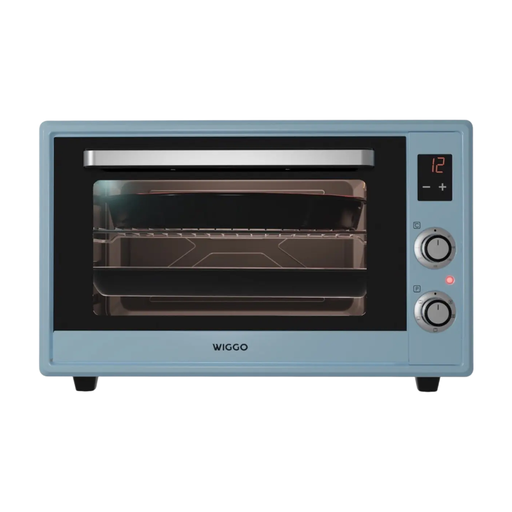 No image available
This 65L midi oven is a larger option if you’re looking for more oven space. Measure carefully to make sure it fits on your worktop with the required clearance.
The product name lists 2000W.
First follow your own recipe and the oven setting it specifies. The Koopmans recipe reviewed, which uses Self-Raising Almond Baking Flour, calls for 170 °C in a conventional electric oven or 160 °C in a fan oven, with a baking time of around 18 minutes. Don’t automatically use these settings for other recipes.
Follow the positioning instructions for your specific model and make sure heat can escape. The manual reviewed for the Princess 112751 specifies at least 30 cm of clearance all around; this distance doesn’t automatically apply to other ovens.
Follow your model’s manual, let the oven cool down and unplug it before cleaning if the manual says to do so. The Inventum manual reviewed instructs users to unplug the ovens it covers and let them cool down thoroughly first.
No. According to the Dutch government, the Netherlands has no fixed legal guarantee period. However, a product must do what you can reasonably expect of it; contact the seller about a faulty product. Any manufacturer’s guarantee does not replace your legal rights.
Electrical equipment within the scope of the EU Low Voltage Directive must meet safety requirements. The directive covers, among other things, equipment with a rated AC voltage of 50–1,000 V. Equipment covered by the directive must carry a CE marking, among other requirements. Check the documentation for the specific offer; a CE marking says nothing about baking performance.