
Vandaag of morgen in huis

Kwaliteit gegarandeerd

Welkomstaanbiedingen ontgrendelen: GRATIS bezorging | Tot 80% korting | Gratis 30 dagen JoyPlus-proefperiode
Download de app
A mini fridge might seem straightforward: plug it in, fill it up and you’re ready to go. In practice, compact models vary considerably in capacity, cooling technology, power supply and noise level. Choose the wrong one and it may be too small for everyday use, fail to keep things cool enough in a hot car or prove awkward because it needs more ventilation space than you have.
This buying guide will help students, people working from home, residents of small flats, campers and motorists choose the right small fridge, mini bar fridge or portable fridge.
A thermoelectric mini fridge is often described as being able to cool to, for example, 8 to 18 °C below the ambient temperature. That doesn’t automatically mean the contents will stay at 4 °C. In a hot car or tent, the actual temperature may be higher.
A compressor fridge works differently. It uses a compressor and is generally a better choice if you need an adjustable low temperature or a freezer function. Always check whether the model really has a compressor and what temperature ranges are listed in the product information.
A capacity of 15 litres sounds generous, but some of that space may be taken up by a fixed interior layout, a protruding cooling unit or an awkward shelf. So check the internal dimensions, the number of shelves and the space available for bottles or lunch boxes too.
A table-top fridge with a capacity of 68 to 92 litres gives you more practical storage for everyday groceries. A model with a capacity of 4 to 10 litres is mainly intended for a few cans, snacks, cosmetics or a compact personal supply.
A mini fridge on a bedside table or next to a desk can be disruptive if its noise level isn’t right for the room. A stated level of around 39 to 41 dB gives you a useful indication, but the noise you hear also depends on the surface it’s placed on and the fan.
Leave enough space around the fridge for heat to escape. For a car fridge, you should also check that the 12V socket is suitable and that prolonged use won’t put a strain on the starter battery. That’s why battery protection is a useful feature on portable compressor models.
Choose according to how you’ll use it:
Measure more than just the space where the fridge will stand. Check there’s room for the door to open, ventilation at the back and space around the hinge side. A reversible door gives you more flexibility in a small kitchen.
A thermoelectric mini fridge with cooling and heating is lightweight and often suitable for both 12V and 220–240V. Its cooling performance usually depends on the ambient temperature. The heating setting is designed to keep food or drinks warm, not to store food safely for long periods.
A compressor fridge is a sensible choice for more intensive use, such as in a campervan or caravan. Some models can both cool and freeze. Check whether there’s a proper freezer compartment, whether the temperature is adjustable and whether the power supply supports 12/24V DC and 220–240V AC.
For household fridges, the EU energy label runs from A to G. As well as comparing the energy rating, check the stated annual consumption in kWh. Your actual costs will depend on your electricity tariff, the ambient temperature and how you use the fridge.
A simple calculation is:
annual cost = kWh per year × your electricity tariff
Bear in mind that a portable fridge will often have its power rating given in watts, while a household model usually lists its annual consumption. You can’t compare these figures directly as if they were the same type of measurement.
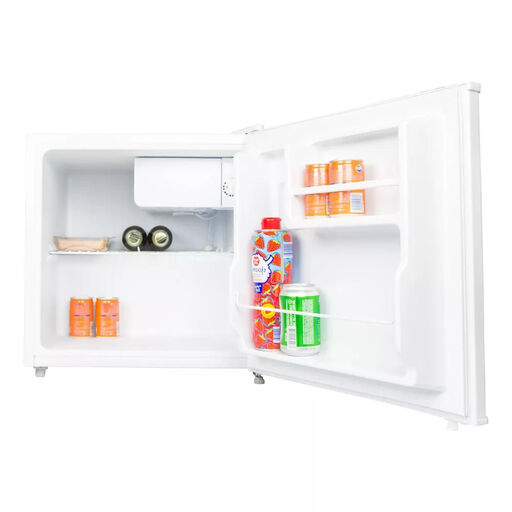
Why it suits this buyer: This freestanding model offers more space than a personal portable fridge without taking up as much room as a full-size fridge. It’s a good fit for students and small households, or for use as a mini bar.
The product information lists a 43-litre capacity, mechanical temperature control and a separate compartment for temporarily storing frozen food. Check the limited freezer function before you buy.
43-litre capacity, 41 dB noise level, reversible door and F energy rating, according to the product information.

Why it suits this buyer: At just 47 cm wide, this model is a good fit for an office, small kitchen or flat where floor space is limited.
The dimensions, annual consumption of 85 kWh and noise level of 39 dB are clearly stated. The model doesn’t have a freezer compartment, so there’s no risk of expecting one.
92-litre capacity, seven temperature settings, adjustable glass shelves and a reversible door.
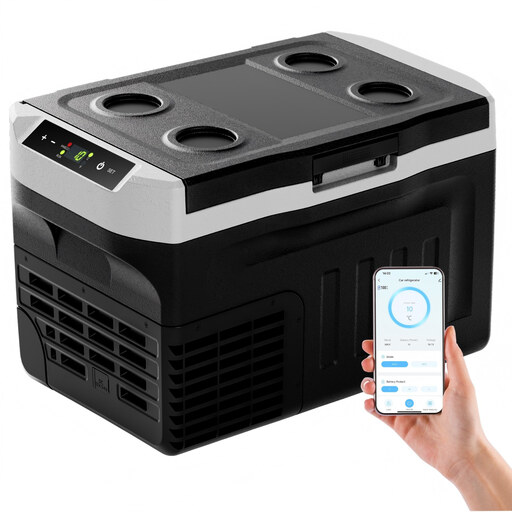
Why it suits this buyer: This model is designed for camping, travel, lorries, campervans and home use. Its compressor design and multiple connection options make it well suited to longer trips.
The product description lists 12/24V DC, 220–240V AC, ECO and MAX modes, and three battery protection settings. Check the settings before connecting the appliance to a vehicle.
21-litre capacity, temperature range from -20 °C to 20 °C according to the product information, app control and a stated noise level of 42 dB.
We’ve put together a complete, up-to-date list of products that meet these strict selection criteria and the applicable European safety regulations.
Use this quick checklist before you order:
It varies by type. A household model will often state its annual consumption in kWh, while a portable 12V fridge might have a power rating of around 45 to 48 watts. Actual consumption depends on the temperature, ventilation, surroundings and how long it’s used.
Yes, as long as it’s on a flat surface with enough space around it for ventilation. Pay particular attention to the stated noise level. A rating of around 39 dB may be suitable for many living spaces, but how loud it sounds is still a matter of personal preference.
Its lifespan depends on the cooling technology, maintenance, ventilation and how it’s used. Don’t place it next to a heat source, block the ventilation openings or neglect to clean the inside regularly. Also follow the manufacturer’s installation and transport instructions.
