
Vandaag of morgen in huis

Kwaliteit gegarandeerd

Welkomstaanbiedingen ontgrendelen: GRATIS bezorging | Tot 80% korting | Gratis 30 dagen JoyPlus-proefperiode
Download de app
A mini fridge may seem straightforward: choose a suitable size, plug it in and you’re ready to go. In practice, small fridges vary considerably in cooling technology, noise levels, energy consumption and layout. A model that works perfectly well for a few cans in the office is not automatically suitable as a fridge for a student bedroom or bedroom.
So pay particular attention to the following common pitfalls.
Some models mention a “freezer compartment” in the product information. This does not always mean that you can store frozen food in it for extended periods. For example, the Salora CFB4300WH states that its freezer compartment is intended for temporarily storing frozen products, rather than freezing them independently.
So check whether the manufacturer actually specifies a freezing function and a suitable temperature. If you mainly need extra chilled storage, a mini fridge without a freezer compartment may actually be more practical.
A fridge in a bedroom, office or student room is often positioned close to your bed or desk. The term “quiet” means little without a decibel rating. A difference between around 39 and 41 dB is not enormous, but it can be noticeable in a quiet room. Also consider the type of cooling: a compressor may sound different from a thermoelectric system.
A compact fridge may offer little usable space if the door compartments, shelves and cooling sections are poorly laid out. So check the net capacity, the dimensions of the interior and whether the shelves can be adjusted. A capacity of 15 litres is suitable for cans, snacks and a few personal-care products, but not for several days’ worth of groceries.
First, measure the space where the fridge will be placed. Leave enough room around it for ventilation, as stated in the instruction manual. Pay attention to:
A table-top fridge of around 43 litres is suitable as an additional fridge for drinks, lunch items and snacks. For a holiday home or shared house, 88 to 126 litres may be more convenient.
A compressor fridge is generally designed to provide stable cooling and, in portable models, may also offer a freezing function. A thermoelectric portable fridge often operates within a temperature range relative to the surrounding environment. The actual internal temperature will then also depend on the room temperature.
For a fridge for camping and use in a car, check:
A portable compressor fridge is better suited to longer car journeys, camping or use in a motorhome when you need an adjustable temperature. A small thermoelectric model is mainly practical for short trips, the office or keeping a few drinks chilled.
Always consider the energy label together with the annual energy consumption. According to the product information, the Salora CFB4300WH has energy label F and a stated annual consumption of 107 kWh. The Bella BKK090.1BE has energy label E and uses 90 kWh per year. The Exquisit KS16-V-E-040DB lists energy label D and 72 kWh per year.
Use the annual consumption to compare models more fairly. The actual cost depends on your energy tariff and the conditions in which the fridge is used. For a fridge that runs 24 hours a day, a small difference will have a greater impact over time than with a portable model used only while travelling.
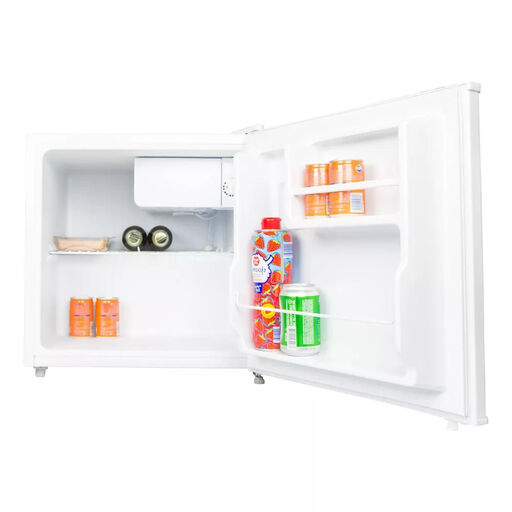
Why it suits this profile: With a 43-litre capacity, freestanding design and mechanical dial, this is a straightforward choice for a student bedroom, home office or minibar.
The net capacity, dimensions of 49.2 × 47.2 × 45 cm and noise level of 41 dB are clearly stated. However, the limited freezer compartment should be viewed as temporary storage only.
43-litre capacity, reversible door and metal shelf; according to the product information, annual consumption is 107 kWh.
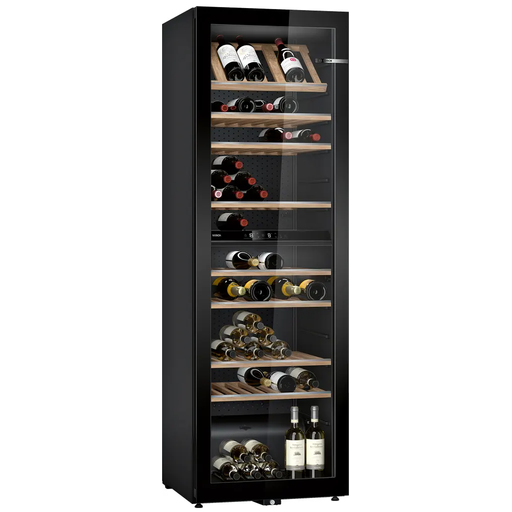
Why it suits this profile: This wine cooler is designed for larger wine collections and offers two temperature zones for different types of wine.
The temperature zones, dimensions of 186 × 60 × 61 cm and noise level of 38 dB are clearly specified. This is not a solution for a small bedroom without sufficient floor space.
Two temperature zones, pull-out wooden shelves, LED lighting and a door lock; the stated capacity is up to 199 bottles of 0.75 litres.
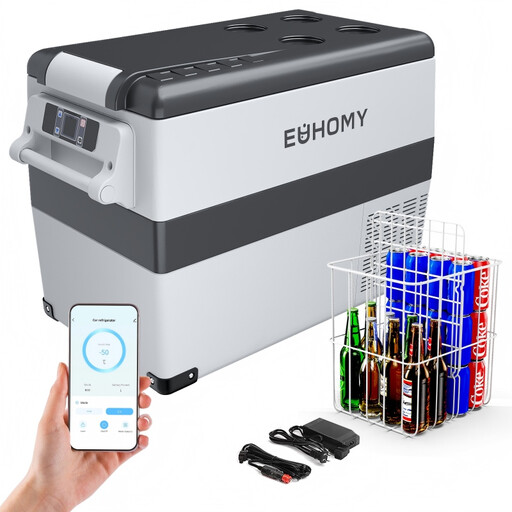
Why it suits this profile: For camping, motorhomes, lorries or longer car journeys, this portable fridge combines compressor cooling with several power options.
The specifications list 12/24 V direct current, 100-240 V alternating current and three battery protection settings. Keep the ventilation openings clear and check the connection in your vehicle.
40-litre capacity, adjustable from -20 °C to 20 °C, ECO mode under 45 W and app control according to the product description.
We’ve put together a complete, up-to-date list of products that fully meet these strict selection criteria and the applicable European safety requirements.
Place a mini fridge on a level, stable surface. Keep the ventilation openings clear and do not position the appliance directly next to a radiator, hob or in direct sunlight. After transportation, it may be advisable to leave the appliance upright for a while before plugging it in; follow the model’s instruction manual for guidance.
For a bedroom, the noise level is important, but so is the positioning. A hard surface can amplify vibrations. Use a reversible door if the room layout calls for it. In a car or motorhome, you should also check whether the battery can handle the load. Battery protection helps, but it does not replace checking the power supply.
This varies by model, energy label, ambient temperature and usage. Check the stated annual consumption in kWh and multiply it by your own electricity tariff. A portable fridge may use a different amount of energy from a table-top fridge that runs continuously.
You can, provided the model is suitable for indoor use, is positioned securely and has enough space around it for ventilation. Check the noise level in dB and avoid placing the fridge directly next to your bed if you are sensitive to the compressor or fan switching on.
Its lifespan depends on build quality, maintenance, ventilation and usage. Keep the condenser and ventilation free from dust, do not force the door and defrost a model with manual defrosting when ice begins to build up. Also keep your proof of purchase and check the statutory guarantee and any manufacturer’s warranty.
