
Vandaag of morgen in huis

Kwaliteit gegarandeerd

Welkomstaanbiedingen ontgrendelen: GRATIS bezorging | Tot 80% korting | Gratis 30 dagen JoyPlus-proefperiode
Download de app
A mini fridge is useful in a student room, bedroom, office, studio, mancave or holiday accommodation. However, not every small model is suited to every use. A portable fridge for the car works differently from a tabletop fridge for everyday groceries. If you only look at the price or the number of litres, you may later find that cooling performance, noise levels or storage space are limited.
Joybuy Product Recommendation Officer filters the most important product specifications and sets out the practical differences. This makes it easier to compare a small fridge based on how you will use it, its size and its running costs, rather than on marketing terms.
Some models have a small freezer or chiller compartment. This does not automatically mean you can store frozen food in it for extended periods. For example, the Salora CFB4300WH states that its freezer compartment is intended for temporarily storing frozen items, not for freezing food.
Therefore, check the following:
A fridge without a freezer compartment may actually offer more usable cooling space. This is often the sensible choice for an office, minibar or bedroom.
A portable mini fridge with a 12V connection is designed for use via a car socket or campervan power supply. A standard tabletop fridge usually runs on 220-240V and is not directly suitable for use in a car.
When choosing a fridge for camping or travelling, look out for:
According to their product specifications, thermoelectric models can cool to a certain number of degrees below the ambient temperature. In warm weather, the internal temperature may therefore differ from that of a compressor fridge. Use this type of model mainly for drinks, snacks and short-term transport, unless the manufacturer states otherwise.
An energy label alone does not tell you how much you will pay each year. Look at the annual energy consumption in kWh and compare it with the fridge’s size and capacity. The current European energy labels for fridges range from A to G. In practice, a model with an E rating may use less energy than a larger model with a lower rating, depending on how it is used and its capacity.
The final cost depends on your electricity tariff. A simple calculation is:
annual consumption in kWh × your price per kWh = estimated annual electricity cost
A 4- or 6-litre portable mini fridge is suitable for a few cans and small products. A 43-litre model is a better fit for a student room or as an extra fridge. For everyday use by one person, a capacity of 80 to 92 litres may be more practical.
Measure not only the space where the fridge will stand, but also:
A reversible door is useful if you want to position the fridge differently later.
A compressor fridge is designed to provide continuous cooling for food and drinks. A thermoelectric mini bar fridge is usually lighter and more portable, but often has a more limited temperature range. Also check whether the temperature is adjusted continuously or using preset levels.
For a fridge in a bedroom or office, noise levels are important. The product details for the models below state figures of around 39 to 41 dB. Your actual experience may depend on the positioning, surface and surrounding environment.
Adjustable shelves, door compartments and a salad drawer make a small fridge more practical than one with an open interior. Check the maximum bottle height and the width of the shelves.
If you are looking for a fridge with a freezer compartment, check whether the compartment is genuinely suitable for freezing. A separate freezer compartment with a stated temperature and freezing capacity provides more clarity than simply calling it a “freezer compartment”.
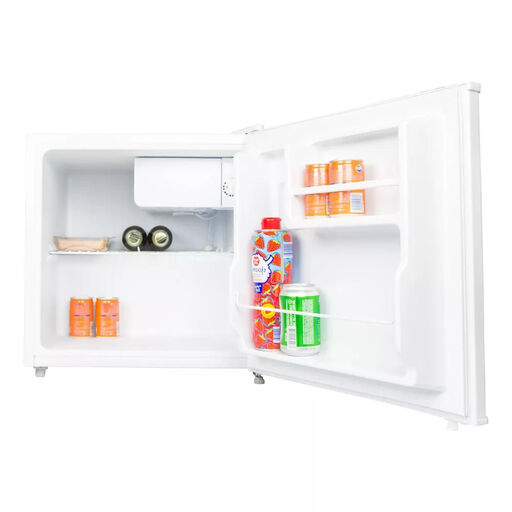
Why it suits this type of user: A well-organised tabletop model for snacks, drinks and everyday essentials in a student room, studio or minibar.
The capacity, dimensions and noise level of 41 dB are clearly stated. The freezer compartment is not presented as a fully functioning freezer.
43-litre capacity, reversible door, metal shelf, 220-240V connection and stated consumption of 107 kWh per year.

Why it suits this type of user: A larger compact fridge for anyone looking for extra cooling space, a flexible layout and a relatively slim body.
The product specification states 92 litres of fridge space and no freezer compartment. This makes it clear what the layout is designed for.
47.4 cm wide, seven temperature settings, adjustable glass shelves, salad drawer, reversible door, 39 dB and 85 kWh per year.
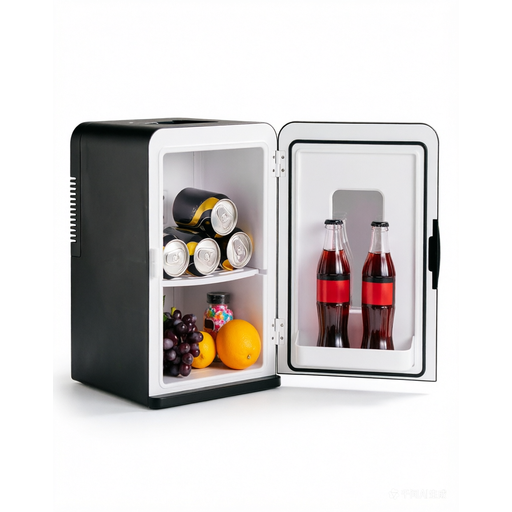
Why it suits this type of user: For anyone who needs a lightweight fridge for a bedroom, office, road trip, campervan or campsite.
The 220-240V and 12V connections are clearly stated. The product information also includes the weight, handle and temperature range.
15-litre capacity, removable shelf, AC/DC power supply, portable design and a stated cooling range of 8-16 °C below ambient temperature.
We have put together a complete, up-to-date list of products that fully meet these strict selection criteria and the applicable European safety regulations.
Place a compressor fridge on a flat, stable surface and keep the ventilation openings clear. Do not position the appliance directly next to a radiator or in full sunlight. Also check the stated ambient temperature. For example, the Salora CFB4300WH specifies a minimum ambient temperature of 10 °C; other models may have a different climate range.
After transporting a fridge, leave it to stand as instructed in the user manual before plugging it in. Do not fill the interior so tightly that air can no longer circulate. A portable fridge in a car must be positioned securely and must not block ventilation at the sides or rear.
It can be, provided the noise level and dimensions are suitable for the room. Models rated at around 39-41 dB are described as relatively quiet in the product specifications, but a compressor may be audible when it switches on. Place the fridge on a stable surface and check whether vibrations are transferred to a cupboard or floor.
This varies according to capacity, energy label, cooling technology and usage. Check the stated annual consumption in kWh. Examples in the range vary from 85 kWh per year for a 92-litre CHiQ model to 172 kWh for a 68-litre Salora model. These are product specifications; your actual consumption depends on the ambient temperature, temperature setting and how often the door is opened.
Its lifespan depends on usage, ventilation, maintenance and cooling technology. Keep the back free from dust, position the appliance according to the instructions and avoid overloading it for long periods. Before buying, check the warranty terms, spare parts service and information about the compressor. A two-year manufacturer’s warranty is available with several models in this overview.
