
Vandaag of morgen in huis

Kwaliteit gegarandeerd

Welkomstaanbiedingen ontgrendelen: GRATIS bezorging | Tot 80% korting | Gratis 30 dagen JoyPlus-proefperiode
Download de app
A mini fridge may seem simple to choose, but there’s a big difference between a fridge for a student room and a portable fridge for your car. If you only look at the capacity or a low price, you could run into practical problems: insufficient cooling, an inconvenient power connection or a unit that won’t fit where you want to put it.
This buying guide helps you compare the key specifications and choose a model for your home, office, campervan, caravan, boat, road trip or camping trip.
Not all electric cool boxes work in the same way. A thermoelectric cool box may be suitable for drinks and lunch on the go, but it usually has a different temperature range from a compressor cool box. According to the product descriptions for various models, a compressor fridge can also reach temperatures below zero. This makes it more suitable if you’re looking for a cool box with a freezer function or a portable freezer.
So check the type of cooling system:
A capacity of 20 litres sounds useful, but insulation, baskets, compartments and the compressor all reduce the available space inside. Also measure the space where you plan to put the appliance. A tabletop fridge around 84 cm high won’t fit under every worktop, while a 6- or 9-litre car fridge will often fit on a car seat.
Before you buy, check:
A 12V fridge won’t automatically work in every situation. Check whether the model supports 12V DC, 24V DC, 100-240V AC or a combination of these. An AC/DC fridge is more practical if you want to use it at home as well as in your car, campervan or caravan.
Battery protection is important when using the car’s power socket. Some portable compressor models have an adjustable safety feature that cuts the power if the vehicle battery voltage gets too low. According to the product information, this is designed to help prevent deep discharge, but it doesn’t replace checking the battery or electrical system.
For drinks, fruit and lunch, a simple compact fridge or thermoelectric cool box is often enough. If you want to keep meat, frozen food or ice for longer, look for a compressor fridge with a stated temperature range below 0 °C.
For example, the BINGI 22L and EUHOMY 18L list adjustable temperature ranges down to -18 °C and -20 °C respectively. These figures come from the brands’ product descriptions. The actual temperature may depend on the ambient temperature, ventilation, how full the fridge is and the power supply.
For everyday use in a student room or office, around 100 to 126 litres is comparable to a small household fridge. A 6 to 10-litre model is mainly intended for a few drinks, snacks or a packed lunch.
Also look out for:
A mini fridge with a freezer compartment is handy for a fixed location. According to its specifications, the Wiggo WL-TT82D(B) has 126 litres of fridge space and a 17-litre freezer compartment. The Severin TKS 8847 lists 107 litres of fridge space and a 13-litre freezer compartment.
A fridge in an office, bedroom or student room is often close to where you work or sleep. So check the stated noise level. The Wiggo lists 39 dB and the Severin 37 dB. The portable compressor models in this selection list around 40 to 42 dB.
Always place a fridge on a stable surface and leave space for ventilation. The Wiggo product information recommends at least 10 cm of clearance around the sides and at the back. Around 10 cm of clear space around the ventilation openings is also recommended for portable compressor cool boxes. Don’t place the appliance right next to a heat source or in direct sunlight.
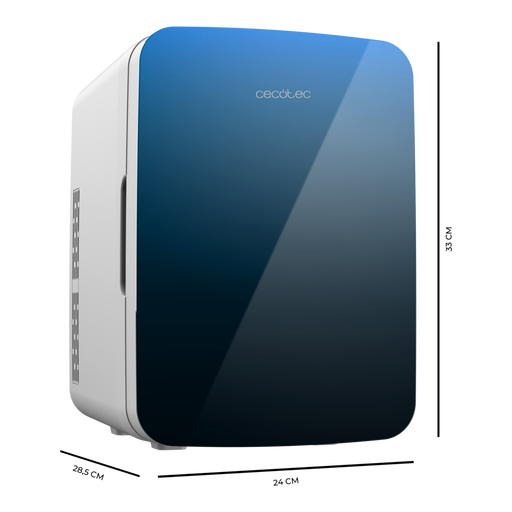
Why it suits this user: This compact fridge is designed for small amounts of drinks and snacks in the car, bedroom, campervan or office. It has a stated capacity of 10 litres and supports 12V and 220V.
The product description clearly states that it uses thermoelectric cooling and has a temperature range of 7 °C to 65 °C. This makes it easy to see how it differs from a compressor cool box suitable for freezing.
10-litre capacity; suitable for 12V and 220V; cools and heats according to the product listing.
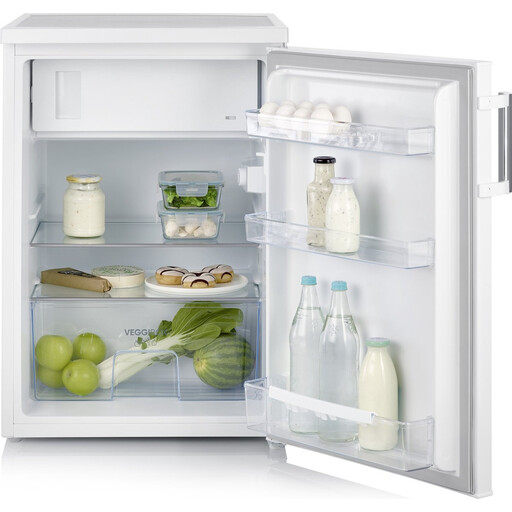
Why it suits this user: This tabletop model is designed for a fixed place in a kitchen, office or student room, or as an extra fridge. Its layout combines fridge space with a separate freezer compartment.
The fridge and freezer capacities are listed separately: 107 litres of fridge space and 13 litres of freezer space. The stated noise level of 37 dB and annual energy consumption of 87 kWh are also useful points to check.
120 litres of total usable capacity according to the product information; 13-litre freezer compartment; C energy rating as listed.
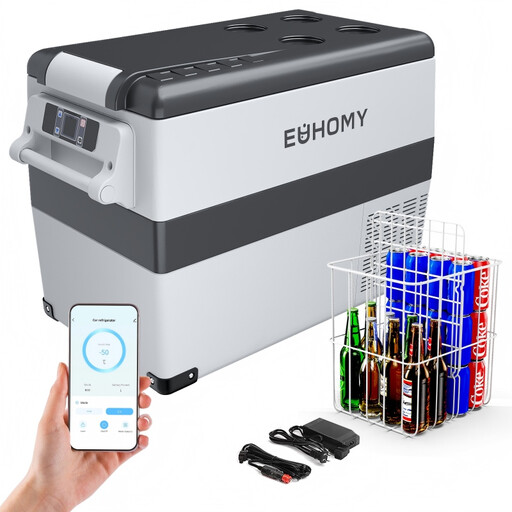
Why it suits this user: Its 40-litre capacity and compressor cooling make it a good fit for longer trips in a campervan, caravan, boat, lorry or car. The product description lists two storage zones, a removable basket and app control.
The combination of 12/24V DC and 100-240V AC means you don’t have to rely solely on a car power socket. The recommended ventilation clearance of around 10 cm helps you position it correctly.
Temperature range of -20 °C to 20 °C according to the product information; ECO and MAX modes; three battery protection levels.
We’ve put together a complete, up-to-date list of products that meet these strict selection criteria and the applicable European safety regulations.
That depends on the connection. A model with 12V DC is suitable for a compatible car power socket. 24V support may be useful in a campervan, lorry or boat. Also check the maximum power output of the socket, and use battery protection if that feature is available.
Its lifespan depends on ventilation, transport, cleaning, load and how often it’s used. A household fridge designed for a fixed location is intended for continuous indoor use. A portable fridge needs extra care when being transported: if a compressor model has been tilted significantly, leave it upright before using it again, following the relevant brand’s instructions.
Energy use varies depending on the size, energy rating, ambient temperature and cooling setting. For fixed models, you can compare the stated annual energy consumption in kWh. For an electric cool box, the power consumption is often given in watts. According to the product description, ECO mode can help reduce energy use while maintaining the temperature, but actual consumption will still depend on the conditions.
