
Vandaag of morgen in huis

Kwaliteit gegarandeerd

Welkomstaanbiedingen ontgrendelen: GRATIS bezorging | Tot 80% korting | Gratis 30 dagen JoyPlus-proefperiode
Download de app
As a car enthusiast or professional detailer, you know that perfection is in the details. Those hard-to-reach areas—around emblems, in door handles, on wheels, or near headlights—are what make the difference. A standard-sized polisher is often too large and cumbersome for these spots. This is where a mini cordless polisher offers the precision and freedom you need.
But the market is filled with options. Which model is right for your work? In this guide, we'll provide practical buying tips and highlight some popular choices to help you make an informed decision for your next detailing polisher.
Before you make a choice, it's wise to consider a few specifications. These determine how versatile and effective the machine will be for your specific jobs.
The polishing action is one of the most important features.
Since it's a small cordless polisher, the battery and motor are crucial. Pay attention to the capacity (expressed in Ah, Ampere-hours) and voltage (V). A higher capacity typically means a longer runtime. Many kits come with two batteries, allowing you to continue working while the other one charges. A brushless motor is often a plus; these are generally more efficient, durable, and deliver more consistent power.
A complete cordless car polishing kit saves you the hassle of buying parts separately. Check which backing plates and polishing pads are included. Common sizes for a mini polisher are 25 mm, 50 mm, and 75 mm. Smaller plates are perfect for highly detailed work, such as on emblems or narrow grille slats. Larger plates are useful for slightly bigger, tight surfaces like bumpers or A-pillars. An extension rod can also be very helpful for reaching deep into wheels or engine bays.
Based on functionality and included accessories, we have selected a few Batoca models that are compelling for both hobbyists and professionals.
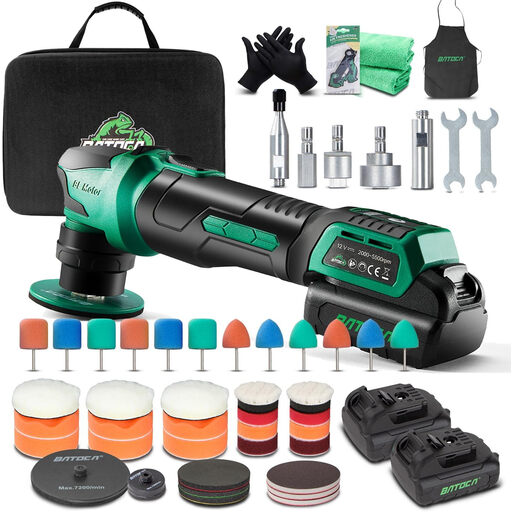
Why It Stands Out The BATOCA S4 is designed for flexibility. Its dual-system allows for a quick switch between a direct-drive rotary motion for precision work and a dual-action motion (3 mm and 12 mm throw) for efficiently polishing small areas. According to the manufacturer, the brushless motor provides more power and a longer lifespan.
Advantages
Who Is It For? For the detailer who wants a versatile and complete kit to get started immediately on a wide range of detailing jobs, from spot repairs to polishing bumpers and mirrors.
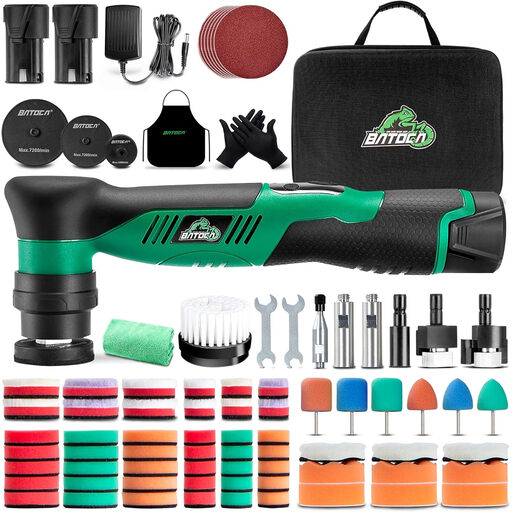
Why It Stands Out The BATOCA S5 focuses on ease of use with its 3-in-1 functionality. By simply swapping the drive shaft, you can change the machine from a rotary to a 3 mm or 12 mm dual-action polisher. Batoca claims this switch can be done in just 5 seconds, without any tools. This makes it a practical machine for those who need to switch quickly between different tasks, such as polishing headlights and paint correction.
Advantages
Who Is It For? Ideal for users who want a no-nonsense machine that can be quickly adapted to the job. The various included backing plates make it immediately ready for polishing emblems, body lines, and other small surfaces.
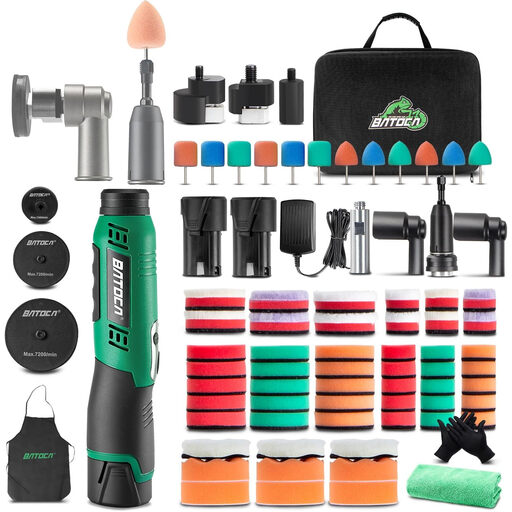
Why It Stands Out The S6 is a very comprehensive set aimed at the demanding user. This polisher for car details also combines a rotary (RO) and dual-action (DA) system. What sets this model apart are the different speed ranges for each mode and a unique mini-polishing head for extremely fine detail work. The kit is very complete with various drive shafts, extension rods, and a wide variety of polishing pads.
Advantages
Who Is It For? For the professional or serious hobbyist who wants to make no compromises and is looking for an all-in-one solution for every imaginable detailing job, from wheels and brake calipers to the smallest interior parts.
The world of polishing tools is vast. If the options above don't perfectly match your needs, or if you're looking for a different type of machine, there's more to discover.
? See more options in the cordless electric polishers category here.
A rotary machine spins on a central point, which provides a lot of correction power but also generates more heat. A dual-action (DA) machine both spins and oscillates, which is safer for the paint and provides a better finish with less risk of buffer trails.
Yes, modern mini polishers, especially those with a brushless motor and high-quality batteries, are powerful enough for light to medium paint correction on small and complex surfaces. For polishing an entire car, they are typically used in combination with a larger machine.
This depends on the specific task. A 25 mm (1-inch) pad is ideal for very small areas like emblems, piano black interior trim, or narrow slats. A 50 mm (2-inch) pad is versatile for areas like door pillars, mirrors, and bumpers. A 75 mm (3-inch) pad is useful for larger 'small' areas like A-pillars or headlights. A set with multiple sizes offers the most flexibility.
