
Livraison le jour même et le lendemain

Qualité garantie

Débloquez vos offres de bienvenue: Livraison GRATUITE | Jusqu'à -80 % | 30 jours d'essai gratuits à JoyPlus
Téléchargez l'application
A milk pan may seem simple, but small differences in material, size and lid make a big difference in everyday use. A pan that is too thin can cause milk to scorch in places. A saucepan without a matching lid loses heat more quickly. And a model that isn’t suitable for induction will sit unused if you change your hob.
For British households, these uses are most relevant: heating milk, making porridge, preparing sauces, cooking small portions and, occasionally, steaming vegetables or dumplings. Below are the key buying criteria and a few product choices for different usage scenarios.
A ceramic outer layer may look appealing, but it doesn’t automatically tell you how the interior performs. Always check the full materials list. A stainless steel milk pan with a smooth interior is generally easy to clean, whereas a coated pan may need extra care.
With a ceramic coating, product descriptions often recommend hand washing, a soft sponge and avoiding metal utensils. Abrasive cleaners can damage the surface. A dishwasher-safe label may sometimes appear, but hand washing can help extend the life of the finish.
For a mug of milk or a single portion of porridge, a large saucepan is impractical. The contents spread over a bigger surface area, making stirring and pouring less convenient. A diameter of around 16 to 18 cm usually suits small amounts and compact hobs better.
Also pay attention to capacity. A 2.5-quart pan is suitable for milk, sauce and a small meal. A 4.25-quart capacity offers more room but also takes up more space in the cupboard and on the hob.
The term pan for all hob types needs to be backed up by a specific product listing. Check that gas, induction, electric, ceramic and halogen are actually mentioned. Also look at oven compatibility; that isn’t a given with a saucepan that has a silicone handle or glass lid.
304 stainless steel is a widely used material for cookware. It’s suitable for everyday cooking and has a smooth, coating-free surface when the interior hasn’t been finished with an extra layer.
316 stainless steel is positioned in product descriptions as a corrosion-resistant grade of steel. That can be useful if you often use the pan for milk, sauces or other moist preparations. Do check whether 316 stainless steel is only on the interior or whether the whole pan is made from it. On some models, the exterior has a ceramic coating.
The product information from PURECOOK states that the relevant models have an interior of 316 stainless steel or 304 stainless steel. This information comes from the product description and should not be translated into unsubstantiated health claims.
A triply base consists of several layers of material. The aim is to spread heat from the hob more evenly across the base. This is practical for milk and sauces, as these preparations are prone to localised overheating.
A good construction doesn’t automatically prevent burning. Set the hob to a moderate heat, stir regularly and don’t leave an empty pan heating for a long time. Supervision is still needed, especially when heating milk.
A milk pan with a lid retains heat and moisture better during gentle cooking. A glass lid lets you see the contents without having to open the pan repeatedly. Check whether the lid has a steam vent or silicone seal.
A milk pan with a steamer insert is more versatile. You can, for example, heat milk or porridge in the bottom and steam small amounts of vegetables, dumplings or fruit in the top. The insert does take up extra storage space and needs to be dried thoroughly after use.
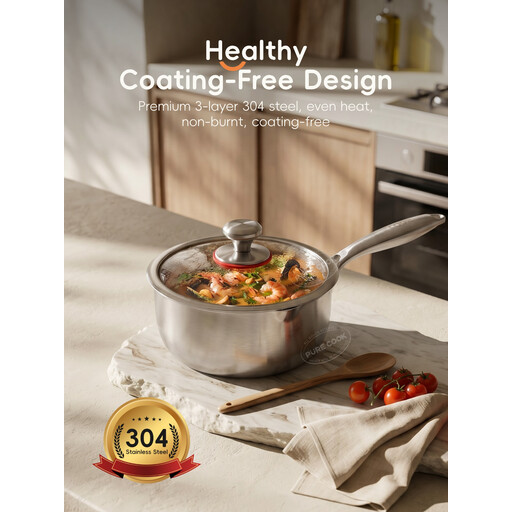
Why this fits the profile: This small saucepan is designed for everyday tasks such as heating milk, preparing baby food, making sauce and cooking single-portion meals.
The 18 cm diameter prevents small portions from being spread over an unnecessarily large cooking surface. The smooth stainless steel interior has no ceramic coating that could be scratched by metal utensils.
304 stainless steel, glass lid, heat-resistant handle and compatibility with gas, induction and electric ceramic hobs according to the product information.
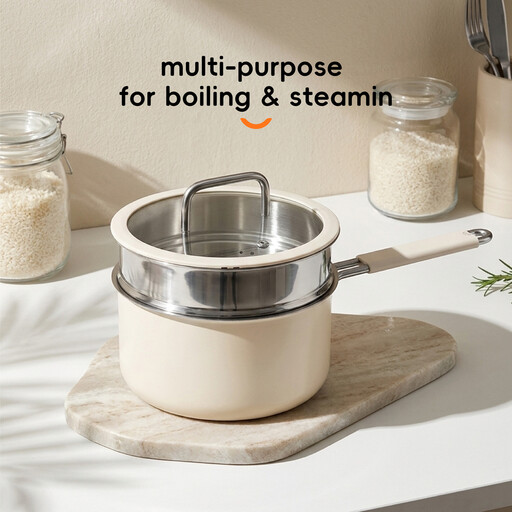
Why this fits the profile: The combination of 316 stainless steel, a multi-layer base, lid and steamer insert suits users who want one compact pan for multiple cooking tasks.
The specifications clearly state the materials, the 16 cm diameter and the suitable heat sources. This means you don’t have to rely solely on general marketing terms.
316 stainless steel interior, triply base, glass lid, ceramic exterior and included steamer insert; suitable for gas, induction, electric, ceramic and halogen according to the product description.
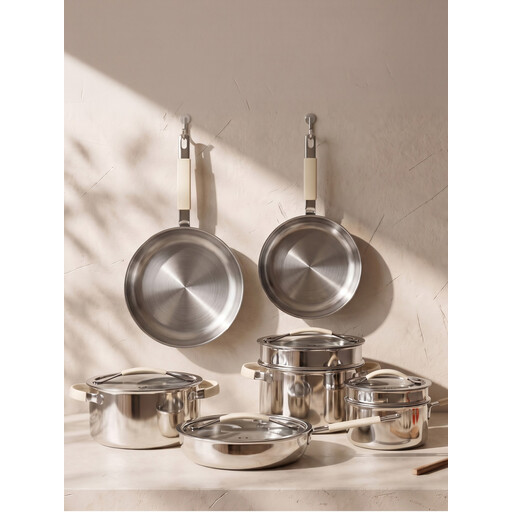
Why this fits the profile: The 2-in-1 design is suitable for families who regularly prepare milk, porridge, soup bases or baby food and want to steam small ingredients at the same time.
The product description mentions a straight inner wall, glass lid and a separate steamer insert. Do check before buying whether the extra parts fit your storage space.
304 stainless steel with no interior coating, 18 cm diameter, steaming and simmering function, glass lid and, according to the product information, suitable for all hob types.
We’ve put together a full, up-to-date list of products that fully meet these strict selection criteria and comply with current European safety regulations.
That depends on the base and the product listing. Only choose a model where induction is explicitly stated as a suitable heat source. The three PURECOOK models mentioned are declared suitable for induction according to their product information.
For milk, porridge, sauce and small portions, a diameter of 16 to 18 cm is usually practical. If you also want to make larger quantities of soup or stew, you could consider a bigger saucepan. Check that the size still fits your hob zone.
A steamer insert is useful if you regularly want to steam vegetables, dumplings or small portions of baby food. If you mainly use the pan for milk and sauce, a simple model with a glass lid is probably more straightforward and easier to store.
