
Colleagues taking coffee breaks one after another
They want a shared appliance with a jug and frothing capacity suited to several people using it in succession.


For a shared office, a milk frother with milk-contact parts that are easy to clean is a practical choice. Then compare its frothing capacity with the portion you want to make each time. An automatic jug can be handy when colleagues take turns making lattes, while a separate battery-powered milk frother takes up little space but doesn’t heat the milk itself. The right choice also depends on the type of foam you want and the milk you use.
They want a shared appliance with a jug and frothing capacity suited to several people using it in succession.
They want to make hot or cold foam and take into account the differences between dairy milk and plant-based barista drinks. This doesn’t prove that every type of milk will produce the same foam in every appliance.
They want to make a single small portion and weigh up a separate frother against the extra steps of heating the milk separately and cleaning the frother.
First, check how the parts that come into contact with milk are cleaned after each use. Then compare how much milk the appliance can froth and check whether its settings suit the latte you want to make.
| What to consider | What should you check? | Who is this important for? |
|---|---|---|
| Easy-to-clean parts | Check whether each part is removable and dishwasher-safe. Severin says the milk jug on the SM 3588 is dishwasher-safe; Inventum recommends cleaning the inside of the MK350 by hand straight after use. | If I share the appliance with colleagues, I want to be able to clean the milk-contact parts quickly after each use. Consumers who prioritise easy-to-clean parts account for around 33% of this choice. |
| Portion size and speed | Compare frothing capacity, not just heating capacity: Severin specifies a maximum of 150 ml for frothing, Nespresso 120 ml and Inventum 115 ml. | If you’re making several lattes in a row, you’ll want to know whether one frothing cycle is enough for the portion you have in mind. Consumers who prioritise portion size and speed account for around 25% of this choice. |
| Foam and type of milk | Check which hot or cold settings are available and whether the guidance is suitable for the milk you use. The Consumentenbond lists barista versions of plant-based drinks as an option; settings alone don’t guarantee the same result with every type of milk. | If I switch between hot lattes, cold drinks or plant-based milk, I want to compare the settings and milk guidance in advance. Consumers who prioritise the type of foam or milk account for around 25% of this choice. |
| Space and how it works | Check whether you need a plug socket and a separate way to heat the milk. The IKEA PRODUKT requires two AA batteries, sold separately; the frother doesn’t heat the milk itself. | With limited worktop space, a separate frother may be suitable, provided that heating the milk separately and cleaning the frother fit into the office routine. Consumers who prioritise a compact, simple set-up account for around 17% of this choice. |
For the automatic models mentioned, the stated capacity for frothing is lower than the capacity for heating. This means larger portions or several lattes may require extra cycles.
Compare the frothing capacity marking with the portion you want to make each time, and treat the heating capacity separately.
Extra frothing cycles can mean a longer wait when colleagues are making coffee one after another.
Cleaning instructions can vary from one part to another. Severin says the removable milk jug is dishwasher-safe; Inventum recommends cleaning the inside of the MK350 by hand straight after use.
When sharing the appliance, agree who will clean the milk-contact parts after each use and check the instructions for every part.
Parts that need to be cleaned by hand take extra time between uses.
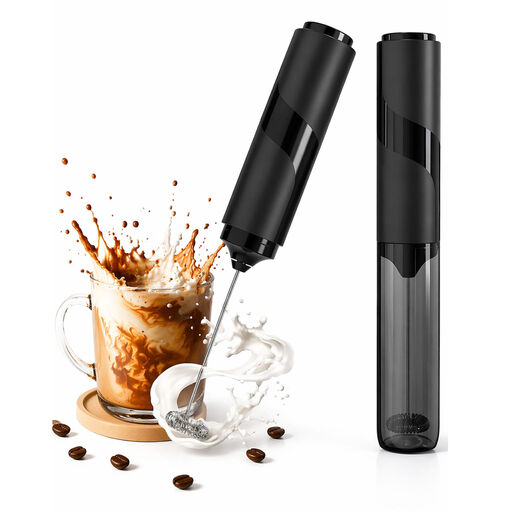
The IKEA PRODUKT froths hot or cold milk, but doesn’t heat the milk itself.
Choose this set-up only if there’s a separate way to heat the milk and cleaning the frother with a damp cloth fits your office arrangements.
It requires two AA batteries, sold separately; hot milk also needs to be heated separately.
The SM 3588 is an automatic option with a removable milk jug for shared use.
The Aeroccino 4 is designed for small portions and offers several ways to prepare milk.
The MK350 is an automatic frother for smaller portions.
The PRODUKT is a separate battery-powered milk frother, not an automatic heating jug.
These products are relevant if you’re choosing a milk frother for lattes in a shared office. Check that each model’s operation and cleaning requirements suit your routine.
 No image available
A good fit if you’re looking for a separate, hand-held electric milk frother. Check that this way of preparing milk suits shared use in your office.
 No image available
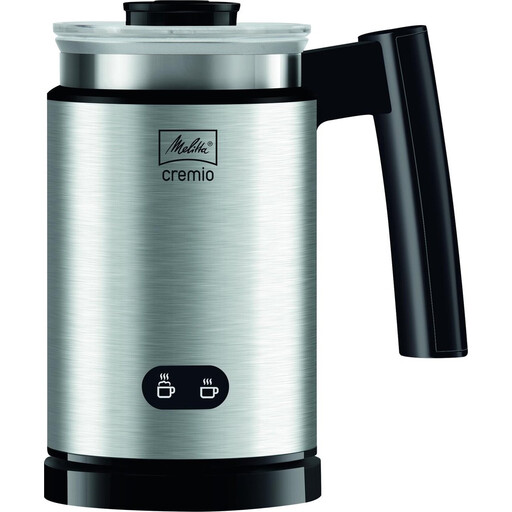
May suit colleagues who use different types of milk and are looking for an automatic frother. Check that the varieties mentioned match your needs.
The product description mentions oat, soya, lactose-free and whole milk, a non-stick container that should be wiped clean with a damp cloth, and a dishwasher-safe lid with mixer.
It also mentions separate frothing and heating functions, one-button operation and automatic shut-off.
Not with the Severin SM 3588: Severin specifies a maximum of 150 ml of milk for frothing and 300 ml for heating. Check the separate markings for frothing and heating on each model.
If milk needs to be kept chilled, put it back in the fridge promptly after use. The Voedingscentrum advises that opened semi-skimmed milk can be kept in the fridge for one week; after that, check its appearance, smell and taste. For other products, follow the label and storage advice on the packaging.
Don’t assume so just because it’s labelled dishwasher-safe. Severin refers specifically to the removable milk jug; Nespresso says the Aeroccino 4 is dishwasher-safe up to a maximum of 70 °C. Follow the care instructions for each model’s jug, lid, whisk and electrical base.
According to the Dutch Ondernemersplein, after assessing the applicable requirements, a manufacturer must affix the required CE marking to an electrical appliance. Consumer purchases are covered by statutory rights; the Dutch government says there is no fixed statutory warranty period and advises consumers to contact the seller about faults. Whether an office purchase counts as a consumer purchase depends on who buys the product and under what terms.