
Travelling without access to a socket
If you want to froth milk in a holiday cottage with few appliances, consider a manual shaker or a battery-powered whisk. HARIO and Severin offer examples of these different options.


Start by considering the power supply at your holiday cottage and whether you want to heat the milk too. A manual shaker or battery-powered whisk works without a socket, while an electric jug may also heat the milk. Then compare the frothing capacity and cleaning instructions with your serving sizes and the facilities available. Whisk the matcha with water first, then add the milk. If you choose an electric model, also check the CE marking on the actual product, as required by the Dutch government for electrical appliances placed on the EU market.
If you want to froth milk in a holiday cottage with few appliances, consider a manual shaker or a battery-powered whisk. HARIO and Severin offer examples of these different options.
If you have a suitable socket and want hot milk, compare electric models with a clearly stated heating function. Inventum and Severin specify separate capacities for frothing and heating.
If you’re making lattes for several people, compare the stated frothing capacity per cycle rather than looking only at the jug’s total capacity. HARIO, Inventum and Severin each state their own capacity.
| What to consider | What to look for | Who is this important for? |
|---|---|---|
| Power and portability | Decide whether you want to shake it by hand, can bring batteries or have access to a socket. Don’t assume batteries are included with an appliance; check the packaging. | If I don’t want to rely on a socket at the holiday cottage, using a frother without mains power is my top priority. Around 27% of consumers put power supply and portability first. |
| Hot or cold latte | Check whether the model froths both hot and cold milk, and whether it also heats the milk. A manual shaker and the battery-powered whisk we looked at don’t heat milk. | If I want the choice of a hot or cold matcha latte, I’ll check the appliance’s functions and power connection. Around 27% of consumers prioritise drink temperature. |
| Amount per cycle | Compare the stated frothing capacity: HARIO lists 70 ml, Inventum 75–115 ml and Severin up to 150 ml. Heating capacity is not the same as frothing capacity. | If I’m making several lattes one after another, I want to know how much milk the appliance can froth at a time. Around 20% of consumers put the amount per cycle first. |
| Cleaning and type of milk | Follow the cleaning instructions for the exact model; Inventum warns against rinsing the MK350B under the tap. Also check which types of milk the manufacturer lists: Inventum mentions cow’s milk and plant-based milk. | If I’m in a temporary kitchen with limited washing-up facilities, or use a particular type of milk, I want to know in advance what the model can handle and how to clean it. Around 26% of consumers make maintenance or type of milk their top priority. |
For the Inventum MK350B and Severin SM 3588, the stated capacity for heating is higher than the capacity for frothing. If you’re making several lattes, you may need to work in batches.
Compare the frothing capacity in millilitres with the amount of milk you need each time.
The battery-powered whisk we looked at and the HARIO Latte Shaker don’t heat milk. So, for a hot latte, you’ll need a separate way to heat the milk or a model with a heating function.
Before you go, think about whether the facilities at your holiday cottage will let you heat milk.
Inventum warns against rinsing the MK350B under the tap. For the SM 3588, Severin specifically states that the removable jug is dishwasher-safe.
Check the manual to see which parts can get wet and which are dishwasher-safe.
These brands have specific models to suit different needs when it comes to power, heating, serving sizes and cleaning.
The SM 3590 runs on batteries, while the electric SM 3588 is an option for frothing hot and cold milk.
The electric MK350B is designed to make hot or cold foam and can also heat milk.
The Latte Shaker LS-70-OW/LS-70-PC is a manual alternative if you don’t want to use a socket or batteries.
The SENSEO Milk Twister CA6500/01 is an electric option for hot and cold milk, which you can compare with other jugs.
This selection includes a battery-powered milk frother and an electric jug for hot and cold foam. Choose based on the power supply at your holiday cottage and whether you also want to heat the milk.
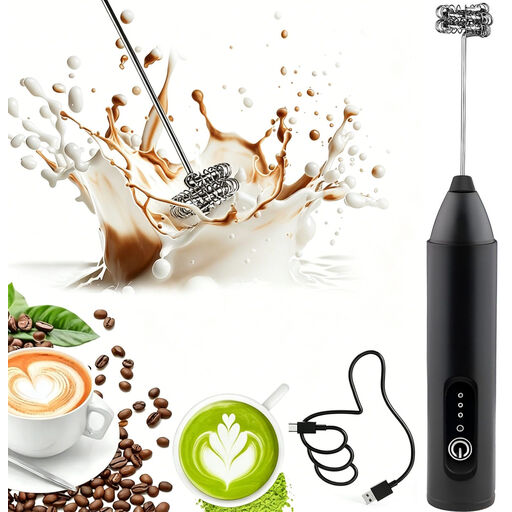 No image available
The product title says it’s battery-powered and suitable for matcha and lattes, making it an option if you don’t want to rely on a socket.
Before buying, check whether this version only froths milk or heats it too. Also check the CE marking on the actual product.
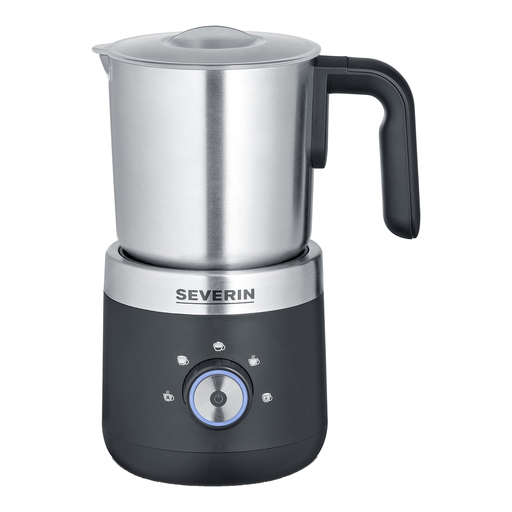 No image available
An electric option if your holiday cottage has a suitable socket and you want to froth hot or cold milk.
Severin says the SM 3588 froths up to 150 ml and heats up to 300 ml. According to the manufacturer, the removable jug is dishwasher-safe. Check the CE marking on the actual product.
Whisk the matcha with water first, then add the milk. Ippodo Tea’s recipe also starts by whisking the matcha with water. Unless you have information about the exact model, don’t assume a milk frother is suitable for mixing matcha powder.
A manual shaker or the battery-powered whisk we looked at won’t heat milk. If you want a hot latte without a separate heating step, choose a model with a clearly stated heating function and make sure you have a suitable power connection.
Follow the instructions for the exact model. Inventum advises against rinsing the MK350B under the tap; HARIO says the Latte Shaker is dishwasher-safe, and Severin says the removable jug of the SM 3588 is dishwasher-safe.
According to ACM ConsuWijzer, under the applicable conditions the seller must put a faulty product right free of charge, for example by repairing or replacing it, or giving you a refund. A manufacturer’s guarantee does not automatically last as long as your statutory rights.
The Dutch government states that electrical appliances placed on the EU market must carry a CE marking. Check the marking on the actual electrical product; a model name or product listing alone doesn’t confirm that it’s present.