For examining the surface of a whole sheet of paper, a compact microscope with incident illumination is a good choice, provided you also have room for the stand and, with a USB model, the computer. If you want to examine individual fibres on a slide, choose a setup with transmitted illumination and suitable sample preparation. A high stated magnification or an image of the surface cannot replace that analysis.
Who is this choice relevant for?
Paper surface inspector
Wants to examine visible fibres and the surface texture of a whole sheet on a small work surface. A laptop may already be available to display the image. Celestron describes a computer as the screen for the Handheld Digital Microscope Pro.
Individual paper fibre researcher
Wants to examine individual fibres on a slide and may want to distinguish between fibre types. Lighting, sample preparation and experience all matter: TAPPI describes fibre analysis as work that requires skill and experience in paper microscopy.
Mobile paper inspector
Wants to examine paper surfaces in different locations without a fixed computer setup. Bear in mind that portability does not make a microscope suitable for transmitted-light examination; Levenhuk states that the DTX 700 Mobi is for opaque samples only.
What should you look for?
When inspecting paper on a small work surface, it helps to decide first whether your priority is the surface of a sheet, individual fibres, saving images or mobile use.
| What to consider |
What should you check? |
Who is this important for? |
| Paper surface and workspace |
Check the dimensions of the complete setup, including the stand, cables and any computer. Also check whether the model has incident illumination. |
If I mainly want to examine the texture of a whole sheet, I need to allow for the space taken up by the complete setup. Around 36% of consumers prioritise compact surface inspection. |
| Individual fibres and transmitted illumination |
Check whether the model has transmitted illumination and a suitable stage. Decide whether you simply want to observe fibres or identify them using an analysis method. |
Anyone wanting to examine individual fibres on a slide needs more than an image of the sheet's surface. Around 29% of consumers prioritise this need. |
| Saving images |
Check how the exact model saves images, whether a memory card is included and which computer or software is required. |
If I want to review or compare samples later, I want to know in advance how to save images. Around 21% of consumers prioritise documentation. |
| Working without a computer |
Check whether the model has its own screen and power supply, and which types of samples it is designed for. |
An integrated screen can be useful if you work in different locations without a fixed computer. Around 14% of consumers prioritise mobile use without a computer. |
Common buying pitfalls
-
Choosing based only on the highest magnification
Magnification figures for USB and screen-based models are not necessarily comparable on the same basis. Incident illumination does not become transmitted illumination just because you increase the magnification.
Start by deciding on the task and the type of lighting you need. Then compare the specifications of the exact models and check the conditions under which magnification is stated.
-
Measuring only the camera head
A USB microscope may also need a stand, computer and cables. These all contribute to the amount of work surface space the complete setup takes up.
Mark out the complete setup in the space available before choosing a model.
-
Choosing a model for opaque samples to examine fibre slides
Levenhuk states that the DTX 700 Mobi is for opaque samples only. That does not automatically make it suitable for slides that require transmitted illumination.
Before buying, decide whether you want to examine a paper surface or individual fibres on a slide.
Relevant brands for paper inspection
BRESSER
The models reviewed suit different tasks: the DST-1028 for USB surface inspection, and the Biolux Touch for a setup with both incident and transmitted illumination.
- According to BRESSER, the DST-1028 has adjustable incident illumination and uses a computer.
- According to BRESSER, the Biolux Touch has its own screen and separately adjustable incident and transmitted illumination.
- A stage and transmitted illumination take up work surface space; having transmitted illumination does not in itself prove that fibre types can be identified reliably.
Levenhuk
The DTX 700 Mobi is a good fit if you want to examine an opaque paper surface in different locations without a fixed computer.
- According to Levenhuk, this model has a built-in screen, a battery and a polarising filter.
- According to Levenhuk, it is designed for opaque samples only; digital zoom does not in itself show that it is suitable for fibre identification.
Celestron
The Handheld Digital Microscope Pro is a USB alternative that uses a computer as its screen and has a separate stand.
- Celestron specifies a 5MP sensor and stand dimensions of 175 × 140 × 110 mm.
- According to Celestron, the final displayed magnification depends on the monitor size. These details do not in themselves determine whether the model is suitable for fibre identification.
Choosing a product at Joybuy
This selection from Joybuy is suited to mobile viewing and examining slides; check that the lighting and setup suit your specific research task.
 No image available
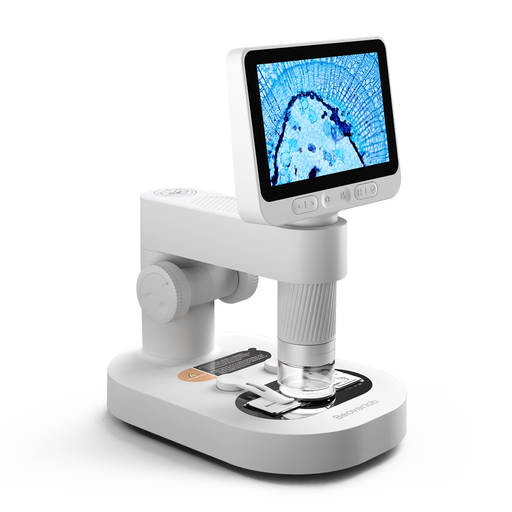
Children's digital microscope with detachable screen
The detachable handheld design may suit viewing in different locations; the product description also mentions the prepared slides included.
The description lists a built-in screen and adjustable LED lighting. Before using it for your research, check that the lighting and setup are suitable for the samples you want to examine.
Check the applicable EU product safety information for the exact version. The product information warns that small accessories must be kept out of reach of children under 3 and that adult supervision is required.
Joybuy
Frequently asked questions
When should I use transmitted rather than incident illumination?
Transmitted illumination is intended for a suitable thin or transparent slide; incident illumination is used to examine an opaque surface. Check that the exact model offers the lighting that suits your sample: BRESSER lists separately adjustable transmitted and incident illumination for the Biolux Touch, while Levenhuk describes the DTX 700 Mobi as being for opaque samples.
Can I tell from a photo of paper which plant all the fibres came from?
Not from a photo of the paper surface alone. TAPPI describes fibre identification as work that requires experience and comparison with known fibres; according to the method, highly refined or recycled fibres can be difficult to analyse.
How can I make the most of limited space on my work surface?
Measure the complete setup, not just the microscope head. For a USB model, allow space for the stand, computer and cables too; if the model has a stage, make sure that fits in the space available as well.
What do I need for my first inspection?
First decide whether you want to examine an intact sheet or a thin slide, then choose the appropriate lighting. You will also need a stable setup; with a USB model, check that it works with your computer and software.
Does a CE mark prove that a microscope is suitable for paper fibre analysis?
No. Dutch government guidance explains that a CE mark relates to the applicable European product requirements and is not a quality mark. On its own, it does not tell you whether a microscope is suitable for fibre identification.


