
Interviewer recording two people at a table
You want to capture both questions and answers clearly, and need a setup that works for both seats. The University of Leicester and Indiana University offer practical recording advice for interviews.


Choose your setup based on the room and the distance to both speakers. In a quiet room, a carefully positioned table microphone or recorder may be enough. If there’s echo, background conversation or a quiet voice, microphones placed close to each speaker are a better option. The University of Leicester recommends placing a microphone close to the speaker to reduce echo in oral history recordings. It’s also a good idea to make a test recording at the interview location, as Indiana University advises.
You want to capture both questions and answers clearly, and need a setup that works for both seats. The University of Leicester and Indiana University offer practical recording advice for interviews.
You’re dealing with background conversation, echo or a quiet speaker, and can place the microphone closer to the speakers. The University of Leicester discusses microphone placement for oral history recordings.
You want to record in different locations and need to check the power, storage and a test recording on site. Zoom and Tascam describe portable recorders with built-in microphones.
Start by considering the distance between the microphone and both speakers. Then assess the room, the recording equipment and how you’ll play the recording back. The University of Leicester recommends placing a microphone close to the speaker to reduce echo, while Indiana University advises making a test recording at the location itself.
Suitable when: both people are sitting at a computer and the room is quiet.
Consider: the distance to a quiet speaker and noise picked up from the table can affect the recording.
Suitable when: the room is noisy or echoey, or the speakers’ voices differ greatly in volume.
Consider: check which receiver, cables and recording equipment you’ll need. Clip-on microphones can pick up rustling clothes.
Suitable when: you want to record without a computer and prefer one compact device with built-in microphones.
Consider: check the storage, power and clarity of both voices. Built-in microphones are still affected by their positioning and the room’s acoustics.
| What to consider | What to look for | Who is this important for? |
|---|---|---|
| Both voices | Make a test recording from both seats at a normal speaking volume. | I want to hear both the questions and answers clearly, rather than testing only the person telling the story. Around 36% of consumers prioritise capturing both voices. |
| Echo and table noise | Test the room with normal movement and listen for tapping, paper and background conversation. | If I’m recording in a shared or echoey room, I want to minimise background noise as much as possible. Around 29% of consumers say reducing this kind of noise is their main consideration. |
| Recording without a computer | Check the storage medium and power, then play back a test recording. | I record in different locations and don’t want to rely on a dedicated computer. Around 21% of consumers prioritise being able to record independently. |
| Checking and saving the recording | Play back a short recording and check which device saves the file. | I want to be sure both voices have been recorded and the file is saved before the conversation starts. Around 14% of consumers prioritise checking and saving their recordings. |
A recording mode won’t automatically change the distance to the speaker, reflections in the room or noise from the table.
Check how clear the recording is with a test at the actual location, and adjust the microphone placement if needed.
According to RØDE, Wireless ME transmitters don’t save an internal recording on their own; the connected device needs to save the file.
Check the entire recording setup before the interview and play back a test file.
At a shared table, the interviewer may be further away from the microphone and recorded at a lower volume.
Have both people speak from their own seats during the test recording, then play it back and listen.
According to Zoom, the H1essential is a compact standalone recorder for conversations on location, and can also be used as a USB microphone.
According to Tascam, the DR-05XP is a portable recorder with built-in microphones and a USB interface.
The Wireless ME Dual set is designed for a setup with two transmitters that can be worn on clothing.
The Yeti is a USB table microphone for a fixed computer setup.
The ATR2100x-USB is a directional microphone for speech, suited to situations where you can place it close to one speaker and want a USB or XLR connection.
These product choices are suited to a setup with a microphone close to each speaker. Before buying, check that the receiver works with your recording device and how you’ll save the recording.
 No image available
A set with two transmitters is suited to recording each speaker separately with a microphone placed close to them.
The product name lists two transmitters, one receiver and a charging case. Check that the receiver works with your recording device and where the interview file will be saved.
 No image available
This set may suit a setup where two speakers each have a microphone placed close to them.
The product name lists two microphones, a camera receiver, a smartphone receiver, USB-C and a charging case. Check the connection and recording function of the device you plan to use.
 No image available
A setup with two transmitters may suit recording two interview participants separately with a microphone placed close to each of them.
The product name lists USB-C, 2TX+1RX and a range of 150m. The receiver uses USB-C, so check that it’s compatible with your recording device.
 No image available
The dual-microphone setup is suited to recording two people separately with a microphone placed close to each of them.
The product name lists USB-C, two microphones, 2.4GHz and a charging case. Check that the receiver works with your recording device.
 No image available
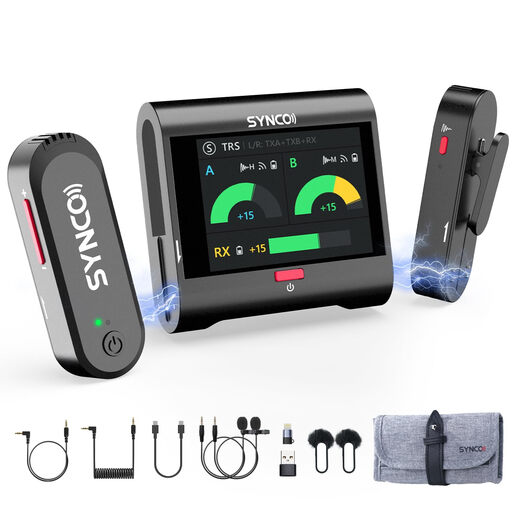
A system with two lapel microphones may suit situations where both people need a microphone placed close to them.
The product name lists 2.4GHz and two lapel microphones. Check the receiver’s connections and how your recording device captures the conversation.
It depends on the room and the distance to both seats. Test whether both voices are clear at their normal speaking volume. If there’s echo or background conversation, the University of Leicester recommends placing a microphone closer to the speaker, such as a clip-on model.
Make a short test recording at the actual location, play back both voices and listen for rustling paper or tapping on the table. If you’re using a recorder, check the power and storage as well. With a wireless set, the connected device must actually save the recording.
Check which storage media, batteries, stand, cables or recording equipment your chosen setup needs, as this varies by model. ACM ConsuWijzer explains that the seller is responsible for providing a suitable solution if a product is faulty. Many online purchases also come with a 14-day cooling-off period, although exceptions may apply.
It depends on the purpose, the participants and how you plan to use the recording. Discuss the recording, storage, access and any plans to publish it with the person telling their story beforehand, and record what you agree. If the GDPR applies to the processing of personal data, you need a lawful basis. Consent is one possible lawful basis and must meet GDPR requirements if you use it. Consent to the interview doesn’t automatically cover every later use for publication.