
Interviewers with two fixed seats
You want to record both questions and answers clearly, and can position a microphone for each speaker. Shure explains how microphone distance and placement affect the balance between direct speech and reflections.


For an interview with two speakers, placing a microphone close to each person is a sensible option if you want to record their voices separately. First, check that your recording device can handle both signals at once. One shared microphone is simpler to set up, but test it from the actual seating positions to make sure both voices come through clearly. A wireless kit with two transmitters gives speakers more freedom to move, but you’ll need to pay extra attention to the receiver, power and any backup recording.
You want to record both questions and answers clearly, and can position a microphone for each speaker. Shure explains how microphone distance and placement affect the balance between direct speech and reflections.
You want to stop the room sound from overwhelming the voices, so you’re paying attention to microphone placement and making a test recording in the booth. Shure recommends trying different distances and positions.
You want equipment that’s easy to set up or use on the move. Check that the connection, power supply and recording method suit your recording device; RØDE and DJI outline the options available with different models.
Best suited to: interviews where the interviewer and guest usually stay seated, and you want to monitor both voices separately.
The trade-off: two microphone positions need a recording setup that supports both signals at once. You may need extra stands or a multi-channel interface.
Best suited to: speakers who move around, or situations where a microphone on the table isn’t practical.
The trade-off: check how many transmitters are included, how the receiver connects, and whether the kit records audio itself or needs another device.
Best suited to: a simple setup, provided a test recording confirms that both voices are captured clearly.
The trade-off: being further from one or both speakers can pick up more of the room sound. A recorder with built-in microphones won’t automatically solve the positioning challenge.
| What to consider | What to look for when buying | Who is this most relevant to? |
|---|---|---|
| Two clear voices | Check whether each speaker can use their own microphone or transmitter, and whether both signals can be recorded at the same time. | If I want to capture both questions and answers clearly, I look at the complete signal path for both speakers. Consumers who prioritise the clarity of both voices make up around 36% of this buying context. |
| Microphone distance and room sound | Test the intended placement from both seats, then listen back to the test recording with headphones. | In a small booth, I want to hear whether the voices remain clear from the chosen seats. Consumers who prioritise microphone placement and room sound make up around 29% of this buying context. |
| Recording a full interview | Check where the audio is saved, whether the transmitters record themselves, and how you can monitor the sound while recording. | For a long conversation, I want to know in advance where the recording will be saved and how I can check the sound. Consumers who prioritise confidence that the whole conversation will be captured make up around 21% of this buying context. |
| Setup and connections | Check the connection, compatibility, included cables and stands, and, for wireless use, the number of transmitters and type of receiver. | If I want to connect the kit quickly to my existing recording device, I check what I’ll need for the complete setup. Consumers who prioritise easy setup and compatible connections make up around 14% of this buying context. |
The distance from the microphone and reflections in the booth affect how direct the speech sounds. As a result, a speaker at the other end of the table may sound different in the recording.
Before you decide, make a test recording from the intended seats and listen back to both voices.
RØDE says the transmitters in the standard Wireless Micro do not record internally. DJI lists internal recording as a feature of the Mic 2; don’t assume this feature is available with other models or bundles.
Check the recording features of the exact model and what’s included in the bundle, regardless of how many transmitters it has.
USB and XLR connections alone don’t mean that two microphones can record simultaneously to your existing computer or recorder.
Check the complete signal path for both speakers in advance, as well as what’s included in the bundle you choose.
The MV7+ is a dynamic microphone for speech, with USB-C and XLR connections for a fixed, close-up position.
The PodMic USB is a wired USB/XLR option for a fixed speaking position; the Wireless Micro offers a wireless setup with two transmitters and a receiver.
The Q2U is a dynamic USB/XLR microphone for a wired speaking position.
The ATR2100x-USB is a dynamic handheld microphone with USB-C and XLR connections.
The Mic 2 is a wireless option for interviews, where a version with two transmitters may be useful.
This selection features wireless microphone systems with two microphones or transmitters, designed for conversations between two speakers.
 No image available
For wireless recording with two speakers; the product name lists two transmitters, one receiver and a charging case.
 No image available
For two speakers who want to record wirelessly; the product name lists two microphones, a camera receiver, a smartphone receiver and a charging case.
 No image available
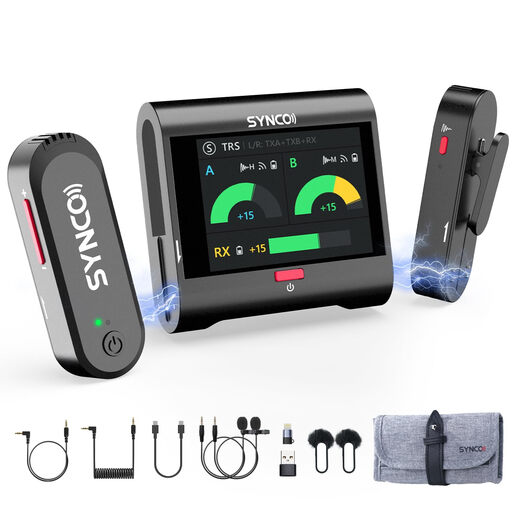
For a wireless two-person setup; the product name specifies a dual-lapel configuration on 2.4GHz.
 No image available
For conversations between two speakers; the product name lists two transmitters, one receiver and a charging case.
 No image available
For wireless recording with two microphones; the product name specifies a dual-mic setup and a Type-C interface.
No, not necessarily. Test from the actual seating positions: the further a speaker is from the microphone, the more noticeable the room sound may be. A microphone close to each speaker is an alternative, as long as your recording setup can handle both signals.
Record a short conversation from the intended seats and listen back to both voices. Also check where the file is saved. Use headphone monitoring if your chosen model supports it, and, with a wireless kit, check whether the transmitters record audio themselves.
A sound recording that makes someone recognisable may contain personal data. If the GDPR applies to the processing, you need a valid legal basis; consent is one possible basis, but it isn’t automatically the only one. The Dutch Data Protection Authority lists an exception for purely personal or household use. Consider recording, archiving and any publication separately for your project.
Consumer purchases are covered by statutory guarantees: you’re entitled to a product that works as it should, and you should contact the seller if there’s a problem. According to the Dutch government, any manufacturer’s guarantee is in addition to this. Also check which accessories and services are included with the version you choose.