What should you look for when choosing?
Start with the microphone’s position and how close it is to your mouth. Then choose between USB for a direct connection and XLR for a set-up with an audio interface. Consider a condenser microphone only if you can record at a quieter time.
| What to consider |
What to look for when buying |
Who is this important for? |
| Clarity and background noise |
Check the polar pattern and which side you should speak into. Make a test recording where you plan to read aloud. |
When I read aloud in a noisy flat, I mainly want my words to stay clear above household noise. Around 36% of consumers put clarity first. |
| Easy connection |
Check whether the microphone can connect directly to your computer and which port or cable you’ll need. |
I want to get started on my computer without a separate audio interface. Around 29% of consumers give ease of connection top priority. |
| Voice and delivery |
Check whether it has a pop filter and headphone monitoring. Listen back to a test recording of both quiet and emphatic lines. |
When reading aloud at different volumes, I want to assess how my voice sounds and whether plosive sounds are distracting. Around 21% of consumers prioritise voice and delivery. |
| Expandability of the set-up |
Check which interface and level of amplification your chosen microphone needs. Also factor in the cable and mounting. |
I want to keep my connection options open for the future, even if that means a more elaborate set-up. Around 14% of consumers put expandability first. |
Joybuy microphones for voice recording
Below are Joybuy microphones with different connections and recording formats. For each model, check that its positioning, connection and features suit your reading style and recording equipment.
 No image available
DJI Mic Mini 2S (2 TX + 1 RX + Charging Case)
The clip or magnetic attachment may suit you if you want to wear a transmitter close to your voice.
The set includes 2 TX, 1 RX and a Charging Case. The product information states that it’s compatible with PCs.
View at Joybuy
 No image available
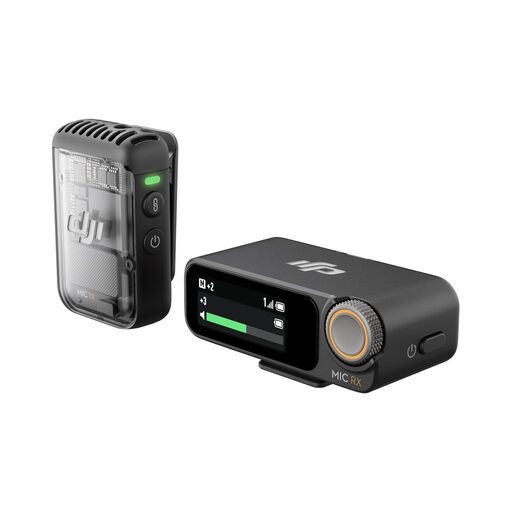
DJI Mic 2 (1 TX + 1 RX)
The transmitter may suit you if you want to wear a microphone close to your voice and connect the set to a compatible device.
The product information lists adapters for USB-C, Lightning and 3.5 mm, as well as internal recording.
View at Joybuy
 No image available
Razer Seiren V3 Mini Quartz
This USB microphone may suit you if you want to record directly and can position the microphone in front of you.
The product information lists a supercardioid polar pattern and a condenser capsule. If you’re using it in a noisy room, bear in mind the noise at your recording location.
View at Joybuy
 No image available
Moman M1CT (USB-C, 1TX + 1RX)
A lavalier microphone may suit you if you want to wear the transmitter close to your voice and use a USB-C device.
The product name lists 1TX + 1RX and a range of 150 m. The product information specifies an omnidirectional microphone, which isn’t focused on a single speaking direction.
View at Joybuy
 No image available
HyperX SoloCast 2
This USB microphone may suit you if you want to record directly to a computer and speak in front of the microphone.
The product information lists a cardioid polar pattern, a condenser capsule and a built-in pop filter. Check that the background noise at your recording location makes this the right choice.
View at Joybuy
Frequently asked questions
Do you have to choose a dynamic microphone?
No. A directional dynamic microphone is a sensible starting point if you can stay close to it in a noisy room. If you can record at a quieter time, also test whether a condenser microphone suits the sound you want to capture.
How should you position the microphone for a test recording?
Point the recording side towards your mouth and place the microphone as close as is practical. Shure also recommends keeping the microphone away from unwanted sound sources. For the PodMic USB, RØDE recommends a distance of around 5–10 cm. Read a quiet and a loud passage, then listen back to check the distance, plosive sounds and room noise.
What extra equipment do you need for an XLR microphone?
To record on a computer, the XLR signal needs to pass through a suitable audio interface. Check the amplification required for the specific model: for the SM7B, Shure specifies a minimum of 60 dB gain when used with a digital computer interface.
Can you publish a recording of a poem online?
This depends, among other things, on who wrote the text. According to the Government of the Netherlands, you may make a copy of copyright-protected work for your own use, but you can’t distribute or publish it without permission. So check the rights before publishing a reading of someone else’s poem.
Do you have a cooling-off period when you buy a microphone online?
According to the Government of the Netherlands, when you buy from a business online, you’ll often have a 14-day cooling-off period. For your specific purchase, check who the seller is and which terms or exceptions apply. A purchase from a private seller isn’t covered by the same distance-selling rules.


