
Speaker in a reverberant workspace
You want to record one clear voice without setting up a studio first. The distance between your mouth and the microphone, along with a test recording, matters more than a general promise of studio-quality sound.


For a clear phone greeting in an untreated room, a microphone you can position close to your mouth is a sensible place to start. You’ll still need to make a test recording, as Shure stresses that a microphone won’t improve the room’s acoustics. For the PodMic USB, RØDE recommends a mouth-to-microphone distance of around 5–10 cm, but this model-specific distance doesn’t automatically apply to other microphones. Choose USB for recording directly to a computer, or USB/XLR if you also want the option of using an interface. Check your phone system’s export requirements too: for the 3CX IVR workflow described, 3CX specifies PCM-WAV, 8 kHz, 16 bit, mono.
You want to record one clear voice without setting up a studio first. The distance between your mouth and the microphone, along with a test recording, matters more than a general promise of studio-quality sound.
You want to record, listen back to and export a short greeting without a separate audio interface. So check the USB connection and whether you can monitor the recording as you make it.
You want the exported file to work with your phone system. The exact file requirements depend on the system you use.
Start with a test recording in the place where you plan to speak. Then choose a connection that suits your recording equipment and check your phone system’s requirements before exporting.
| What to consider | What should you check? | Who is this important for? |
|---|---|---|
| Clarity in a reverberant room | Check the speaking side and positioning, then listen back to a test recording. For the PodMic USB, RØDE recommends a mouth-to-microphone distance of around 5–10 cm. | If I want to record one clear voice in a reverberant workspace, I’ll start with positioning and a test recording. Around 36% of consumers prioritise clarity despite room reverberation. |
| Easy recording | Check that the USB connection and cable work with your computer, and whether you can connect headphones while recording. | If you want to record and listen back to your greeting directly on a computer, a suitable, straightforward connection will help. Around 29% of consumers give this priority. |
| File for your phone system | Check your system’s requirements, such as file type, encoding, sample rate, bit depth and channel layout. For the 3CX IVR workflow described, 3CX specifies PCM-WAV, 8 kHz, 16 bit, mono. | If I want to use the file directly in my phone menu, I’ll check the phone system’s own upload requirements first. Around 21% of consumers prioritise compatibility with their phone menu. |
| What else you’ll need | Check whether you’ll need a stand, boom arm, cables or an interface for the version you choose, and what’s included in the box. | If you don’t want to buy separate recording equipment for a single short greeting, compare complete set-ups. Around 14% of consumers make this their top priority. |
A microphone won’t improve the room’s acoustics. A manufacturer’s feature is no guarantee of a reverb-free recording in your room.
Start by making a short test recording with the microphone in the intended position, then listen back to it.
A poorly chosen recording spot could mean you have to record again or change where you’re set up.
Different versions may come with different mounts, cables and connection options.
Check the exact version and what’s included in the box before deciding which extra parts you need.
A missing stand, boom arm, cable or interface could mean extra steps when setting up.
A recording can sound good and still fail to meet the file requirements of the system you use. The 3CX IVR guide specifies settings for that workflow; they won’t automatically apply to other providers.
Check your phone system’s current requirements, upload the file, then call the number to test the greeting.
You may need to convert the file and test the phone menu again.
The ATR2100x-USB is a dynamic cardioid handheld microphone with USB and XLR connections, designed for uses including voice-overs.
Samson describes the Q2U as a dynamic USB/XLR microphone for voice recording.
The PodMic USB is a dynamic USB-C/XLR microphone for voice recording. Another option is the NT-USB+, a cardioid USB condenser microphone.
The MV7+ is a USB-C/XLR option with adjustable features for anyone who also wants to record other voice content.
The AM8T is a USB/XLR kit with a boom arm, while the K688 is a separate dynamic USB/XLR microphone.
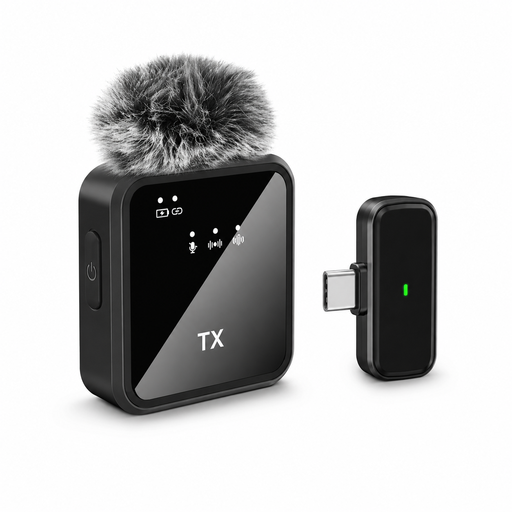
The Joybuy options below are wireless mini or lapel microphones for voice recording. Check that each model’s connection is compatible with your recording device.
 No image available
An option for voice recording if your device supports the listed Type-C connection. Make a test recording in the room where you plan to speak first.
Wireless; Type-C connection; mini lapel microphone.
 No image available
An option for wireless voice recording. Check that the listed interface works with your recording device and make a test recording in the intended room.
Wireless; single microphone; mini button-style lapel microphone; universal interface.
No, a microphone won’t improve the room’s acoustics. Position it carefully, make a test recording and listen back to hear how the room sounds.
It depends on the model and how you position it. For the PodMic USB, RØDE recommends a mouth-to-microphone distance of around 5–10 cm and using a pop filter. Don’t automatically use the same distance with other microphones.
Not always; follow your system’s process and upload requirements. For a pre-recorded file using the 3CX IVR workflow described, 3CX specifies PCM-WAV, 8 kHz, 16 bit, mono. Check the relevant guide if you use another phone system.
USB is suitable for recording directly to a compatible computer. USB/XLR also gives you the option of an XLR connection, but recording via XLR to a computer requires a suitable interface or other conversion equipment. Check which equipment and cables you already have.
Recording your own greeting in advance is not the same as recording calls with callers. If you also process callers’ personal data, assess separately which information and privacy obligations apply to that use.