What should you look for when choosing?
First, make a test recording where you plan to speak. The distance and direction will help you judge how your voice compares with the noise in your flat. Then choose between recording directly via USB, using an XLR interface, or trying a USB condenser microphone to see if it suits the space.
For this particular choice, the table looks at consumers’ first buying priority when recording a walking route script at home in a noisy flat. Each row covers a different priority.
| What to consider |
What to look for when buying |
Who this matters to |
| Clarity with background noise |
Test the intended distance and direction while the usual flat noise is present. |
If ventilation or noise from neighbours is an issue, I want to know whether my voice comes through clearly where I’ll be recording. Around 36% of consumers put clarity first. |
| Easy to connect |
Check that the connection and included cable are suitable for your recording device; recording to a computer via XLR requires a suitable interface. |
If I want to record straight to a computer without a separate interface, I’ll check the connection first. Around 29% of consumers make ease of connection their top priority. |
| Hear what you’re recording |
Check whether the exact model has a headphone output, and listen back to a test recording. |
If I want to check the distance, interference or plosive sounds while recording, monitoring matters. Around 21% of consumers put recording monitoring first. |
| Equipment you’ll need |
Check what’s included and what you already have, such as a suitable stand, cable, headphones or interface. |
If I want to know in advance what else I need for a complete recording setup, I’ll compare the box contents with the equipment I already have. Around 14% of consumers start by checking what equipment they’ll need. |
Joybuy products for this recording
The products below include wireless microphones for mobile recording and USB condenser microphones. Check that the connection and any required device support are suitable for the space and equipment you plan to use.
 No image available
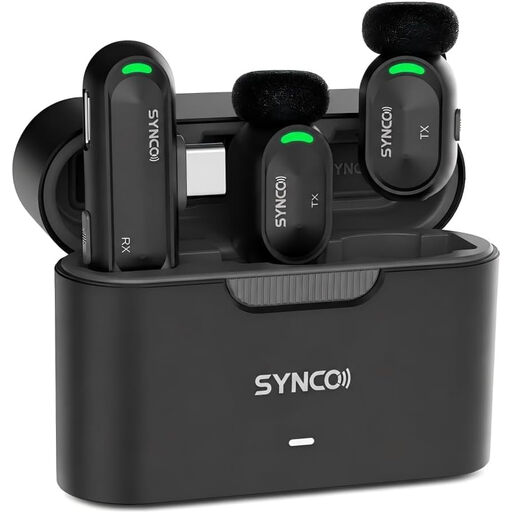
SYNCO P2XT USB-C wireless microphone
For mobile recording with an Android device with USB-C; OTG must be enabled.
Wireless; USB-C.
View at Joybuy
 No image available
SYNCO SMIC AI wireless microphone for Android USB-C
For mobile recording with an Android device that supports USB-C and OTG.
Wireless; USB-C. The OTG support required depends on the device you’re using.
View at Joybuy
 No image available
USB condenser microphone with cardioid pattern
For USB voice recording at a desk; make a test recording to see how the microphone sounds in your space.
USB condenser microphone; cardioid pickup pattern.
View at Joybuy
 No image available
DJI Mic 3 (1 TX + 1 RX)
For mobile recording with one transmitter and receiver; check that the connection is suitable for your phone or camera.
Wireless set; 1 TX and 1 RX. The product name lists use with iPhone, camera and Android.
View at Joybuy
 No image available
DJI Mic 3 (2 TX + 1 RX + Charging Case)
For a wireless recording setup with one or two speakers; check the connection on the device you’ll be recording with.
Set with 2 TX, 1 RX and charging case.
View at Joybuy
Frequently asked questions
Does noise reduction help if you can hear your neighbours talking?
Not as a guaranteed solution. Shure distinguishes between continuous sounds, such as a fan, and background voices or sudden noises. Speak close to the microphone, point it towards your mouth and make a test recording.
How should you position a PodMic USB if your voice sounds too quiet in the recording?
RØDE recommends positioning the PodMic USB around 5–10 cm from the speaker, with the top pointing towards their mouth. Also check the USB input level and listen back to a test recording. This distance is guidance for this model, not a general rule for microphones.
Do you need an audio interface for XLR?
To record to a computer, the XLR signal needs to be processed through a suitable audio interface. A microphone with both USB and XLR can connect directly to a computer via USB; check whether the digital features you want are also available through XLR.
What cooling-off period and warranty apply to online purchases in the Netherlands?
Online consumer purchases generally come with a statutory cooling-off period of up to 14 days after delivery, subject to legal exceptions. ACM ConsuWijzer also explains that if a product doesn’t do what you could reasonably expect when used normally, the seller is responsible for providing an appropriate solution free of charge. There isn’t one fixed statutory warranty period of two years for every product.


