
Readers aloud in a noisy flat
You’re recording a single voice while traffic, housemates or room echo can be heard. Shure stresses that a microphone won’t improve the room’s acoustics; RØDE recommends speaking close to the PodMic USB.


If you can keep a microphone close to your mouth and steady, start with a directional dynamic speech microphone. Even then, it won’t make a noisy flat quiet, as Shure explains. Choose USB to connect directly to a compatible device, or XLR if you already have a suitable interface or deliberately want to build that setup. Test both soft and loud passages: the connection type or a manufacturer feature alone doesn’t prove that your room will capture both levels well.
You’re recording a single voice while traffic, housemates or room echo can be heard. Shure stresses that a microphone won’t improve the room’s acoustics; RØDE recommends speaking close to the PodMic USB.
You move between quiet passages, emphasis and loud lines, and want to check how distance and settings affect the sound in a test recording.
You want to record directly via USB, or deliberately choose XLR with an audio interface and the other components you’ll need. Samson describes USB and XLR for the Q2U; Elgato lists an interface, cable and mount for the Wave DX.
First decide how you’ll connect and position the microphone. Then use a test recording to check whether quiet and loud passages both sound clear.
A good fit if: you want to record directly to a compatible device without using an XLR interface.
Keep in mind: check that the chosen model’s connection is compatible with your device.
A good fit if: you want to start with USB and have the option of using an XLR connection too.
Keep in mind: having an extra connection option doesn’t, by itself, tell you how well background noise will be reduced.
A good fit if: you already have a suitable interface or are deliberately building a separate XLR setup.
Keep in mind: you’ll also need a suitable interface, cable and mount to record on a computer.
| Key consideration | What should you check? | Who is this important for? |
|---|---|---|
| Background noise | Check the microphone’s pickup pattern, speaking direction and whether you can position it steadily nearby. Make a test recording where you plan to use it. | If I’m recording in a noisy flat, I want my voice to remain clear without expecting the microphone to silence the room. Around 36% of consumers prioritise limiting the effect of background noise on their recording. |
| Quiet and loud passages | Look for headphone monitoring and easy-to-reach controls. Record the same passage quietly and loudly, then listen back with any processing switched on and off. | For a dramatic reading, I want to assess both whispers and loud lines. Around 29% of consumers make preserving these changes in vocal delivery their top priority. |
| Getting started straight away | Check that the connection suits your device and that the required cable, stand and headphone output are available with your chosen model. | If I want to record without a separate interface, I’m looking for a setup that works with my device. Around 21% of consumers prioritise being able to get started straight away over expandability. |
| XLR compatibility | Check that your interface has a suitable input and whether you’ll also need an XLR cable and mount. | If I already have an interface or deliberately plan to use XLR later, I want to make sure the connections and required components will work together. Around 14% of consumers prioritise an existing or planned XLR setup. |
A microphone won’t improve your flat’s acoustics. RØDE describes a noise gate as processing that reduces quieter sounds below a set threshold; this could also affect quiet words in your reading.
Test with the sounds you actually hear while recording, and record a quiet passage before deciding that processing is the answer.
You may spend extra time making test recordings and adjusting your recording position.
For the Wave DX, Elgato lists an XLR audio interface, XLR cable and mount as required parts of the setup.
Compare the complete setup with a USB or USB/XLR model before deciding.
Shure distinguishes the MV7+ from the MV7X: the MV7+ has USB-C and XLR, while the MV7X is XLR-only.
Check the full model name and connections of the exact version before ordering.
The PodMic USB is a dynamic speech microphone with USB-C and XLR, for anyone who records close to the mic and wants a choice of connections.
The MV7+ combines USB-C and XLR; the MV7X is a separate XLR-only model.
The AT2040USB is a dynamic USB speech microphone with a hypercardioid pickup pattern.
The dynamic Q2U offers USB and XLR, giving you a choice of connection.
The dynamic Wave DX is an XLR-only microphone for an existing interface setup or one you’re deliberately planning to build.
This selection includes wireless clip-on microphone systems and a USB desktop microphone for recording your voice. For a dramatic reading aloud in a noisy flat, it’s important to check how you can position the microphone close to your voice and how a test recording sounds in your room.
 No image available
A wireless lavalier system could suit you if you want to wear the microphone on your clothing, close to your voice; the description mentions a clip or magnetic attachment.
The product description mentions internal 32-bit float recording and AI noise reduction. These are product claims, not measurements taken in a noisy flat. Check compatibility with your recording device; the description lists selected Osmo devices.
 No image available
The clip-on design could suit you if you want to wear a wireless microphone close to your voice.
For plug-and-play use, the product description specifies an Android device with USB-C and OTG support. It also mentions AI noise reduction and automatic level control; test the effect for yourself with quiet and loud passages.
 No image available
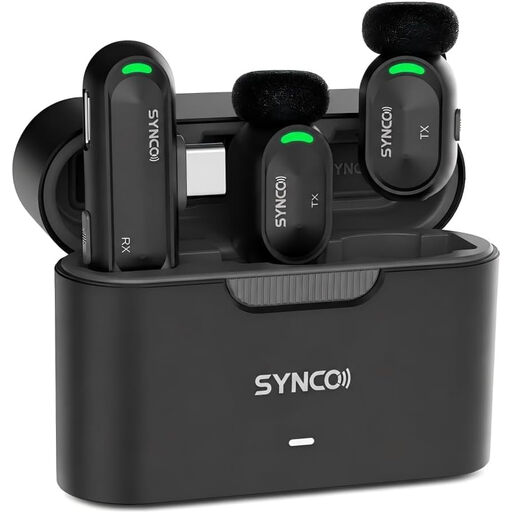
The set with two transmitters may be useful if you need a recording setup with multiple microphone transmitters; for a solo reading aloud, one transmitter may be enough.
The product name lists two transmitters, one receiver and a charging case. Check that the receiver is compatible with the device you want to record on.
 No image available
This USB desktop microphone could suit a dedicated recording spot on your desk.
The product description lists a supercardioid pickup pattern, USB and compatibility with PC and Mac. The title mentions tap-to-mute; check whether you can position the microphone close enough to your mouth on your desk.
 No image available
The clip-on design could suit you if you want to wear a small wireless microphone close to your voice.
The product name lists a Type-C connection. The product description mentions noise reduction and wind protection; check that your chosen version is compatible and listen back to a test recording.
No, it can’t block out every sound. Point the microphone towards your mouth and try speaking close to it at a steady distance. Shure explains that a microphone won’t improve the room’s acoustics or completely separate your voice from background sounds happening at the same time.
Position the microphone securely, speak towards it and record your quietest and loudest passages. RØDE recommends a distance of around 5–10 cm for the PodMic USB; this isn’t a universal distance for every model. Listen back to your recording and check for plosive sounds too.
For the Wave DX, Elgato lists an XLR audio interface, XLR cable and mount. Check the exact model to find out which components you need to connect the microphone to your recording device.
Not without first checking the rights to the text. According to the Dutch government, you can make a private copy of someone else’s text for personal use, but you can’t distribute or publish it. So check what permission you need before publishing.
There is no fixed statutory warranty period in the Netherlands. According to the Dutch government, you should contact the seller if a product doesn’t meet what you could reasonably expect from it.