
Recordists dealing with audible background noise
If you want to capture a single acoustic source more clearly, you can experiment with distance and direction. Shure recommends positioning the microphone close to the sound source you want to record.


Start by positioning a directional microphone close to the vocal or instrument, as far as the sound you want allows, then listen to a test recording with your usual background noise. Next, choose between an XLR setup with a suitable interface, direct USB recording or multiple microphones for separate sources. A low self-noise rating or digital noise reduction does not, on its own, make noise from your flat disappear.
If you want to capture a single acoustic source more clearly, you can experiment with distance and direction. Shure recommends positioning the microphone close to the sound source you want to record.
If the sound of your acoustic instrument matters to you, you can adjust the position carefully and use an XLR setup. Sennheiser and RØDE describe instrument microphones with XLR connections.
If you want to record directly to a computer without a separate audio interface, consider a USB microphone. Audio-Technica lists direct headphone monitoring as a feature of the AT2020USB-X.
| Concern | What to look for | Who is this important to? |
|---|---|---|
| Source versus room noise | Polar pattern and positioning close to the source; make a test recording with your usual background noise. | If I’m recording in a noticeably noisy room, I want to capture the source more clearly without losing sight of the instrument’s sound. Around 36% of consumers prioritise reducing room noise. |
| Instrument sound | Test the polar pattern and microphone distance with the instrument you want to record. | If the sound of my instrument is the deciding factor, I want to be able to adjust the positioning to suit it. Around 29% of consumers prioritise a natural instrument sound. |
| Connection and setup | Check which computer port or audio interface you need, whether phantom power is required and how many inputs are available. | If I want to record quickly on a computer, I need to know which connections and extra equipment are required. Around 21% of consumers prioritise a straightforward connection. |
| Recording vocals and instruments separately | Decide whether one combined recording is enough; if you’re using multiple microphones, check the number of channels and how they need to be positioned. | If I want to position vocals and instruments separately, I may need more than one microphone and recording channel. Around 14% of consumers prioritise recording separate sources. |
Microphone noise and audible traffic or neighbour noise are two different things. The microphone’s position affects how much room sound makes it into the recording.
Test the distance and direction with your usual background noise before relying on a self-noise figure.
The Sennheiser e 614 and RØDE M5 pair require phantom power; using two M5 microphones at the same time also requires enough inputs.
Before buying, check the connection, phantom power and number of available recording channels.
You may need a suitable interface, cables or extra inputs to use the setup.
A stereo pair offers different positioning options, but it may also pick up more of the room.
First, compare a directional mono test recording with the intended two-microphone setup.
A two-microphone setup requires extra positioning and recording channels.
The SM57 reviewed is a cardioid dynamic XLR instrument microphone for focused close-up recording.
The e 614 reviewed is a compact supercardioid XLR condenser microphone for focused instrument recording.
The AT2020USB-X reviewed is a cardioid USB-C microphone that connects directly to a computer.
The M5 pair reviewed consists of small-diaphragm condenser microphones that can be used individually or as a stereo pair.
These products are wireless microphone systems for voice and content recording. Consider them if you mainly want to record vocals or speech; they are not a direct replacement for a suitably positioned directional instrument microphone. Before buying, check that the connections are compatible with your device.
 No image available
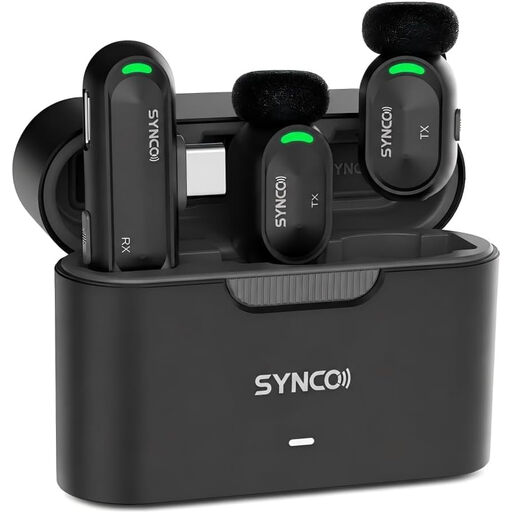
A possible option for wireless voice or content recording; the listed uses include cameras, smartphones and PCs.
Bundle: 2 transmitters, 1 receiver and charging case. The product description mentions AI noise cancellation for voices; this does not mean that sound from an acoustic instrument or the room will disappear.
 No image available
A wireless kit for content recording; check that the included receivers connect to the device you want to record with.
The title lists two microphones, camera and smartphone receivers, a charging case and USB-C.
 No image available
A possible option for voice recording with a USB-C device; OTG is required for Android.
The description mentions a clip-on setup, noise reduction for voice recording and real-time monitoring. Check your device’s connection.
 No image available
A possible option for wireless voice recording with a USB-C device; OTG is required for Android.
The description mentions a clip-on setup, noise reduction for voice recording and real-time monitoring. Check that the connection is compatible with your device.
 No image available
A possible option for wireless voice recording with an Android device that supports USB-C and OTG.
The description mentions a clip-on microphone and automatic voice level control. Check that your device supports OTG.
No. According to Audio-Technica, the AT2020USB-X has a USB-C connection. The Sennheiser e 614 and RØDE M5 pair are XLR condenser microphones that need suitable phantom power; also check how many inputs your interface has.
Store the microphone and accessories carefully, and check the cables, mounting and positioning before your next recording. Shure warns that touching the microphone can transmit mechanical noise and vibrations.
According to the Dutch government, online purchases made by consumers from a business usually come with a 14-day cooling-off period, although exceptions apply. Consumers are also entitled to a product that meets the terms of the agreement; in the Netherlands, there is no fixed statutory guarantee period. Check the terms that apply to your specific purchase.