
Vandaag of morgen in huis

Kwaliteit gegarandeerd

Welkomstaanbiedingen ontgrendelen: GRATIS bezorging | Tot 80% korting | Gratis 30 dagen JoyPlus-proefperiode
Download de app
A metal storage cabinet with doors can keep documents, tools and household items organised and out of sight. However, not every steel cabinet is suitable for the same space. A model that works well as an office storage cabinet may offer too little protection in a damp garage. A cabinet with a lock is not automatically suitable for storing valuable items either.
When comparing cabinets, pay particular attention to these three common pitfalls:
A steel storage cabinet is generally suitable for everyday use in an office, utility room or garage. Check that the product information specifies steel and look at the finish. A moisture-resistant or easy-to-clean surface is practical when dealing with dust, stains and temperature fluctuations.
Pay attention to the difference between a fully metal cabinet and one made from a combination of steel, chipboard or plastic. This is not necessarily a problem, but it does affect the weight, appearance and maintenance. For a tool cabinet, the load capacity is also more important than simply the number of doors.
Do not just measure the available space. Also measure:
A cabinet with adjustable shelves offers greater flexibility for ring binders, boxes and tool cases. Check how many shelves are actually included and what load each shelf can support. A wide shelf is useful for storage bins, while several levels are better suited to smaller items.
A lockable storage cabinet is useful when documents, cleaning products or tools should not be freely accessible. Check whether keys are included and whether the lock forms part of the cabinet’s construction.
Steel cabinets are relatively heavy. Even so, doors and a tall internal layout can affect the centre of gravity. Therefore, use the supplied anti-tip kit when specified by the manufacturer. Secure the cabinet to the wall according to the instructions and place heavy items as low as possible. This is particularly important in a home office, garage or room where children are present.
The selection below is based on verifiable information such as material, dimensions, lock, shelf layout and stated load capacity. Where the product description mentions brand claims, these are not presented as independently proven performance.
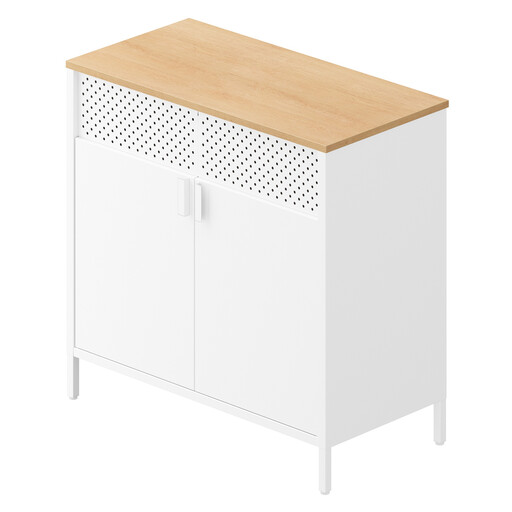
Why it suits this profile: Measuring 80 x 40 x 76 cm, this cabinet fits under a desk, against a low wall or as a storage unit in the living room. The magnetic closure is suitable for everyday storage, but this is not a metal cabinet with a lock.
The precise dimensions and stated top load capacity of 50 kg make it easier to compare. Bear in mind that the cabinet has a chipboard and steel construction and one adjustable shelf.
Compact size, one adjustable shelf and a magnetic closure. The product description also mentions a pegboard back for ventilation and attaching hooks.
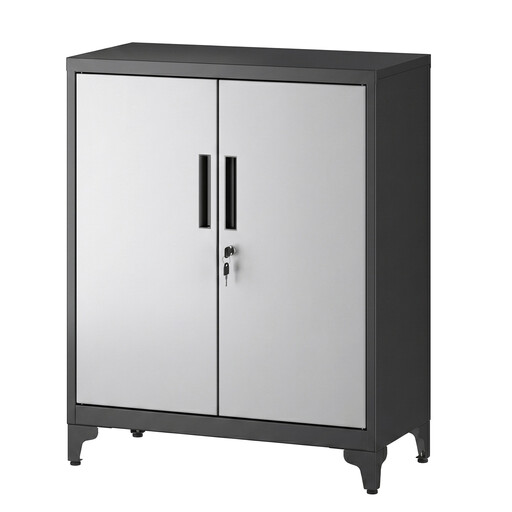
Why it suits this profile: This wide metal storage cabinet with doors measures 80 x 40 x 90 cm, combining an office-style layout with suitability for use in the garage or utility room.
The two adjustable shelves and stated load capacity of 25 kg per shelf provide clarity about the layout in advance. The steel lock comes with two keys.
Steel construction, two adjustable shelves, a top load capacity of 30 kg and a supplied anti-tip kit. The surface is described as water-resistant and easy to maintain.
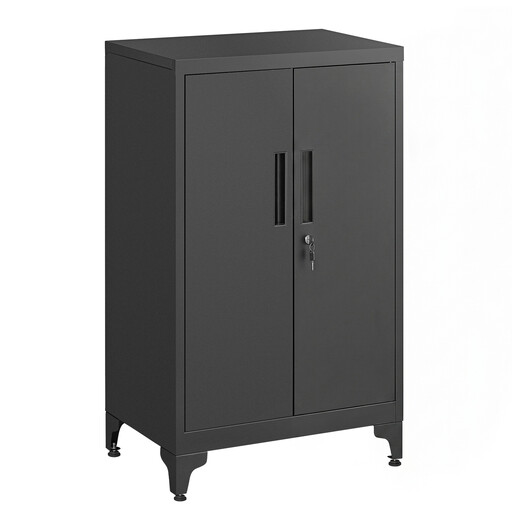
Why it suits this profile: Measuring 60 x 40 x 90 cm, this cabinet takes up less wall width and is practical as a garage cabinet, tool cabinet or home office storage cabinet.
The manufacturer specifies adjustable shelves, a steel lock and an anti-tip kit. The maximum static weight is 25 kg per adjustable shelf and 30 kg for the top.
Compact width, lockable doors, adjustable shelves and adjustable feet according to the product description. Before buying, check that the available space is deep enough: the cabinet is 40 cm deep.
A metal storage cabinet is usually supplied flat-packed. On delivery, check that all parts, keys, shelf supports and fixings are included. Assemble the cabinet on a level surface and only fully tighten the connections once the frame is straight.
Do not place a garage cabinet directly against a damp external wall. Even a moisture-resistant finish cannot prevent prolonged condensation from affecting metal components, hinges or stored documents. For paperwork, you may wish to use lockable plastic boxes inside the cabinet. Clean the surface with a soft, slightly damp cloth and dry it afterwards.
For a filing cabinet, the relationship between ring-binder height and shelf spacing is important. For tools, the available width and load capacity matter most. If you use loose boxes, adjustability is more useful than a large number of fixed compartments.
We have put together a complete, up-to-date list of products that fully meet these strict selection criteria and the applicable European safety regulations.
That depends on the finish, ventilation and conditions in the garage. Check whether the product description mentions a moisture-resistant surface or rust-resistant finish. Do not place the cabinet directly on a wet floor and leave space between the cabinet and the wall.
Its service life depends on the material, coating, load, assembly and maintenance. A cabinet used within its stated load capacity and kept dry will generally experience less wear than one in a damp or unheated space. Check the hinges, lock and fixings regularly.
In addition to the purchase price, assembly, wall fixing and any accessories are the main factors to consider. A metal cabinet does not use electricity. Recurring costs are therefore usually limited to maintenance and the possible replacement of keys or shelf supports. Always compare the included components, dimensions and load capacities rather than looking at the price alone.
