
Vandaag of morgen in huis

Kwaliteit gegarandeerd

Welkomstaanbiedingen ontgrendelen: GRATIS bezorging | Tot 80% korting | Gratis 30 dagen JoyPlus-proefperiode
Download de app
A metal storage cabinet may seem like a straightforward purchase at first glance. However, it is often only after assembly or everyday use that you discover whether the cabinet really suits your space. A cabinet that is too shallow offers little practical storage, a door without a proper catch can quickly become inconvenient, and a heavy piece of furniture without wall fixing can pose safety risks.
For homes, home offices, garages and kitchens, three pitfalls are particularly important:
Below, you’ll find out which specifications to check first and which models suit different situations.
Steel is generally easy to clean and less susceptible to moisture than untreated wood. This makes a metal cabinet for an office or a garage storage cabinet practical for tools, cleaning products and documents. Do pay attention to the exact construction: a steel body may be combined with chipboard shelves or a chipboard top.
Therefore, check:
Place heavy items low down in the cabinet. A tall pantry cabinet or storage cabinet with doors should also be fixed to the wall whenever the manufacturer specifies this. This reduces the risk of the furniture tipping over when a door is opened or a shelf is heavily loaded.
Measure the available space before choosing a model. Leave extra room at the front for doors that open outwards, and check that the cabinet will fit through door frames, stairwells and lifts.
A cabinet with adjustable shelves is more flexible than one with a fixed layout. You can adapt the interior space to suit, for example, lever-arch files, storage jars, tool cases or small kitchen appliances. In a kitchen, the distance from sockets and the worktop is also important.
A compact sideboard with storage will often fit better in a living room or dining room. For a garage or workspace, a taller model may be more efficient, provided the floor is level and the cabinet is securely assembled.
A lockable storage cabinet is suitable when you want to keep documents, tools or personal belongings out of sight. Check whether it has a proper keyed lock or simply a magnetic catch. These two options do not offer the same level of access control.
Ventilation is important in damp-prone areas and for items that should not be stored in a completely airtight space. A perforated panel can support air circulation and may provide room for hooks. However, it is not a substitute for a dry, well-ventilated room.
Also read the assembly information. Labelled parts and clear instructions save time, but a steel cabinet can still be heavy. Plan the assembly with enough space and, when fixing the cabinet to the wall, use the right fixings for your type of wall.
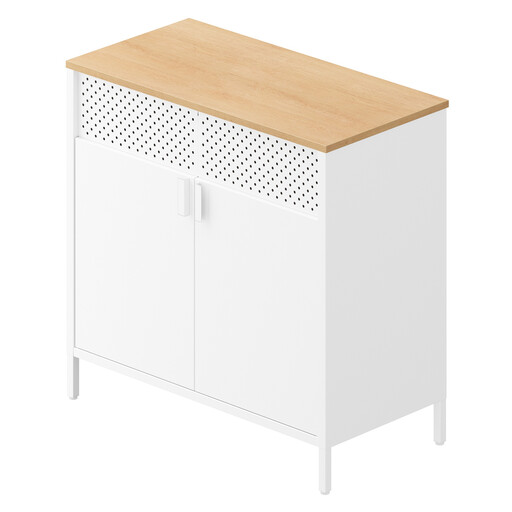
Why it suits this profile: This compact 80 x 40 x 76 cm model fits in a home office, dining room or smaller storage area. The adjustable shelf makes the layout suitable for items of different heights.
The dimensions and maximum load-bearing capacity are specified: the top is rated for up to 50 kg. The manufacturer states that it has a magnetic catch and supplies an anti-tip kit.
Steel cabinet body, easy-clean surface, one adjustable shelf and a perforated panel for ventilation and possible hooks.
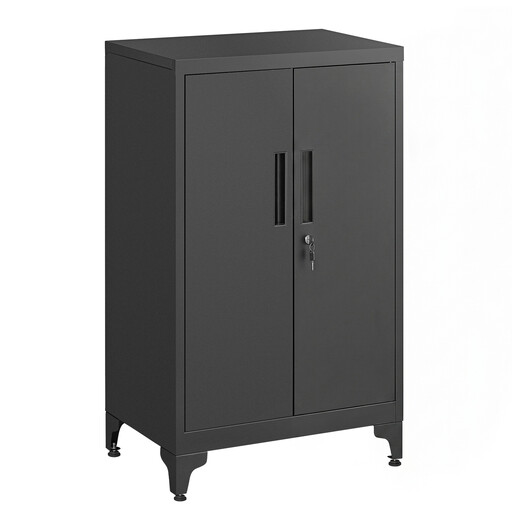
Why it suits this profile: Measuring 60 x 40 x 90 cm, with lockable doors, it is suitable for a garage, office or home where you want to keep tools and documents out of sight.
The product information specifies a steel lock with keys, adjustable shelves and an anti-tip kit. This means the locking system, layout and stability can all be checked in advance.
Steel construction, supporting up to 25 kg per adjustable shelf and 30 kg on the top. Adjustable feet can help when positioning the cabinet on a floor that is not completely level.
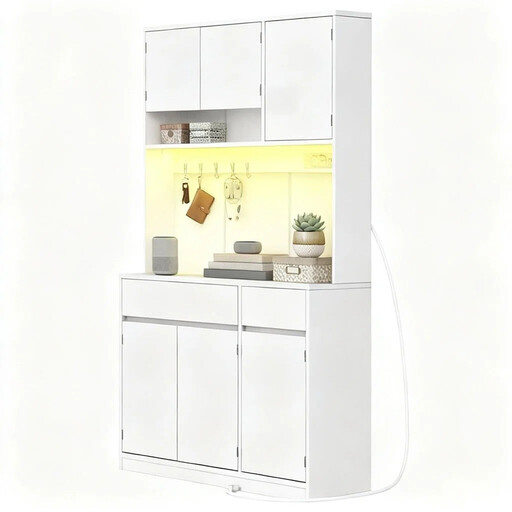
Why it suits this profile: This tall 40 x 100 x 180 cm model is designed for use in the kitchen and living areas, with room for crockery, provisions, small appliances and accessories.
The layout consists of adjustable shelves, two drawers and a bottom cupboard. Before assembly, check that the supplied power supply is compatible with your connection and intended use.
Two AC sockets, two USB ports, a 100 x 38,5 cm worktop and, according to the product description, 25 adjustable LED lighting modes.
Do not place a metal storage cabinet directly in front of a radiator or somewhere exposed to persistent moisture. In a garage, it is sensible to keep the cabinet slightly off a damp floor and check metal surfaces regularly for damage.
With a kitchen cabinet that includes storage, you need to take heat, grease and steam into account. Do not store electrical appliances so close together that their ventilation openings become blocked. A cabinet with sockets and LED lighting also requires extra attention to cable management, the load on the connection and protection from splashes.
Treat the stated load-bearing capacity as an upper limit, not a target weight. Distribute heavy items across several shelves and check after assembly that all the doors close properly. With a sideboard that includes storage, you should also check whether the top is suitable for a television, decorations or other equipment.
We’ve put together a complete, up-to-date list of products that fully meet these strict selection criteria and the applicable European safety regulations.
Yes, provided the cabinet is suitable for the garage’s dimensions and conditions. Check the material, ventilation, load-bearing capacity and protection against moisture. Position the cabinet securely and fix it to the wall if this is stated in the instructions.
Its lifespan depends on the load, assembly, moisture and maintenance. A steel cabinet is easy to clean, but scratches and damage can affect the surface. Use the cabinet within its stated load-bearing capacity and treat any damage in line with the manufacturer’s care instructions.
The electricity costs depend on the lighting’s power consumption and how long it is switched on. Sockets do not use electricity themselves when no device is plugged in. Before buying, check the lighting’s technical specifications and only connect devices within the permitted load.
