
Vandaag of morgen in huis

Kwaliteit gegarandeerd

Welkomstaanbiedingen ontgrendelen: GRATIS bezorging | Tot 80% korting | Gratis 30 dagen JoyPlus-proefperiode
Download de app
A kitchen knife set may seem straightforward to choose at first. But attractive photos, terms such as “professional” and a large number of pieces can give a misleading impression. A set with twenty knives isn’t automatically more useful than a compact kitchen knife set with three carefully chosen knives.
Look out for these three common pitfalls:
A stainless steel knife set is popular because stainless steel is relatively easy to care for. But look beyond the name alone. Product descriptions may specify high-carbon stainless steel, German stainless steel or a particular grade of steel such as 1.4116.
A full-length tang, also known as a full tang, extends into the handle. This can contribute to stability and even balance. Check how the handle is attached, too. According to the product description, the 5-piece Chef’s Knife Set has a handle made from red pakkawood, secured with three rivets.
A cutting angle of 15° per side is often specified for sharp kitchen knives. This tells you more than simply “sharp”, but it doesn’t tell you how long the knife will stay sharp with your use. A fine edge generally calls for careful cutting and regular maintenance.
The blade shape determines what you’ll use the knife for:
A non-slip handle can give you more control, especially when your hands are damp. Pay attention to the shape, weight and join between the blade and handle. An ergonomic claim in a product description is subjective: what feels comfortable to one person may feel too heavy or too large to another.
Also check whether hand-washing is recommended. Several sets in this guide advise washing by hand and drying carefully. Heat, moisture and contact with other items in a dishwasher can affect the edge and handle. Use a stable chopping board, and don’t use a standard kitchen knife to cut bones, frozen food or hard packaging.
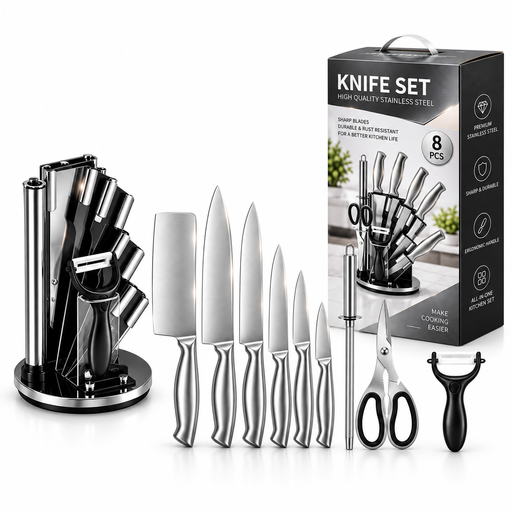
Why it suits this profile: This set combines several essential tools, including a chef’s knife, carving knife, fruit knife, sharpener, kitchen scissors and peeler. It’s a practical choice if you’re setting up your kitchen and would rather not buy each item separately.
The contents are clearly listed, so you can check in advance whether the accessories really suit your cooking routine.
Food-grade stainless steel, a V-shaped edge, non-slip hollow handles and a wide selection of tools for everyday food preparation.
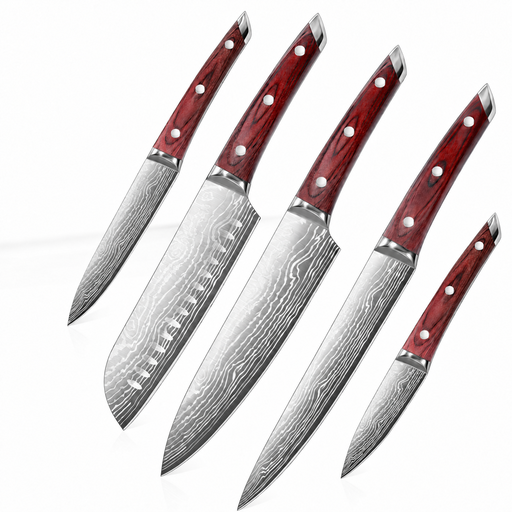
Why it suits this profile: This set is aimed at cooks who would rather use five carefully chosen knives than a large assortment. It includes a chef’s knife, Santoku knife, carving knife, utility knife and paring knife.
The product description lists the blade material, full-tang construction, three rivets and a 15° cutting angle. This lets you compare the key features before you buy.
High-carbon German stainless steel and red pakkawood handles; supplied in a gift box.
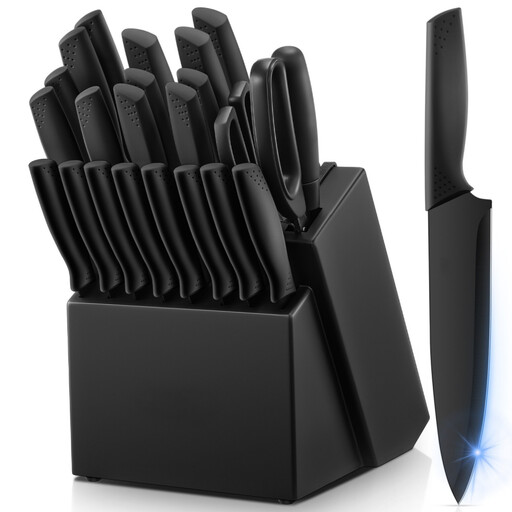
Why it suits this profile: For households that cook often and prepare a variety of dishes, this set includes steak knives, a bread knife, Santoku knife, carving knife, boning knife, cheese knife, pizza cutter and poultry shears.
The wooden knife block provides dedicated storage and, according to the product description, includes an integrated sharpener. Check that you have enough worktop space for a set with 23 pieces.
A wide selection of specialist knives, eight steak knives, kitchen scissors and poultry shears in one block.
We’ve put together a complete, up-to-date list of products that meet these strict selection criteria and the applicable European safety regulations.
A kitchen knife set will stay in good condition if you care for it according to the material and the manufacturer’s instructions.
Buying a knife set as a gift? Check the contents, the dimensions of the block and the care instructions. A compact set is often better suited to a flat, while a larger set needs more space.
For most households, a chef’s knife, bread knife and small vegetable or paring knife are a good starting point. A Santoku knife can complement a chef’s knife, especially if you often chop vegetables and herbs. Only choose extra knives if you’ll actually use them.
It depends on the steel, cutting angle, chopping board, cutting technique and care. There’s no set lifespan that applies to every kitchen. Careful, regular sharpening and hand-washing can help keep the edge in good condition for longer.
Not necessarily. An integrated sharpener is handy for basic maintenance, but the right sharpening method varies by blade. If you already own a suitable whetstone or honing steel, it may be better to give more weight to the quality and selection of the knives themselves.
