
Vandaag of morgen in huis

Kwaliteit gegarandeerd

Welkomstaanbiedingen ontgrendelen: GRATIS bezorging | Tot 80% korting | Gratis 30 dagen JoyPlus-proefperiode
Download de app
A pair of men’s trainers should look good, but above all, they need to suit the purpose you are buying them for. Lightweight trainers for commuting require different features from a model for basketball, running or long walks. If you focus only on colour, brand name or discounts, you could end up with footwear that fits poorly, wears out quickly or does not provide enough grip.
Not every trainer with a dynamic sole is suitable for running or intensive training. Casual men’s trainers are generally designed for everyday use. They do not automatically offer the support, cushioning or stability you need from men’s running shoes or basketball shoes.
Always check the product description. Does it clearly state that the model is designed for running, training or basketball? Before ordering, also check the sole, upper and fit.
An EU size can fit differently depending on the brand or model. A size 44 from one brand does not necessarily have the same internal length as a size 44 from another. Wherever possible, check the foot length or insole length in centimetres.
Measure your feet at the end of the day, wearing the socks you normally use. If you have wide feet or wear thick sports socks, check whether the model has a standard or roomy fit. With large-size trainers, it is particularly important to consider more than availability: check the actual size chart too.
Terms such as ‘breathable’, ‘durable’ or ‘comfortable’ do not mean much without technical context. A textile mesh upper may feel more breathable than fully synthetic material, but it often needs more care in wet weather and when cleaning. Men’s leather trainers can have a smart appearance, but they are not automatically suitable for intensive sport.
Always check the material composition, lining, insole and outsole. According to the manufacturer’s product information, a model may, for example, contain partially recycled materials; this does not automatically indicate anything about its overall lifespan or water resistance.
A lace-up fastening allows you to adjust the pressure around the instep. On sporty models, moulded details or a reinforced heel can provide additional support. A round toe generally offers more room than a narrow, tapered last, but the feel is ultimately personal.
If you are unsure, choose a model whose product page clearly states the fit, such as ‘regular fit’ or ‘standard fit’. If you fall between two sizes, follow the sizing information provided by the specific brand. For the PUMA Smash 3.0, for example, the product description recommends considering the larger size if your foot length falls between two sizes.
For everyday use in the Netherlands, a rubber or EVA outsole is practical, but the tread also affects how much grip you have on wet paving or uneven ground. A flat sole works well with many casual outfits, while a pronounced tread makes more sense for training or changing surfaces.
Quick changes of direction are important in basketball. According to the product information, the LI-NING Wade 808 5 Ultra V2 features a GCU rubber outsole, a carbon plate at the heel and a SUPER BOOM midsole. These features are intended for court use; treat such claims as product specifications rather than a guarantee of personal performance.
Textile and mesh are often lightweight, while leather, suede and synthetic leather have a different appearance and care routine. According to the product specifications, the Geox models in this selection combine leather or suede with textile mesh. For some models, the manufacturer recommends cleaning with a soft, damp cloth and advises against machine washing.
White men’s trainers show dirt more quickly than blue men’s trainers. That is not a problem if you are prepared to clean them carefully and regularly. For suede or leather, only use suitable care products and follow the washing and care label.
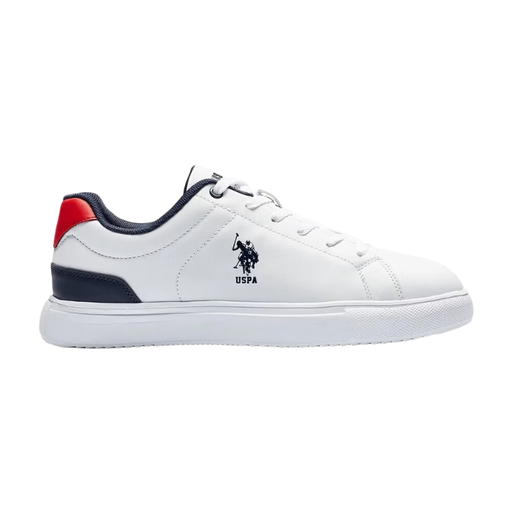
Why it suits this profile: This casual model combines white, dark blue and red with a standard width and lace-up fastening. It works well with jeans, chinos and everyday outfits.
The product information specifies a lightly cushioned insole and rubber sole. However, check that the standard width is suitable for your feet.
Synthetic leather with mesh, lace-up fastening, rubber sole and a versatile white-and-blue colourway.
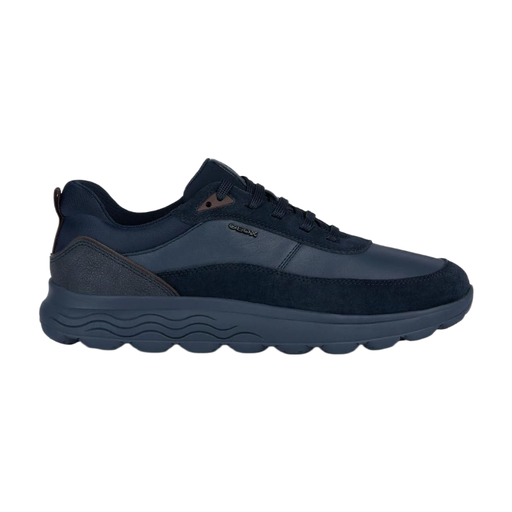
Why it suits this profile: The combination of Nappa leather and suede gives these blue trainers a smart appearance for commuting, casual occasions and smart-casual clothing.
The materials are clearly specified: 60% leather, 28% textile and 12% synthetic material in the upper. This makes it easier to understand the care requirements and choose where to wear them.
Nappa leather and suede upper, textile lining and a sole designed for shock absorption according to the product description.
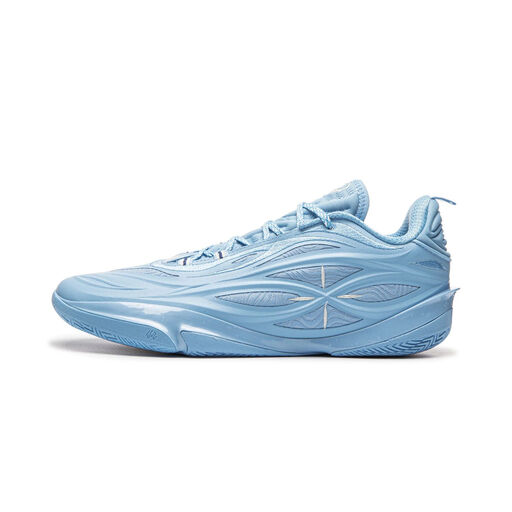
Why it suits this profile: This model is specifically designed for basketball and, according to the product information, features properties suited to quick cuts, jumps and stops on indoor and outdoor courts.
This is not a general lifestyle trainer with a sporty appearance, but a model with explicitly court-focused specifications. Check the fit if you wear thick sports socks.
SUPER BOOM midsole, carbon plate at the heel, GCU rubber outsole and a supercritical foam insole according to the product description.
For a lightweight combination of training and everyday use, consider PUMA men’s trainers from the Pounce Lite collection. The product information specifies ultra-light foam, a PROTREAD outsole and an upper containing at least 30% recycled materials. For example, take a look at the PUMA Pounce Lite in white, black, blue and orange or the navy Pounce Lite.
For a distinctive retro look, the Lacoste Storm 96 2K and the PUMA Smash 3.0 L are options worth comparing. According to the product description, the Smash 3.0 has a regular fit, leather and synthetic sections, and a SOFTFOAM+ insole. Before buying, always check the available size and material information for the variant you have chosen.
We have put together a complete, up-to-date list of products that fully meet these strict selection criteria and the applicable European safety regulations.
Choose a model with a secure, comfortable fit, an adjustable fastening and a sole suited to the surface you walk on. Casual models made from textile, synthetic leather or leather are generally suitable for everyday use. Do not automatically use them for running or basketball; for those activities, men’s sports shoes with a purpose-designed construction are the more sensible choice.
Their lifespan depends on walking distance, body weight, surface, materials and care. Regularly check the tread, heel and insole for signs of wear. Alternating between two pairs can give your footwear a rest, but it will not extend its lifespan indefinitely. Careful cleaning is important for leather and suede; according to the label, some models must not be machine washed.
Measure both feet in centimetres and use the larger measurement. Compare it with the brand’s size chart or the insole length shown on the product page. Take sock thickness and foot width into account. A wider foot may need more room in a standard-fit model, while a performance sports shoe may be designed to fit more closely.
