
Vandaag of morgen in huis

Kwaliteit gegarandeerd

Welkomstaanbiedingen ontgrendelen: GRATIS bezorging | Tot 80% korting | Gratis 30 dagen JoyPlus-proefperiode
Download de app
Choosing a new pair of men’s trainers seems straightforward. Yet many shoppers are disappointed after a few weeks by the wrong fit, a sole that wears out quickly or shoes that are less breathable than the product photo suggests. When ordering online, it is particularly important to look beyond colour, brand name and discount.
These three pitfalls are common:
With the right checks, you can compare men’s trainers more effectively based on use, materials, size and care.
For everyday wear, commuting and casual outfits, men’s casual shoes with a flat or lightly treaded rubber sole are usually practical. Look for a closed toe, secure lace fastening and an insole that does not feel immediately too thin.
If you run regularly, you need different features. With men’s running shoes, weight, cushioning, flexibility and the fit around the heel are all relevant considerations. A model for easy-paced road training does not need the same sole as men’s trail running shoes.
For woodland paths, mud and loose ground, a tread with clearly defined lugs is more important. Men’s walking shoes and Salomon trail running shoes are generally designed to provide grip and stability. Always check whether waterproofing is actually mentioned. A textile upper without a membrane is not the same as a waterproof construction.
The combination of materials determines how a shoe feels and how much care it needs.
With men’s black trainers, dirt may be less noticeable at first, but dust and salt marks can still show. A model with mesh panels, such as some Skechers men’s trainers, may be more breathable than one with a fully enclosed synthetic upper. According to the Skechers Track-Ripkent product description, this model has a lightweight upper with mesh panels, a rubber sole and a fixed Memory Foam insole.
An incorrect size is a common reason for returns. Measure your foot at the end of the day, when feet often take up slightly more room. Then compare the measurement with the size chart for the specific model.
Pay attention to the stated width:
If you are buying shoes for running or walking, take the socks you wear into account. A fixed insole can be comfortable, but gives you less opportunity to adjust the fit later. Also check whether the insole is removable.
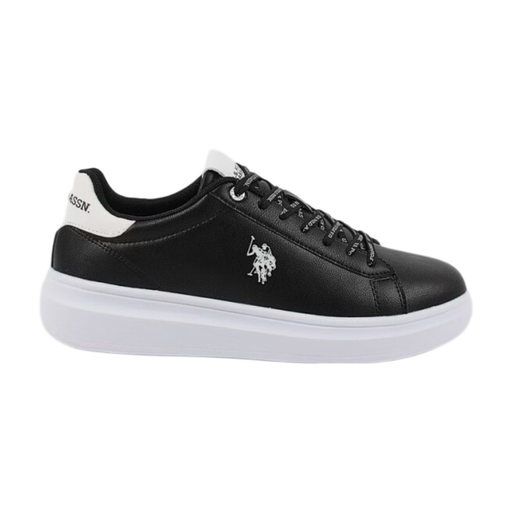
Why it suits this profile: A simple black model for everyday wear, shopping trips and casual outfits. The standard width and lace fastening make it straightforward to choose the right size.
The product information specifically mentions a lightly padded insole, mesh and synthetic leather. You therefore do not have to rely solely on the word “comfortable”.
Rubber outsole, closed toe and available in black. Designed for casual wear.

Why it suits this profile: Designed for walkers and trail runners who regularly cover wet or uneven ground.
The description mentions a GORE-TEX membrane, 3D Advanced Chassis, Quicklace and a Contagrip rubber outsole. These are measurable features for wet and technical routes.
Waterproof membrane according to the product information, reinforced toe and heel, plus grip on wet and dry surfaces.

Why it suits this profile: Suitable for users who switch between tarmac, park paths and rougher terrain and are looking for one versatile pair.
The product description specifies mesh and woven fabric, EVA foam and a ROCKYTEC rubber outsole. Both standard and slim fits are also listed.
Lightweight upper, EVA midsole and treaded outsole for changing ground conditions. Check the selected variant and size before buying.
We have compiled a complete, up-to-date list of products that fully meet these strict selection criteria and the applicable European safety regulations.
Lifespan depends on use, surface, body weight, care and materials. Do not wear a pair every day for intensive sport if the model was not designed for it. Let wet shoes dry at room temperature and avoid direct heat, as this can damage the glue and materials.
Clean textile and mesh carefully with a soft brush and a damp cloth. Some Skechers models state that they can be washed on a programme of up to 30 °C, while Vans Old Skool should not be machine-washed according to the product information. Always follow the care advice for the specific pair.
Not always. Casual trainers are designed for everyday wear and often do not have features specifically intended to handle the demands of running. Choose men’s sports shoes or running shoes when the cushioning, fit, weight and running surface suit your training.
There is no fixed timeframe. Look out for a tread that is becoming smooth, cracks in the upper, seams coming apart and a compressed midsole. With frequent running or trail running, replacement may be needed sooner than with light everyday wear.
The price varies according to the brand, materials, sole and technology. Do not compare the discount alone; consider the fit, care requirements, sole construction and suitability for how you intend to use them. This will help prevent a cheap pair from needing to be replaced quickly.
