If fibre is your priority, wholemeal Melba toast is a clear choice: Albert Heijn lists 9.7 g of fibre per 100 g for Van der Meulen Melba wholemeal toast. The multigrain version listed by Jumbo contains 7.5 g of fibre and 1.5 g of salt per 100 g, but includes wheat flour as well as wholemeal wheat flour. A 240 g pack of plain toast may be a better fit if pack size matters most. For every variety, check the latest allergen information and, if iodine is relevant to your choice, look for a mention of baker’s salt or iodised salt.
Who are these options for?
Shoppers looking for fibre and wholemeal options
You want crisp toast for a get-together or lunch and want to see how much fibre and wholemeal flour each variety contains. Albert Heijn lists 9.7 g of fibre per 100 g for Van der Meulen Melba wholemeal toast.
Shoppers looking for a pack that suits their needs
You enjoy Melba toast at different times and want to choose a pack size that you can use and store after opening. The AH Melba plain toast listed by Albert Heijn comes in a 240 g pack.
Shoppers who read labels carefully
You need to avoid certain ingredients or want to check the salt content and whether baker’s salt is listed. Allergens vary by variety; according to the Netherlands Nutrition Centre, using baker’s salt in baking is not compulsory.
What should you look for in Melba toast?
Wholemeal Melba toast
A good fit if: fibre and a clearly labelled wholemeal variety are your priorities. Albert Heijn lists 9.7 g of fibre per 100 g for Van der Meulen Melba wholemeal toast.
Keep in mind: the same product information lists 1.9 g of salt per 100 g and allergens including wheat, sesame and soya.
Multigrain Melba toast
A good fit if: you’re looking for a variety made with different grains. Jumbo lists 45% wholemeal wheat flour and 7.5 g of fibre per 100 g for Van der Meulen Melba Multigrain Toast.
Keep in mind: this variety also contains wheat flour. So, multigrain does not mean that all the flour used is wholemeal.
Plain Melba toast
A good fit if: you mainly want a larger pack for several occasions. Albert Heijn lists AH Melba plain toast in a 240 g pack.
Keep in mind: this plain variety contains 3.9 g of fibre per 100 g, compared with 9.7 g for the Van der Meulen Melba wholemeal variety mentioned above.
| What to consider |
What to look for |
Who it matters to |
| Fibre and wholemeal content |
Read the ingredients and compare fibre per 100 g. The word multigrain on its own does not confirm that the product is made entirely with wholemeal flour. |
When I choose toast for lunch, I want to be able to identify a wholemeal variety instead of relying on the front of the pack alone. This is the top priority for around 40% of shoppers. |
| Pack size |
Check the net weight and storage instructions for after opening. |
For several get-togethers, I want a pack I can use up without leaving opened toast for too long. Pack size matters most to around 30% of shoppers. |
| Label and ingredients |
Check the latest allergen declaration and salt content per 100 g. If iodine matters to you, look for a mention of baker’s salt or iodised salt. |
If I need to avoid an ingredient or want to know what kind of salt has been used, I need to be able to rely on the packaging. Checking the label is the main priority for around 30% of shoppers. |
Common mistakes
-
Assuming multigrain means entirely wholemeal
A toast made with different grains is not necessarily made entirely with wholemeal flour. For Van der Meulen Melba Multigrain Toast, Jumbo lists wheat flour as well as 45% wholemeal wheat flour.
Read the ingredients and compare the fibre per 100 g if wholemeal content is a deciding factor for you.
-
Choosing a large pack without considering how you’ll use it
A 240 g pack only makes sense for your shop if you can store and use the contents appropriately after opening.
Compare the net weight with the occasions you have planned, and follow the storage instructions on the pack.
-
Assuming baker’s salt means the product contains iodine
According to the Netherlands Nutrition Centre, using baker’s salt in baking is not compulsory. So you can’t tell what type of salt has been used simply because the product is toast.
Check the latest label for a mention of baker’s salt or iodised salt, and ask the manufacturer if you’re unsure.
-
Guessing allergens from the product name
The listed ingredients and allergens vary between the wholemeal, multigrain and plain varieties discussed here. A simple name such as ‘plain’ doesn’t tell you which grains or other allergens are present.
If you have an allergy, always read the latest ingredients and allergen declaration on the exact pack you’re buying.
Brands and product ranges compared
Van der Meulen Melba
The Melba toast range reviewed here includes wholemeal and multigrain varieties. Compare the information for each one, as their ingredients and nutritional values differ.
- Albert Heijn lists 9.7 g of fibre per 100 g for the wholemeal variety; Jumbo lists 7.5 g of fibre per 100 g for the multigrain variety.
- The multigrain variety listed by Jumbo contains wheat flour as well as wholemeal wheat flour. Check the packaging for allergens for both varieties.
Albert Heijn
AH Melba plain toast is an own-brand option if you’re looking for a 240 g pack.
- Albert Heijn lists a pack size of 240 g and 3.9 g of fibre per 100 g.
- The product information lists 1.93 g of salt per 100 g and ingredients including wheat, soya and barley.
Bolletje
A brand to consider if you’re also looking at crisp bread products other than Melba toast.
- Jumbo’s Bolletje range includes wholemeal crispbread, wholemeal breakfast crackers and wholemeal rusks.
- Crispbread, crackers and rusks are different products from Melba toast. Compare the ingredients and nutritional information for the product you’re actually choosing.
Melba toast in a larger pack
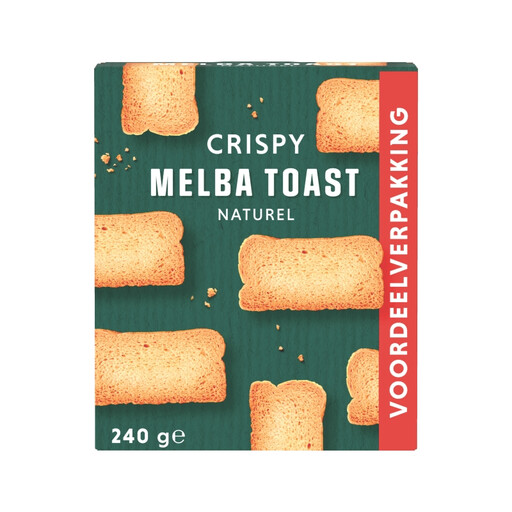
This 240 g pack of Melba toast is an option if a larger pack suits your planned get-togethers or lunches. If you’re specifically looking for wholemeal flour or a particular fibre content, check the nutritional information for this variety separately.
 No image available
Crispy Melba Toast 240 g
An option if you’re looking for a 240 g pack of Melba toast to enjoy on several occasions.
If you’re comparing fibre or salt, check the nutritional information per 100 g on the pack. If you have an allergy, check the latest allergen declaration. If iodine matters to you, look for a mention of baker’s salt or iodised salt.
View on Joybuy
Frequently asked questions
Is multigrain Melba toast automatically wholemeal?
No. For Van der Meulen Melba Multigrain Toast, Jumbo lists both 45% wholemeal wheat flour and wheat flour. So, if you want to know which parts of the flour used are wholemeal, read the ingredients.
Which of these Melba toasts contains the most fibre?
Of the three varieties compared here, Van der Meulen Melba wholemeal toast has the highest listed fibre content: 9.7 g per 100 g, according to Albert Heijn. Jumbo lists 7.5 g per 100 g for Van der Meulen Melba Multigrain Toast, while Albert Heijn lists 3.9 g per 100 g for AH Melba plain toast.
Does toast always contain iodine from baker’s salt?
No, you can’t tell from the type of product. The Netherlands Nutrition Centre says that using baker’s salt in baking is not compulsory. Check the ingredients for a mention of baker’s salt or iodised salt, and ask the manufacturer if you’re unsure.
How should I store an opened pack of Melba toast?
Follow the instructions for the variety you’ve bought. For AH Melba plain toast, Albert Heijn recommends storing it in a sealed tin after opening. Jumbo says to store Van der Meulen Melba Multigrain Toast in a cool, dry place.


