
Host serving a range of toppings
You want a crisp base for a variety of spreads, fish, cheese or vegetables, with the toppings taking centre stage. If you choose sesame or herb toast, you’re deliberately adding an extra flavour note.


For a variety of toppings, plain Melba toast is an obvious choice if you want a crisp base without a strong flavour. Choose sesame or herb toast when that extra flavour complements your toppings. If you’re specifically looking for medium-sliced bread to toast yourself, check the slice thickness on the bread packaging: the properties of Melba toast won’t tell you anything about that. For each option, compare the ingredients, allergens, nutritional information per 100 g and quantity per pack.
You want a crisp base for a variety of spreads, fish, cheese or vegetables, with the toppings taking centre stage. If you choose sesame or herb toast, you’re deliberately adding an extra flavour note.
You want to check the ingredients and allergens in a particular type of toast before serving it. A plain flavour doesn’t mean a product is suitable for someone with an allergy or intolerance.
You compare the number of toasts, individual packets and quantity per pack so you can buy enough without opening everything at once.
First decide whether you want to toast bread slices yourself or buy ready-made Melba toast. For a table with a range of toppings, choose based on flavour, the label and how much you need. The packaging of Melba toast won’t tell you how thick a slice of bread is.
| What to consider | What to check before buying | Who it matters to |
|---|---|---|
| Flavour with toppings | Compare plain toast with sesame or herb varieties; for small bites, check the shape and size too. | If you’re serving lots of different toppings, you’ll want toast that doesn’t overpower their flavour. Around 33% of consumers would choose a neutral base as their top buying priority. |
| Ingredients and allergens | Check the current ingredients list and any warnings about possible traces for each variety. | If a guest needs to avoid certain ingredients, I want to know whether the toast I’ve chosen is suitable before serving it. Around 27% of consumers would put this check first. |
| Nutritional information | Compare salt on a like-for-like basis, for example per 100 g, and check the label to see whether baker’s salt is listed. | When comparing varieties, I want to be able to compare the salt values without assuming anything about iodine from the word ‘toast’. This would be the top buying priority for around 20% of consumers. |
| Quantity and packaging | Check the number of toasts or packets, the quantity per pack and availability at your chosen retailer. | When catering for a group, I want to serve enough toast and keep unopened packets in reserve. Around 20% of consumers would base their choice mainly on this. |
The plain varieties examined from AH and Van der Meulen contain wheat, barley and soya, and warn that they may contain traces of sesame. A neutral flavour doesn’t make a product suitable for someone who needs to avoid these ingredients.
For every guest with an allergy or intolerance, check the current packaging for the variety you’ve chosen and, if necessary, choose an alternative that is confirmed as suitable.
According to the Netherlands Nutrition Centre, using baker’s salt is not compulsory. An organic label also doesn’t tell you whether a specific product is made with it.
If this information matters to your choice, check the ingredients list for baker’s salt or iodised salt.
A 240 g pack may be divided up differently than you expect: according to Albert Heijn, AH plain Melba toast contains twelve packets of six toasts. Availability also varies by retailer and sales channel.
Work out how many toasts you need and check how many individual packets are included. Then check whether the variety you’ve chosen is available through your preferred retailer.
Sesame or herbs add their own flavour, which may not work with every topping. A sesame variety also has a different allergen profile from toast that doesn’t contain sesame as an ingredient.
For a variety of toppings, start with a plain option and serve a flavoured variety separately only if its extra flavour suits part of the menu.
A range of Melba toast including plain, wholemeal, sesame and multigrain varieties, as shown in Jumbo’s range.
Own-brand range with a plain multipack and a separate organic sesame variety.
Own-brand range including a tomato and basil variety, alongside Van der Meulen products.
Plain Melba toast in a 240 g pack, as listed by ALDI Netherlands.
240 g of Melba toast, listed by Lidl as a store product.
If you’re looking for ready-made plain Melba toast as a base for different toppings, this product is a good fit. If you want medium-sliced bread to toast yourself, check the slice thickness and packaging separately.
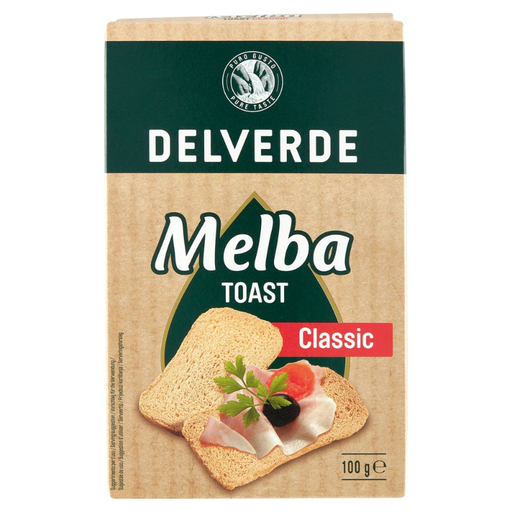 Image unavailable
Its neutral flavour makes this Melba toast a good option when you want to serve a range of toppings. The pack contains 100 g; if you’re serving guests with allergies, check the current ingredients and allergens on the label. Compare nutritional values, including salt, only when the quantity they refer to is clear, and check the number of toasts if you’re buying for a group.
No. According to the Netherlands Nutrition Centre, using baker’s salt is not compulsory. Check the ingredients list for the specific toast if you want to know whether it was made with baker’s salt or iodised salt.
Check the ingredients and any warnings on the current packaging for each variety. The plain AH and Van der Meulen products examined contain wheat, barley and soya, and warn of possible traces of sesame; the ingredients may differ in other varieties. The Netherlands Food and Consumer Product Safety Authority explains how allergens must be listed on labels.
Store opened Melba toast in a sealed container in a dry place, following the storage instructions on the relevant packaging. Albert Heijn recommends keeping its plain and organic Melba toast in a sealed tin after opening; check the instructions for other products.
No. An organic label doesn’t tell you whether the toast was made with iodised baker’s salt. According to the Netherlands Nutrition Centre, using baker’s salt is not compulsory, so check the ingredients of the specific product.