If you’re choosing melba toast for your summer holiday based on its sugar content, compare the amount per 100 g across similar types of melba toast rather than relying on a product name alone. Jumbo lists 3.2 g of sugars per 100 g for Van der Meulen Joy of Melba Toast Naturel Rondjes, but that figure alone doesn’t prove that it contains less sugar than a similar product. Check the ingredients, allergens and salt content too, and remember that toppings and dips aren’t included in the toast’s nutritional information.
Who might find this choice relevant?
Those comparing sugar in party toast
If you’re planning a get-together, picnic or stay in a holiday cottage, you might be looking for melba toast to serve with snacks and want to compare its sugar content. For similar products, compare the nutritional information per 100 g, as recommended by the Netherlands Nutrition Centre.
Holidaymakers mindful of allergens
If you’re buying toast for someone with a relevant allergy, the information on the current packaging is what matters. The melba toast described by Jumbo lists barley, soya and wheat, and may contain sesame.
Snack planners weighing up toast and crackers
You’re looking for something crunchy for breakfast, lunch or a get-together and wondering whether a cracker might work too. For small topped snacks, the shape of melba toast may matter; a cracker with a different nutritional claim isn’t automatically a suitable alternative.
What should you look for when choosing melba toast?
First decide whether you want small pieces of melba toast for snacks or whether a cracker would suit your needs too. Then compare sugars within a similar product type, and check the ingredients, allergens and salt content as well.
| What to consider |
What to look for |
Who should pay particular attention? |
| Sugars |
For similar types of toast, compare the ‘of which sugars’ value per 100 g. Check the ingredients list alongside the nutrition table. |
For party snacks, I want to choose toast based on its sugar content without different portion sizes skewing my comparison. Around 38% of consumers put this sugar comparison first. |
| Ingredients, allergens and salt |
Check the current allergen information and compare salt per 100 g if it matters to your choice. Jumbo lists barley, soya and wheat for Van der Meulen Joy of Melba Toast Naturel Rondjes, says it may contain sesame, and gives a salt content of 1.3 g per 100 g. |
When I’m taking toast for others, I want to be able to judge whether they can eat it, even if I like its sugar content. Around 37% of consumers prioritise ingredients, allergens and salt. |
| Shape and use |
Check whether you need small pieces of toast for toppings or dips, or a cracker for breakfast or lunch. Then check the sugars per 100 g again. |
For my holiday, I want to choose something that suits the occasion; a breakfast cracker won’t necessarily replace melba toast for snacks. Around 25% of consumers consider this the most important factor. |
Common mistakes when comparing products
-
Comparing sugars per portion only
Portion sizes can vary between packs. A lower figure per portion doesn’t show which similar type of toast contains less sugar for the same amount.
First compare the ‘of which sugars’ value per 100 g, as recommended by the Netherlands Nutrition Centre. Then consider the portion you actually plan to eat.
-
Assuming ‘lower carb’ means ‘less sugar’
Carbohydrates and sugars are different values in the nutrition table. Even if you’re considering a cracker as an alternative, a claim about carbohydrates doesn’t tell you how much sugar it contains.
First decide whether a cracker suits the occasion, then compare the sugars per 100 g on the current packaging.
-
Overlooking allergens and salt because you’re focused on sugars
A sugar figure doesn’t tell you whether the toast is suitable for someone with an allergy. The Van der Meulen toast described by Jumbo also contains 1.3 g of salt per 100 g.
Before buying, check the ingredients, allergen warnings and salt content on the current pack, especially if you’re buying for several people.
Brands and product ranges to consider
Van der Meulen / Joy of Melba
Joy of Melba Toast Naturel Rondjes is a 90 g pack of melba toast, suitable for things like topped snacks.
- For this specific product, Jumbo lists 3.2 g of sugars and 2.4 g of fibre per 100 g.
- Jumbo also lists 1.3 g of salt per 100 g, as well as barley, soya and wheat; it may contain sesame. The sugar figure alone doesn’t support a comparison with a product marketed as ‘lower sugar’.
Albert Heijn Huismerk
AH Melba toast naturel is an own-brand product in Albert Heijn’s melba toast range.
- Albert Heijn says that ingredients and nutritional values may change. Check the current packaging when comparing this product for sugars or allergens.
Bolletje
Bolletje Proteïn & Low carb Crackers are worth considering as an alternative if you don’t specifically need melba toast.
- The cracker shape may suit breakfast or lunch when you’re not looking for small pieces of toast for snacks.
- The ‘Low carb’ description doesn’t show how its sugar content compares with melba toast. Compare the nutritional information for each product separately.
Melba toast for toppings and dips at Joybuy
This selection features melba toast for toppings or dips. If sugars are your main concern, compare the nutritional information with that of other melba toast and check the allergen information too.
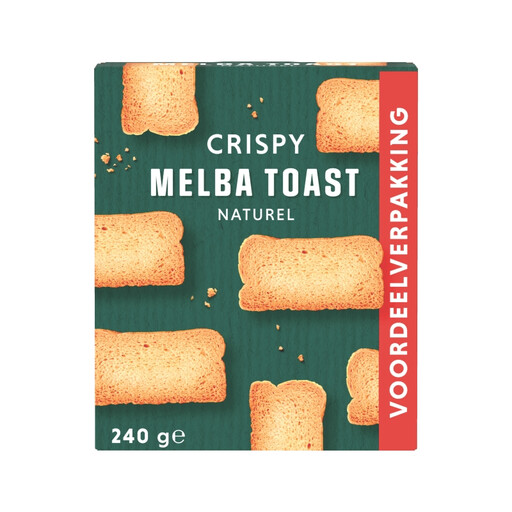 Image unavailable
Crispy Melba Toast, 240 g
Melba toast to consider if you’re looking for something to serve with toppings or dips.
Pack size: 240 g. Check the sugars and salt per 100 g on the current packaging.
The ingredients list includes wheat, barley and soya, and says it may contain sesame, but another allergen statement contradicts this. If you have an allergy, check the current label before buying.
View at Joybuy
Frequently asked questions
How do I compare sugars when packs of toast list different portion sizes?
For similar types of toast, compare the ‘of which sugars’ value per 100 g. The Netherlands Nutrition Centre recommends using this basis for comparison. Then consider your own portion size and what you plan to put on the toast.
Is Van der Meulen Joy of Melba Toast Naturel Rondjes automatically a lower-sugar product?
No, that doesn’t follow from the product’s nutritional value alone. Jumbo lists 3.2 g of sugars per 100 g for these rounds. To say they contain ‘less sugar’ than other toast, you need a suitable basis for comparison.
Which allergens are listed for Van der Meulen Joy of Melba Toast Naturel Rondjes?
Jumbo lists barley, soya and wheat, and says the product may contain sesame. If you have an allergy, always check the current packaging of the product you’re buying.
Does the Dutch rule on baker’s salt mean that all toast contains iodine?
No, it doesn’t mean that every type of toast contains iodine. According to the Netherlands Food and Consumer Product Safety Authority, iodine compounds may be present in bread, bread substitutes and other bakery products only through added baker’s salt. Check the product information for the specific type of toast.


