
Student who eats Melba toast regularly
You have Melba toast for lunch or as a snack, and want to choose a pack you can finish.


A small pack is a good choice if you’re a student who won’t eat much Melba toast after moving in. Only choose a larger pack if you can finish it and store it somewhere dry. If you eat Melba toast regularly, compare the fibre, salt and ingredients of the specific variety too.
You have Melba toast for lunch or as a snack, and want to choose a pack you can finish.
You’re not sure how much Melba toast you’ll eat in your new room and want to try a smaller pack first.
You check the ingredients, fibre, salt or allergens, so you look at the specific variety rather than just the brand.
First, work out how much Melba toast you’re likely to eat. Then check the label on the pack you’re considering.
| What to consider | What to look for | Who it’s relevant to |
|---|---|---|
| Pack size | Compare the pack size with how much you expect to eat and the storage space available. | After moving in, I don’t want to leave a large pack unfinished. Around 42% of consumers prioritise being able to finish the pack. |
| Nutritional information | If you eat it regularly, check the fibre and salt per 100 g and see what type of flour has been used. | If I often have Melba toast instead of bread, I want to know what’s in the variety I choose. For around 33% of consumers, nutritional information is the most important factor. |
| Ingredients and storage | Read the allergen information for the variety you’ve chosen and follow the storage instructions on the pack. | If I need to take an allergen into account or have little dry cupboard space, I should first check whether a pack will work for me. This is the main consideration for around 25% of consumers. |
Melba toast varieties differ in their ingredients, fibre and salt. This is especially relevant if you often have it instead of bread.
Compare the nutritional information per 100 g and read the ingredients list for the variety you want to buy.
The product category alone won’t tell you what type of salt has been used in a specific product.
If this matters to your choice, check the ingredients list on the pack.
Ingredients and allergens vary between varieties. You’ll also need to store a larger pack according to the instructions on the packaging.
Before buying, read the allergen information and check that you have a suitable, dry place to store it after opening.
According to ALDI Netherlands, Sun Snacks Melba Toast Original is available as a 240 g own-brand product.
Albert Heijn lists JP by Jos Poell Crispy Toast in a 100 g pack.
Jumbo lists Van der Meulen Melba toast in varieties including Original, Wholemeal and Multigrain.
This 100 g pack of Melba toast is a small option to consider if you’re not yet sure how much you’ll eat after moving in. Check that the ingredients and storage instructions suit your needs.
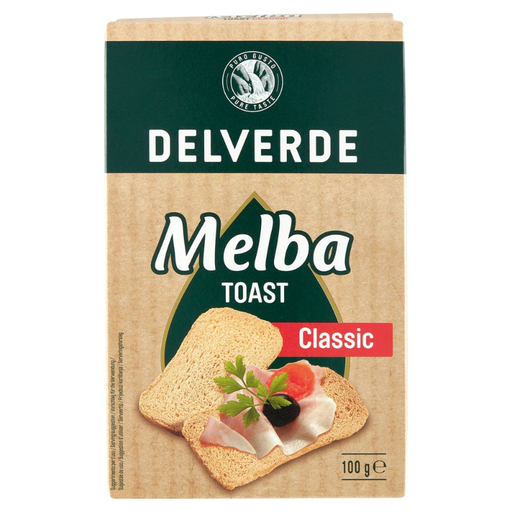 Image unavailable
An option if you want to start with a small pack of Melba toast. If allergens or regular use are a concern, check the ingredients and nutritional information on the pack.
Read the ingredients list on the specific pack. Don’t rely only on the product being labelled as Melba toast or on the brand name.
Compare the ingredients, fibre and salt per 100 g with those of the other products you’re considering for that meal. According to the Netherlands Nutrition Centre, a piece of Melba toast can only be called wholemeal if it’s made from 100% wholemeal flour; don’t rely on the name alone for a multigrain variety.
Follow the instructions on the pack and seal it well after opening. Before choosing a larger pack, check that you have a suitable, dry place to store it.
Always check the allergen information for the variety you’re buying. The listed JP by Jos Poell toast contains wheat and may also contain milk, egg and sesame; the listed Van der Meulen Multigrain variety includes oats, rye, sesame, soya and wheat among its ingredients.