
A small Italian-style gathering
You only need a limited amount of toast for one evening. Compare 100 g and 120 g packs with what you actually plan to serve.


Choose plain Melba toast if you want the toppings to provide a variety of flavours; choose flavoured toast if you want the toast itself to add flavour. For a small gathering, 100–120 g packs are a useful starting point, but how much you have left over will depend on what else you serve. Check the ingredients and allergens for the variant you choose.
You only need a limited amount of toast for one evening. Compare 100 g and 120 g packs with what you actually plan to serve.
You might want to pair tapenade, cheese or fish with toast that doesn’t add a pronounced herb flavour of its own. Plain Melba toast is a good fit.
You want the toast itself to contain ingredients such as tomato, garlic or rosemary. Compare the ingredients lists, as Italian-inspired varieties differ in composition.
First decide how much toast you need for the evening, and whether you want the topping or the toast itself to provide the flavour. Then check the ingredients and consider what you’ll do with any leftovers.
| What to consider | What to check before buying | Who should pay particular attention? |
|---|---|---|
| Amount for one evening | Compare the net weight in grams with the amount of toast you plan to serve; options include 100 g and 120 g packs. | I don’t want to open more toast than I need for a small gathering. Around 31% of consumers prioritise a small pack. |
| Flavour with toppings | Choose plain toast if the toppings should provide the flavour; for flavoured toast, check which ingredients give it its taste. | With a variety of toppings, I want to decide for myself which flavours go together, while flavoured toast can be a good choice with a simple dip. Flavour and topping combinations are a priority for around 31% of consumers. |
| Using it after the evening | Compare the contents of larger packs with your plans for using the toast next, and read the storage instructions. | If I’m serving toast again soon, a larger pack might suit my plans. For around 23% of consumers, being able to use it again later is the most important factor. |
| Ingredients and labelling | Check the allergens in the exact variant and, if you wish, compare the salt per 100 g. | If I need to avoid specific ingredients, I want to know what’s in this variant before I buy it. Checking the label is the top priority for around 15% of consumers. |
Toast packs are labelled by weight in grams. The products mentioned range from 100 to 250 g, so the front of the pack won’t tell you how much toast you’re taking home.
Compare the net weight with how you plan to use it. For one small gathering, 100 g or 120 g packs are a practical starting point.
The Scrocchi varieties at Albert Heijn have different ingredients: the mixed variety includes tomato, olive, rosemary and garlic, among others, while the sea salt variety has a different composition.
Read the ingredients list and decide whether you want a plain base for toppings or flavour in the toast itself.
The plain, multigrain and wholemeal varieties reviewed don’t all list the same ingredients and allergens. As well as wheat and gluten, sesame, soya, barley or oats may also be relevant.
Check the current label on the exact variant you’re buying, even if you know another product from the same brand.
You can’t tell which type of salt has been used in the toast from the product category or its Dutch origin.
If this ingredient matters to your choice, check the ingredients list on the pack or ask the producer.
Melba toast for toppings, including plain, multigrain and wholemeal 120 g varieties at Jumbo and Albert Heijn.
Stocks both Melba toast and Italian-inspired Scrocchi toast.
Lists Van der Meulen Melba Toast Naturel 120 g, among other products.
Stocks Sun Snacks Toast Cups Naturel 100 g, Melba toast 240 g and crisp wheat toast 250 g, among other products.
Lists party toast in pack sizes from 100 to 150 g, as well as Fornaccini, a thin 150 g toast for dipping.
Ciabatta Crackers Tomaat & Kruiden are an alternative if you’re looking for a seasoned cracker rather than classic toast.
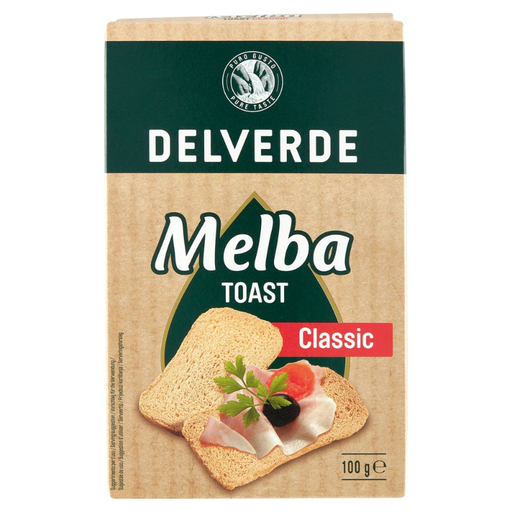
This 100 g pack of Melba toast is a good fit if you’re looking for a plain base for a variety of toppings at a small Italian gathering.
 No image available
Plain Melba toast to pair with a variety of toppings for a small gathering.
The pack contains 100 g. Check the ingredients and allergens on the pack if they’re relevant to your choice.
No, half a loaf isn’t a standard measure for toast. Compare the net weight in grams: for a small gathering, you could start with 100 g or 120 g and work out how much toast you want to serve.
Choose plain Melba toast if you want tapenade, cheese or another topping to provide the flavour. If you want the toast itself to have flavour even without a strongly flavoured topping, compare the ingredients in flavoured varieties; they differ from one another.
No, don’t infer the type of salt used from the product’s origin or name. Check the ingredients list on the exact pack if iodised baker’s salt matters to your choice.
Check the allergen information for the exact variety, starting with wheat and gluten. Sesame, soya, barley or oats may also be relevant in the Melba toast varieties reviewed; ingredients vary by product.
Follow the storage instructions on the pack you buy. The products reviewed recommend storing toast in a cool, dry place; some also advise keeping it in an airtight container after opening.