
Families who regularly have lunch together
If several people eat Melba toast on work-from-home days, a 240 g pack could be useful. Just consider whether you’ll use it all while the toast is still at its best.


For regular working-from-home lunches with several people, a 240 g pack of Melba toast is a practical option to stock up on, provided you use it up and can store it somewhere dry. A smaller wholemeal option may suit you better if you mainly want to compare fibre content. Whichever you choose, check the ingredients and allergens on the exact pack, as ‘plain’ and ‘wholemeal’ alone don’t tell you enough.
If several people eat Melba toast on work-from-home days, a 240 g pack could be useful. Just consider whether you’ll use it all while the toast is still at its best.
If you often use Melba toast as a lunch base, check the type of grain and the fibre content per 100 g. A wholemeal option may be a better choice than a larger plain pack, depending on what you’re looking for.
If you need to avoid certain ingredients, the current ingredients and allergen list is more important than the pack size or the name of the toast. Always check the variant and pack you’ve chosen.
First, work out how much Melba toast you’ll get through at lunchtime. Then compare the nutritional information and check the label on your chosen variant before buying.
| What to consider | What to check when buying | Who it matters to |
|---|---|---|
| Pack size | Compare the net contents of the 240 g and 120 g packs, and check whether you can reseal an opened pack properly and store it somewhere dry. | When several of us have lunch at home, I want to have enough toast in the cupboard without leaving a pack open for too long. For around 38% of consumers, having the right amount in stock is the top priority. |
| Fibre and type of grain | Check which grains are listed in the ingredients and compare the fibre content on a like-for-like basis, per 100 g. | When Melba toast is often the basis of my lunch, I want to know how much fibre the chosen variant contains. For around 37% of consumers, this takes priority. |
| Allergens and labelling | Check both ‘contains’ and ‘may contain’ on the exact pack. If needed, also look at the salt content per 100 g. | If I need to avoid wheat, soya or sesame, I need to be able to see which ingredients are in the product on the current packaging. For around 25% of consumers, checking the label comes first. |
A product listing doesn’t always tell you where you can buy the toast. Lidl lists its 240 g Melba toast as available in store only.
Check what’s available at the shop where you plan to do your food shopping before adding the toast to your list.
The wholemeal Melba toast described contains wheat, barley, rye, sesame and soya, among other ingredients. Jumbo also lists 1.9 g of salt per 100 g for Van der Meulen Wholemeal Melba Toast.
Use ‘wholemeal’ as information about the type of grain, not as a substitute for checking the allergen list and nutritional information.
Albert Heijn warns that ingredients, nutritional values and allergen information can change. A product page you viewed earlier may therefore not match the pack you buy.
If you have an allergy or intolerance, or need to choose products based on specific ingredients, check the label on the exact pack as well.
Plain and wholemeal Melba toast for shoppers who want to compare the ingredients as well as the pack size.
Plain Melba toast in a 240 g pack listed by Jumbo.
Supermarket own-label AH plain Melba toast in a listed 240 g pack.
ALDI own-label plain Melba toast in a listed 240 g pack.
An in-store option for a listed 240 g pack of Melba toast.
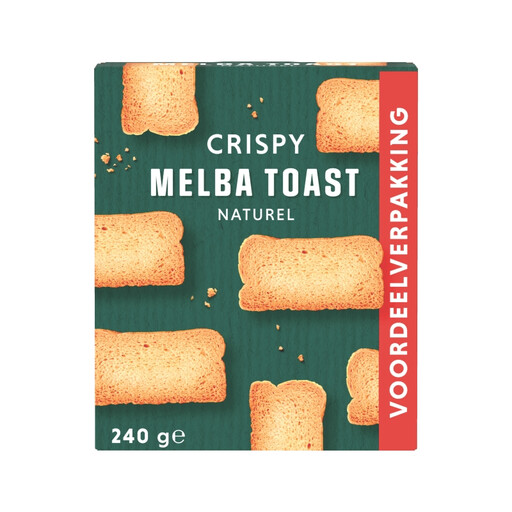
This 240 g pack of Melba toast could suit you if you’re looking for a larger pack for regular lunches with several people. Before choosing, check the information on the packaging, especially if ingredients or allergens are a deciding factor.
 No image available
The 240 g pack could be a good fit for regular working-from-home lunches with several people.
Reseal the pack properly after opening and store the toast somewhere dry. Check the ingredients and allergens on the packaging for this variant.
A 240 g pack is most useful if several people eat Melba toast regularly and you can store it properly after opening. Think about how much you actually use: a larger pack offers little practical benefit if it stays open for a long time.
No. ‘Wholemeal’ describes the type of grain used; it doesn’t mean the Melba toast is allergen-free. The wholemeal option described lists wheat, barley, rye, sesame and soya, among other ingredients. Always read the label on the variant you’re buying.
No, you can’t use that information to work out the iodine content of a specific Melba toast product. The Netherlands Food and Consumer Product Safety Authority explains that iodine compounds may be present in bakery products through baker’s salt. Check the ingredients on your chosen pack for baker’s salt or iodised salt, but don’t use this to infer an amount.
Follow the storage instructions on the packaging and reseal the pack properly after opening. The storage advice described for Melba toast recommends keeping it somewhere dry. Also check the best-before date and don’t use a damaged pack.