
Trainer with remote participants
Wants remote participants to be able to follow explanations, classroom questions and shared teaching materials. Speaking positions and audio pickup are important considerations.


Choose based on who needs to be on screen and where they are sitting: a webcam or compact USB video bar can suit an individual participant or a small group in front of the camera, while a central 360° camera may work well for conversations around a table. In a deeper room, a PTZ camera with optical zoom can help you frame the shot precisely. Also check the sound from the furthest speaking position, the connections and how teaching materials will be shared.
Wants remote participants to be able to follow explanations, classroom questions and shared teaching materials. Speaking positions and audio pickup are important considerations.
Wants to keep several participants in view and decide whether a front-facing camera or a central 360° setup around the table is the better fit.
Needs to decide whether trainers will start sessions from a laptop each time or whether the room will have a permanent installation, with suitable connections and platform settings.
Start with the seating and speaking positions. Then choose the camera angle or zoom, and check that the setup suits the way you teach.
| Consideration | What should you check? | Who is this important for? |
|---|---|---|
| Clear audio | Test the microphones from the furthest speaking position. Manufacturers describe microphone capabilities for specific setups, so check the sound in your own room. | If trainers and learners speak from different positions, I want to know whether everyone can be heard clearly. Around 30% of consumers prioritise sound from multiple speaking positions. |
| Keeping the group in view | Compare the seating positions with the stated field of view: Logitech lists 120° for MeetUp, Jabra lists 180° horizontally for PanaCast 50, and Owl Labs describes a 360° view for Meeting Owl 3. | If you want participants at the sides to remain in view, compare the camera angle with the actual seating layout. Around 30% of consumers prioritise framing that suits the group. |
| Showing the trainer or teaching materials | Check whether you need an overview, a targeted zoom or a separate view of teaching materials. AVer lists 12× optical zoom for the CAM520 Pro3; Jabra lists an integrated whiteboard camera for the PanaCast 50. | If the trainer moves around or uses a board, I want to be able to choose between a group view and a close-up of the explanation. Around 20% of consumers prioritise displaying teaching content. |
| Connection and management | Check whether the session starts via a computer or in a dedicated room mode, and what power supply the chosen version requires. Logitech describes several operating modes for Rally Bar Huddle; the HP Studio V12 ‘Without power supply’ version is supplied without a mains power cable. | If I need to manage the teaching computer or a permanent room installation, I want to know in advance how the session starts and what the setup requires. Around 20% of consumers prioritise connection and management. |
The camera sensor and video output are not the same thing. Jabra specifies panoramic output of 3840 × 1080 at 30 fps for the PanaCast 50.
Compare the output used by your meeting platform and check the picture in your intended setup, not just the sensor specification.
A wide shot does not tell you whether questions from the back of the room will come through clearly. Logitech’s product positioning and Owl Labs’ microphone specifications do not describe the acoustics in your room.
Test the furthest speaking position before deciding whether the built-in microphones are sufficient.
If people speak from different parts of the room, you may need an additional audio solution.
The Meeting Owl 3 is designed to capture the area around the camera, while a PTZ camera such as the AVer CAM520 Pro3 can frame a specific subject and zoom in optically.
Position the camera to suit the seating and walkways, and decide whether the trainer, the group or the board needs to be on screen most often.
According to HP, the ‘Without power supply’ version of the HP Poly Studio V12 does not include a mains power cable.
Before buying, check the exact version, power supply and included components.
For this specific version, a country-specific mains power cable must be purchased separately.
Logitech positions the MeetUp USB video bar for small rooms. According to Logitech, Rally Bar Huddle offers several ways to set up a room.
The PanaCast 50 is a panoramic video bar for groups seated across a wide area in front of the camera.
The Meeting Owl 3 is a central 360° camera for conversations around a table.
The CAM520 Pro3 is a PTZ camera for situations where you want to show the trainer, participants or board in a targeted shot.
HP positions the Studio V12 as a USB video bar for small rooms.
This selection includes webcams for use with a computer and PTZ meeting cameras. The right choice depends on the seating positions, the framing you want and the room setup.
 Image unavailable
A webcam option for a training session attended on a computer.
The product name lists 4K, a 99° field of view, a microphone and noise reduction.
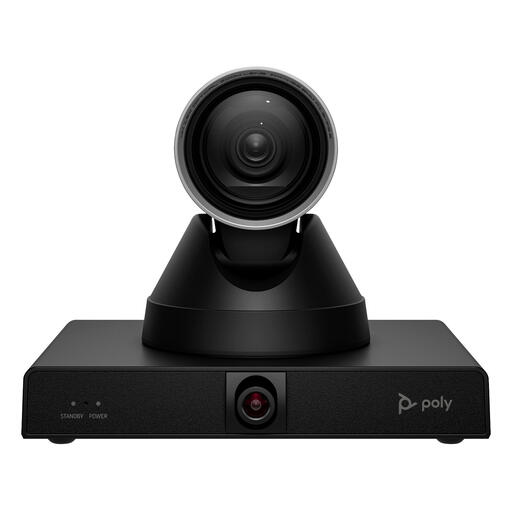 Image unavailable
Suitable for a setup where you want to frame a speaker at a distance.
The product name lists a 4K MPTZ camera with 12x optical zoom. The stated mounting and power options include a display, tripod or ceiling mount, and a 12V adapter or PoE+; plan your installation accordingly.
 Image unavailable
A webcam option for computer-based training; check in advance that this version suits your setup.
The product name lists an 8MP camera, autofocus, two built-in microphones and a privacy cover.
 Image unavailable
A USB video bar for a small room where sessions start from a computer.
Logitech lists a 120° field of view and built-in microphones for MeetUp. Its positioning for small rooms does not guarantee that every seat in a full classroom will be clearly in view.
 Image unavailable
A webcam option for computer-based training when automatic framing suits your preferred setup.
The product name lists 4K, a 1/2-inch sensor, autofocus, auto-framing, HDR and a microphone with AI noise reduction.
Not based on the field of view alone. Decide whether you need an overview of the group, targeted zoom or a separate view of digital teaching materials. AVer specifies optical zoom for the CAM520 Pro3; Jabra lists an integrated whiteboard camera for the PanaCast 50. How well it works depends on the setup you choose.
Before the session, test the connection, power supply, camera mounting, picture and sound from the actual seating and speaking positions. Also check the exact package: HP states that a country-specific mains power cable must be purchased separately for the ‘Without power supply’ version of the Poly Studio V12.
It depends on the version and the room. Logitech lists an optional expansion microphone for MeetUp; HP states that a mains power cable must be purchased separately for the specific ‘Without power supply’ version of the Poly Studio V12. Check the package and which accessories your setup requires.
First consider the purpose, privacy risks and applicable GDPR obligations. The Dutch Data Protection Authority states that a DPIA is mandatory when processing involves a high privacy risk. For publishing identifiable images of pupils aged 16 or over, the DPA sets out specific consent requirements. This rule on publication does not mean that the same consent requirement applies to every live lesson.