
Writers who revise frequently
If you write long passages and navigate your text often, look for a layout that keeps the arrow and function keys within easy reach.


Choose a layout that lets you write fluently and use the arrow keys to revise your work. Then check whether the keyboard fits alongside your mouse at your desk height. A compact board frees up space, quieter switches may suit a shared workspace, and a split model gives you more freedom to position each half. These choices may mean adapting to a different key layout or taking time to get used to it.
If you write long passages and navigate your text often, look for a layout that keeps the arrow and function keys within easy reach.
If you adjust your desk height, you’ll want to position your keyboard and mouse comfortably. The keyboard’s width can make a difference.
If you’re mindful of others, compare the switch type and typing noise rather than choosing on brand name alone.
Start with the layout you need for writing and editing, then consider the space available, noise levels and the connection you want.
| What to consider | What should you check? | Who should give this more weight? |
|---|---|---|
| Space and positioning | Measure the available width and check where your mouse sits at both sitting and standing desk heights. | If I want to keep my mouse close when I change the desk height, I’ll consider the keyboard’s width and positioning. Around 33% of consumers give space and positioning top priority. |
| Sound and typing feel | Check which switches come with the version you’re considering. If possible, try out the sound and feel in a similar workspace. | If I write in a shared space, I want a typing feel that suits me without making unnecessary noise for others. Around 25% of consumers prioritise sound and typing feel. |
| Layout for editing | Check the position of the arrow keys, function row and Delete key, as well as the key legends on the exact version. | When rewriting, I want the navigation keys close at hand and the right characters for my settings. Around 25% of consumers give the editing layout top priority. |
| Connectivity | Check whether the version is wired, connects via Bluetooth or uses a receiver, and whether it’s compatible with your devices. | If I switch between devices, I want a connection that suits my setup. Around 17% of consumers give connectivity and switching between devices top priority. |
Compact models don’t all position their keys in the same way. Awkwardly placed keys, such as the arrow keys or Delete, can make repeated text editing more difficult.
Check the layout and physical key legends on the exact version you’re considering, and check your software settings too.
Switch types vary. A dampened construction alone doesn’t tell you how loud the version you choose will sound.
Check which switches are included and, if possible, try out the typing noise in a similar workspace.
Product descriptions for the AJAZZ AK820 list different numbers of keys and switch types. The model name alone doesn’t make these versions identical.
Before buying, compare the full model name, layout, switches and connection type of the specific version.
The MX Mechanical range includes a full-size model and the more compact MX Mechanical Mini, both with low-profile mechanical keys.
The K8 Pro ISO has a compact TKL layout, Bluetooth, hot-swap switches and customisable keys.
The wired AK820 is a compact option with arrow keys, a function row and a rotary knob.
The F75 is a compact wireless option, while the Galaxy100 QMK/VIA has a larger 1800 layout.
A split mechanical model for anyone who wants to position each half of the keyboard independently.
This selection includes compact mechanical keyboards for writing and editing, as well as models with a number pad for anyone who regularly enters figures.
 No image available
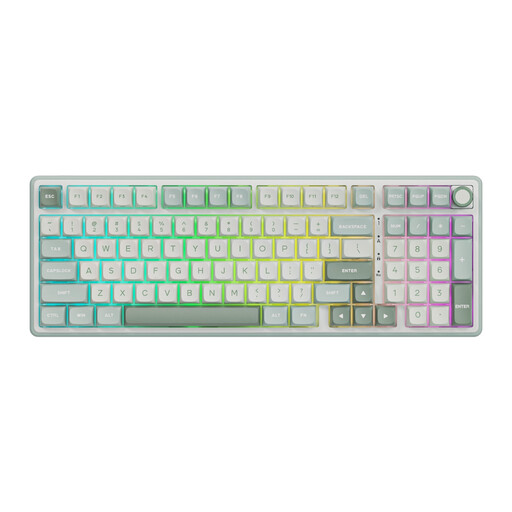
A wired version with a number pad for entering figures as well as text.
The title lists a number pad, hot-swap switches and Cream Switches.
 No image available
A compact 75% layout for anyone who wants to keep space free beside the keyboard.
The title lists a QWERTY US layout and three connection options: wired, Bluetooth and 2.4G.
 No image available
A compact wired version for anyone who wants to keep space free beside the keyboard.
The title lists a QWERTY US layout, 83 keys, hot-swap switches and linear switches.
 No image available
A compact layout with arrow keys and a function row for writing and editing.
The product description lists 82 keys. The title lists a QWERTY US layout, wired, Bluetooth and 2.4G connections, and Flying Fish switches.
 No image available
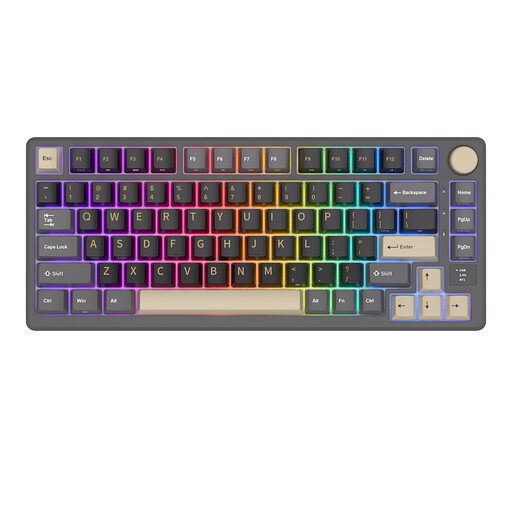
A compact 75% layout for anyone who wants to keep space free beside the keyboard.
The title lists 81 keys, Cream Switches, and Bluetooth, 2.4G and USB-C connections.
No. The Dutch regulations cited don’t require a mechanical keyboard. Arboportaal states, among other things, that for employees who work at a screen for more than 2 hours a day, the screen and keyboard must not be attached to each other. This requirement for employees doesn’t automatically apply to every individual writer.
Adjust your workstation to suit you again whenever you change your sitting position or desk height. According to Arboportaal, a narrow keyboard can leave room to position your mouse closer to your body. A different keyboard isn’t a substitute for varying your tasks and taking breaks.
You can only replace switches without soldering on a version designed for this; Keychron, for example, lists hot-swap switches for the K8 Pro ISO. To clean it, Keychron recommends using a soft brush or cotton bud between the keys, among other options. Follow your model’s instructions for removing keycaps and cleaning.
When a consumer buys online, there is generally a statutory 14-day cooling-off period after delivery, subject to legal exceptions. Your statutory guarantee also depends on what you could reasonably expect from the product. Any stated manufacturer’s warranty doesn’t replace these statutory rights.