What should you look for?
Start with noise and typing feel. Then check that the keyboard has the keys you use for writing and editing, and consider whether you need extra connectivity or customisation options.
| What to consider |
What to look for |
Who is this important for? |
| Typing feel and noise |
Check the exact switch type and variant. The name of a switch alone doesn’t tell you how loud the complete keyboard will be. |
If I write long pieces in a shared space, I want a satisfying feel without unnecessarily disturbing housemates or conversations. Around 33% of consumers prioritise typing feel and noise. |
| Layout and desk space |
Check the physical layout and whether it includes the arrow, function, navigation and number keys you use. |
If I need plenty of room for documents and a mouse while editing, I still want my usual keys within easy reach. Around 27% of consumers give layout and available desk space top priority. |
| Connecting to devices |
Check which connections and devices the model supports; compare wired use with the wireless options you need. |
If I work on text using more than one computer or tablet, I want to be able to switch easily between them. Around 20% of consumers prioritise connectivity and switching between devices. |
| Customisation |
Check whether you actually want to customise the layout or switches, and allow time to get used to a different layout. |
If I want to change my hand position or the feel of the switches, I look for features that suit me without assuming they’ll improve my health. Around 20% of consumers prioritise customisation. |
Keyboards at Joybuy
This selection includes full-size and compact mechanical layouts, with wired or multiple connectivity options. In particular, compare the keys you need, the switch variant listed and the connectivity of each model.
 Image unavailable
Ticktype DP104, full-size, 108 keys, Powder White
The full-size layout with 108 keys is a good fit if you’re looking for a comprehensive keyboard layout for writing and editing.
Hot-swappable linear switches; wired, Bluetooth and 2.4 GHz; US layout; 8000mAh; Powder White.
Joybuy
 Image unavailable
AJAZZ AK820 75%, 83 keys, Red Switch-Black
The 75% layout is a compact option if you want to use less desk space. Check that it includes the keys you need for editing.
Wired; hot-swappable linear switches; US QWERTY layout; 83 keys with volume knob; Red Switch-Black.
Joybuy
 Image unavailable
AJAZZ AK820 Pro 75%, tri-mode, Flying Fish Switch Purple
The 75% layout could be a good fit if you want a compact keyboard with several connectivity options. Check that the key layout suits your editing work.
Wired, Bluetooth and 2.4 GHz; hot-swappable; RGB backlighting; Flying Fish Switch Purple.
Joybuy
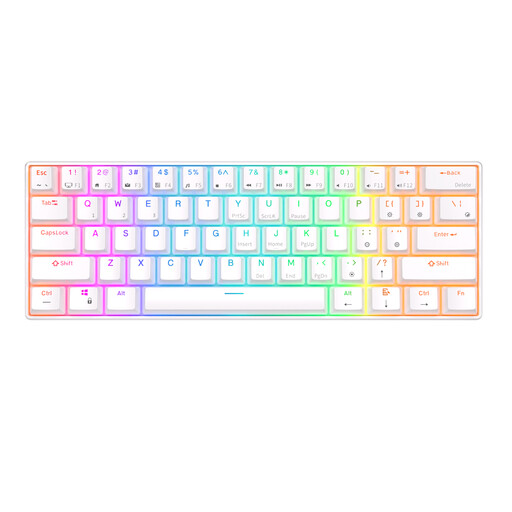 Image unavailable
RK ROYAL KLUDGE RK61 60%, 61 keys, Quiet Red Switch-White
The compact layout could be a good fit if you want to free up desk space. Before buying, check that the lack of dedicated keys won’t be a problem for your writing and editing work.
61 keys; tri-mode; hot-swappable; Quiet Red Switch-White.
Joybuy
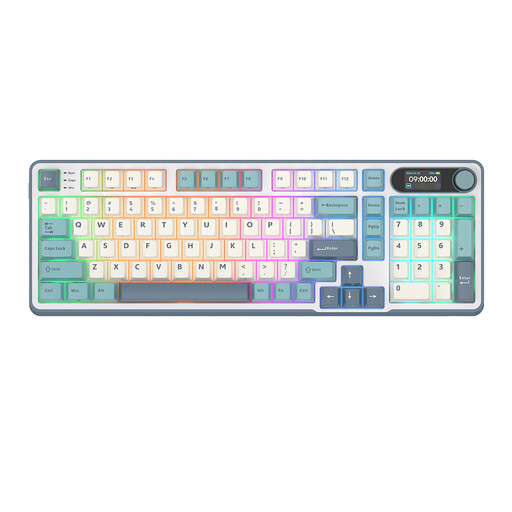 Image unavailable
RK ROYAL KLUDGE S98, Light Cloud, Snow Emperor Switch
The expanded layout with 98 keys could be a good fit if you want to keep plenty of keys within easy reach while writing and editing.
96% layout; 98 keys; wired, Bluetooth and 2.4 GHz; hot-swappable; Snow Emperor Switch.
Joybuy
Frequently asked questions
Do I need a keyboard with a number pad for editing?
Only if you use the number pad often. A full-size keyboard keeps it within easy reach, while a more compact layout can leave you with more desk space. Check the arrow, function and navigation keys on each model too.
How do I clean a mechanical keyboard?
Switch off or unplug the keyboard before cleaning it. Logitech recommends gently loosening any dirt and removing dust with short bursts of air. Follow the instructions for your specific model before removing keycaps.
What are my rights if a keyboard bought online isn’t right for me or breaks quickly?
For an online consumer purchase, you generally have a statutory 14-day cooling-off period from delivery, subject to legal exceptions, according to ACM ConsuWijzer. If a product breaks during normal use sooner than you could reasonably expect, the seller is responsible for the statutory guarantee; it isn’t automatically limited to two years.
Does Dutch law require a mechanical or ergonomic keyboard for working from home?
The Arboportaal guidance cited here doesn’t require a mechanical keyboard. For employees who spend more than 2 hours a day working with display screens, Arboportaal does say that the screen and keyboard must not be attached to each other. This requirement for employees doesn’t automatically apply to someone who writes at home solely for personal use.


