
Writers using one computer and two screens
You write on one screen and refer to or edit material on the other. In this case, a suitable key layout and enough room for your mouse and documents may matter more than switching between devices.


If you use both screens with one computer, you don’t need a keyboard that switches between devices for your setup. A compact keyboard can leave more room beside your mouse, while a larger layout can keep more keys within easy reach. For example, Logitech offers the MX Mechanical in both a standard and a more compact size. Also consider which switch type suits your workspace, and position your screens so you don’t have to turn or bend your neck unnecessarily, as advised by the Chartered Institute of Ergonomics & Human Factors.
You write on one screen and refer to or edit material on the other. In this case, a suitable key layout and enough room for your mouse and documents may matter more than switching between devices.
You want to choose a switch type that suits your preferred key feel and the space where you type. The exact version matters: the brand or model name alone doesn’t tell you what it will sound like.
You use the screens with separate computers and may want to switch one keyboard between them. If so, check which connections the keyboard and both computers support.
First, work out whether you use your two screens with one computer or two. Then choose a layout and switch type that suit your editing work and the space where you write.
| What to consider | What should you check? | Who is this important for? |
|---|---|---|
| Layout and desk space | Compare the position of the arrow, navigation and function keys, and decide whether you need a number pad. | If I often use navigation keys while writing, I want to know where they are on the keyboard and whether a more compact layout will work for me. Around 36% of consumers prioritise layout and space for writing and editing. |
| Key feel and sound | Check the exact switch type. A sound-dampening case doesn’t prove how loud the keyboard will be in your space. | In a shared space, I want to know which switches the keyboard has and whether their feel suits my preferences. Around 29% of consumers prioritise key feel and sound. |
| Workspace setup | Check that the keyboard and mouse are comfortably within reach and that you can view both screens without turning or bending unnecessarily. | With two screens, I want to position my keyboard and mouse comfortably and view both screens with ease. This is the top priority for around 21% of consumers who want to sort out their workspace setup first. |
| Switching between computers | Work out how many computers you use and check which connections the keyboard supports for each device. | If my screens are connected to two separate computers, switching between them with one keyboard could be useful. With one computer, it isn’t a deciding factor. Around 14% of consumers prioritise switching between devices. |
A feature for switching between devices won’t help if both screens are connected to the same computer.
Map out your connections before comparing models with a switching feature. Only consider this feature if you really do switch between computers.
The switch type and the way you type also play a part. A manufacturer’s description of sound dampening isn’t a measurement of how the keyboard will sound in your room.
Check the exact switches and, if possible, try the keyboard in a similar space.
Models with similar names can differ in layout, switches and connectivity, so don’t compare just the model range.
Check the full model name, key layout, switch type and connectivity options on the product page.
The MX Mechanical range includes standard and more compact sizes, with a choice of switch types.
The K3 Max is a compact, low-profile option with several connectivity choices.
The F75 is a 75% model with a rotary knob and several connectivity options.
The AK820 is a compact wired option; the AK820 Pro is a separate model with different connectivity options.
The MX 2.0S is a wired mechanical option for use with one fixed computer.
This selection includes compact 60% and 75% models, as well as a full-size keyboard, with both wired and several other connectivity options. Focus on comparing the layout and switch type with the way you write, and check whether you want to switch between computers.
 Image unavailable
A compact layout to consider if you want to leave room beside your keyboard; check that the key positions suit your editing work.
75% layout; QWERTY US; Reaper Switch; wired, Bluetooth or 2.4 GHz.
 Image unavailable
An option to consider if you’re looking for a full-size layout; the switch name doesn’t measure how loud the keyboard will be in your space.
108 keys; QWERTY US; Silent Tactile Switches; tri-mode connectivity; 8000mAh battery.
 Image unavailable
A compact wired option for use with a fixed computer; compare the key layout and linear switches with your preferences.
75% layout; 83 keys; QWERTY US; linear switches; hot-swappable.
 Image unavailable
A compact option to consider if you want several ways to connect; check which connection suits each device you use.
75% layout; 82 keys; QWERTY US; wired, Bluetooth or 2.4 GHz; hot-swappable.
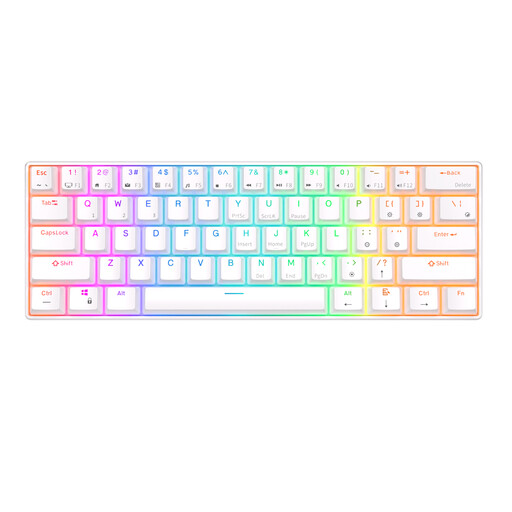 Image unavailable
A very compact layout to consider if desk space is important; check that the key positions suit the navigation you use while writing.
60% layout; 61 keys; tri-mode connectivity; Quiet Red Switch. The switch name isn’t a sound measurement.
No, not just because you use two screens. Switching matters if you type on separate computers. Check which connections your setup and the keyboard support.
Position the screens so you don’t have to turn or bend your neck unnecessarily. The Chartered Institute of Ergonomics & Human Factors recommends angling multiple screens slightly towards you and keeping your keyboard and mouse within reach. This is workspace guidance, not a claim that a particular keyboard prevents discomfort.
Only if your chosen version supports hot-swapping and the replacement switches are compatible. Keychron lists this feature for the RGB hot-swappable version of the K3 Max, so check the exact version.
Arboportaal states that for employees who work with a screen for more than 2 hours a day, the screen and keyboard must not be attached to each other. This requirement applies to the employee situation described; don’t automatically apply it to personal use.
According to the Dutch government, distance purchases usually come with a 14-day cooling-off period; conditions and exceptions may apply. In addition, if there’s a problem with the product, the seller must provide a solution under the statutory guarantee.