
Writers with limited desk space
If you want to keep a manuscript or notes beside your keyboard and move easily through text, compare 75%, 65% and TKL layouts. Consider both the layout and the model’s actual dimensions.


Start by considering the space available on your desk and the keys you use when editing. A 75% layout usually retains the arrow keys and function row, while a 65% layout is more compact but does away with the separate function row. Then check the exact key layout and connectivity, and choose a switch to suit your surroundings. A compact size or a label such as ‘Quiet’ won’t, on its own, tell you how the keyboard sounds or feels.
If you want to keep a manuscript or notes beside your keyboard and move easily through text, compare 75%, 65% and TKL layouts. Consider both the layout and the model’s actual dimensions.
If other people are working or resting nearby, the switch type is an important consideration. A label such as ‘Tactile Quiet’ isn’t an independent sound measurement and doesn’t guarantee that the entire keyboard will be quiet.
A familiar layout and typing feel may be important. A low-profile design may be a personal preference, but it’s no substitute for setting up your workstation properly and varying your posture.
For writing a synopsis at a small desk, first weigh up the space available and the keys you need when editing. Then consider the sound, layout and typing feel.
Best for: keeping the arrow keys and separate function row on a small desk.
Bear in mind: there’s no number pad, and keys may be close together. Check the position of Delete and other editing keys.
Best for: when every centimetre counts and you rarely use the function row, or can access its functions using key combinations.
Bear in mind: there’s usually no separate function row. Also check the precise position of the navigation keys.
Best for: when you don’t need a number pad and would prefer more space between the key groups than on a tightly packed 75% keyboard.
Bear in mind: it usually takes up more room than a 75% model. Compare the specific model’s dimensions with your desk space.
Best for: when having an integrated number pad for your work matters more than the extra space it takes up.
Bear in mind: on a small desk, the number pad can leave you with less working space. Measure the model before you choose.
| Consideration | What to look for | Who it matters most to |
|---|---|---|
| Space and navigation | Measure the available width and depth; check the arrow keys, function row and Delete key on the exact layout. | If you want to keep a manuscript and notes beside your keyboard but use navigation keys while editing, the layout matters a great deal. Around 36% of consumers prioritise space and navigation. |
| Typing noise | Check which switch type is included and, if possible, try that version. | If you write while other people are working or resting, you’ll want to know how your chosen version sounds, and noise may matter more than lighting. Around 29% of consumers prioritise typing noise. |
| Layout and connectivity | Check the letter, Enter and navigation key layout, the operating system and the connections you need. | If you switch between devices or need familiar key positions, you’ll want to know in advance whether the version is right for you. Around 21% of consumers prioritise layout and device compatibility. |
| Typing feel and customisation | Check the switch type and whether that specific version supports hot-swapping. | If your preferred typing feel or the ability to change switches is a deciding factor, check the full version details. Around 14% of consumers prioritise typing feel and customisation. |
A smaller keyboard may leave out keys you use for editing text.
Compare the exact layout with the tasks you do often, and measure the space available on your desk.
According to Keychron, hot-swapping on the Keychron K3 Max is supported only by the RGB Backlight Hot-Swappable version.
Check the full version name and supported switches before assuming you can replace them later.
You may need a different version or to buy switches separately later.
A switch label or manufacturer description won’t tell you how loud the complete keyboard sounds when you type.
Choose your preferred switch type carefully and, where possible, try the exact version.
The Ducky OK-M product page lists both multiple connection modes and ‘wired only’.
If you need wireless connectivity, ask for confirmation of the full model number before choosing.
The K3 Max is a low-profile 75% model for anyone who wants to keep the arrow keys and function keys on a compact desk. Keychron lists its dimensions as 306 × 116 mm.
The MX Mechanical Mini is a compact, low-profile mechanical option for writing across multiple devices.
The KW X ULP 2.0 MINI is a compact mechanical model without a number pad, with a low-profile design and multi-device connectivity.
The OK-M range includes a 75% version and may be worth considering if you’re looking for replaceable switches.
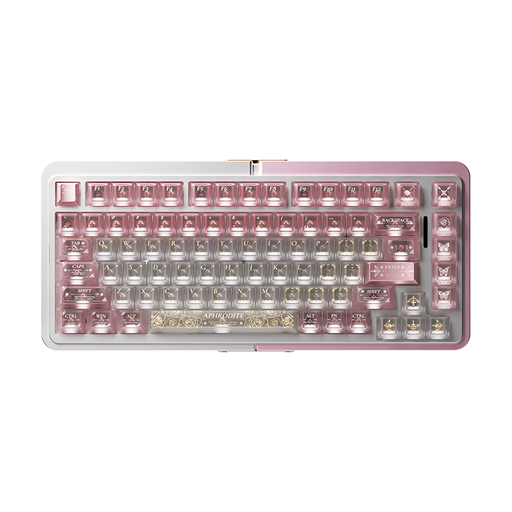
This selection features mechanical keyboards with a 75% layout for a compact desk.
 No image available
A 75% model for anyone looking for a compact layout for a small desk.
The product name lists a US QWERTY layout, a Reaper switch and tri-mode connectivity: cable, Bluetooth and 2.4 GHz.
 No image available
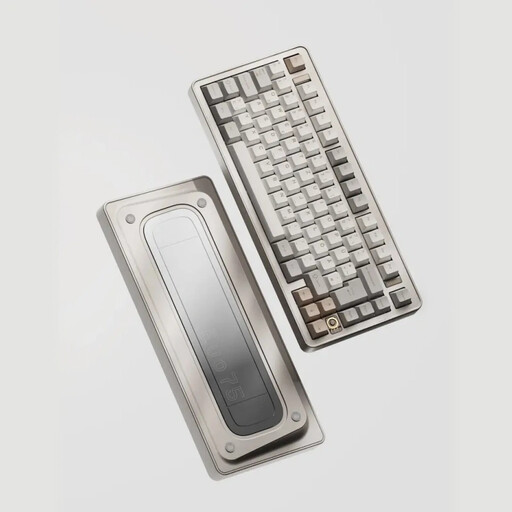
A 75% model to consider if you’re looking for a compact keyboard with a wired connection.
The product name lists TTC Magnetic HE switches, hot-swappable switches and a wired connection.
 No image available
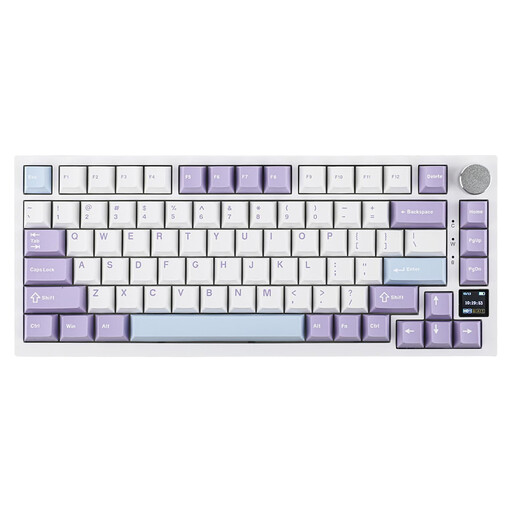
A 75% model for anyone looking for a compact layout and a choice of connection options.
The product name lists tri-mode connectivity, a US layout and hot-swappable Creamy Rye switches.
 No image available
A 75% model to compare if you’re looking for a compact keyboard with multiple connection options.
The product name lists tri-mode connectivity, a US layout and hot-swappable Flying Fish switches.
 No image available
A 75% model for anyone looking to compare compact layouts and multiple connection options.
The product name lists US QWERTY, hot-swappable switches and connectivity via cable, Bluetooth or 2.4 GHz.
No, not if you need the keys that have been left out. A 60% layout usually lacks a separate arrow-key cluster and function row, too. Choose a smaller size only if you can work without those keys or access their functions using key combinations. Check the exact layout.
Make sure there’s room for your mouse and papers beside the keyboard, and set up your workstation so you can sit comfortably. Arboportaal recommends a relaxed posture with neutral joint angles as a starting point, and advises paying attention to your workstation. A low-profile keyboard on its own doesn’t prove that your posture will be better.
Keychron recommends using a brush or cotton bud between the keys, and says you can carefully use a small amount of isopropyl alcohol for stubborn dirt. Follow your own model’s instructions, too, and don’t take the keyboard apart without good reason.
For a standard online consumer purchase, you’ll usually have a legal cooling-off period of up to 14 days after delivery, subject to legal exceptions. ACM ConsuWijzer explains that the seller is also responsible for the statutory guarantee if a product doesn’t perform as you could reasonably expect under normal use. In the Netherlands, there’s no single fixed time limit that applies to this guarantee in every case.
Not every writer is. Arboportaal describes a workplace rule for employees who use a screen for more than 2 hours a day: the screen and keyboard must not be attached to each other, so a separate screen or keyboard can be used with a laptop. This rule shouldn’t automatically be applied to personal use.