
Writers with limited desk space
If you need to fit a screen, paper and perhaps a mouse on a small desk, consider a keyboard without a number pad.


Start with the desk space available and the keys you want to use straight away when writing and editing. A compact layout can free up room, but the smallest sizes don’t always have separate arrow and function keys. Then consider the feel and sound, and check the exact variant, keyboard layout and connection before buying.
If you need to fit a screen, paper and perhaps a mouse on a small desk, consider a keyboard without a number pad.
If you don’t want to disturb others, consider both the switch and the keyboard case when choosing how much sound is acceptable.
If you often use the arrow keys, function keys or keyboard shortcuts while rewriting, choose a layout that keeps those keys easy to reach.
First, measure the space for your keyboard and the room you want for your mouse. Then compare the keys you use when editing, the sound and the exact version.
TNO points out that a narrower keyboard can leave room to position the mouse closer to your body. Hardware Info’s size comparison explains that 60% and 65% layouts are smaller than 75% layouts, but may not have certain keys as separate keys.
| What to consider | What to look for | Who should consider this? |
|---|---|---|
| Size and mouse space | Measure the available width and depth; check the dimensions and whether the layout has arrow and function keys. | If I want to use a mouse alongside my keyboard and have limited desk space, I’ll focus on the width. Around 36% of consumers put space first. |
| Sound while writing | Check which switch is fitted and whether the case is dampened on the exact version you’re considering. | If I write in a shared space, I want to know how much of the keystroke others might hear. Around 29% of consumers give sound the greatest importance. |
| Key feel and editing keys | Check the exact keyboard layout and switch option; think about which keys you use most when rewriting. | If I edit lots of sentences, I want arrow and function keys to be readily available and a key feel that suits me. Around 21% of consumers prioritise these editing keys and key feel. |
| Layout and connection | Check the physical keyboard layout, compatibility with your device and the available connection options. | If I need familiar punctuation key positions or want to use a specific connection, I’ll check the full product description for the variant. Around 14% of consumers prioritise layout and connectivity. |
A compact label doesn’t tell you which keys are present as separate keys. A layout without keys you use often may require extra key combinations while writing.
Check an image of the exact keyboard layout and measure your available space before choosing a size.
If the editing keys you want are missing, having to switch to key combinations can make writing and editing more cumbersome.
Sound depends on more than just the type of switch. CHERRY describes its MX Blue as audibly clicky and says the MX Silent Red has sound damping; this doesn’t tell you how loud a complete keyboard will be.
Check which switches are actually fitted to the version you’ve chosen and whether the manufacturer provides information about case damping.
The same model name can refer to different physical layouts or switch options. For example, the K3 Max is available in separate layouts, while the MX Mechanical Mini has different switch variants.
Compare the full product description for the variant and the image of the keys before ordering.
Different key positions or a key feel you weren’t expecting can make the keyboard less familiar to use.
The K3 Max is a low-profile 75% range for anyone looking for a compact layout with arrow keys.
The MX Mechanical Mini is a low-profile keyboard for a compact workspace.
According to CHERRY, the KW 300 MX is a compact version with mechanical MX2A switches.
The Air75 V2 is a low-profile mechanical keyboard with a 75% layout.
The Apex Pro Mini represents the 60% option for anyone who prioritises a very small layout.
This selection includes compact 75% and TKL mechanical keyboards for a small writing space. Check the physical keyboard layout and variant for each product.
 No image available
The 75% layout is designed for a compact workspace and, according to the product description, retains essential navigation keys.
Tri-mode: wired, Bluetooth and 2.4 GHz. Reaper switches. US QWERTY layout.
Check that the US layout suits your preference.
 No image available
According to the product description, the 75% layout retains arrow and function keys, which is useful if you want to use them straight away while editing.
Tri-mode: wired, Bluetooth and 2.4 GHz. Flying Fish switches. US QWERTY layout.
Check that the US layout suits your preference.
 No image available
This wired 75% version is a good fit if you want a compact layout for a permanent workspace.
Linear hot-swappable switches. Gasket mount. US QWERTY layout.
Check that the US layout suits your preference.
 No image available
The 75% layout is designed for compact typing while keeping separate navigation keys.
Wired, Bluetooth and 2.4 GHz. Hot-swappable switches. PBT keycaps. US QWERTY layout.
Check that the US layout suits your preference.
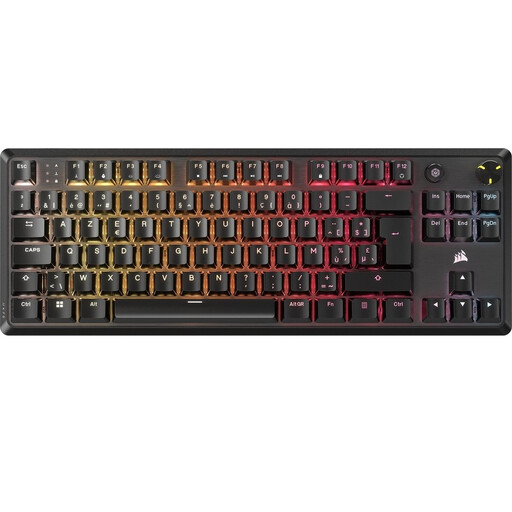 No image available
The TKL layout removes the number pad, making it a good option if you don’t need one and have enough desk width.
MLX Red switches. Belgian AZERTY layout.
Check that the Belgian AZERTY layout matches your preference.
A 75% layout makes more sense if you want separate arrow keys and a function row. According to Hardware Info’s size comparison, 60% layouts don’t have these as separate keys. Always check the layout of the specific model before buying.
First, measure the keyboard and the space available, then position your mouse so you don’t have to reach unnecessarily far. TNO recommends varying your posture and tasks; a smaller keyboard alone won’t prevent discomfort.
It depends on the model. Keychron lists 2.4 GHz, Bluetooth and wired use for the K3 Max; CHERRY lists Bluetooth and cable connectivity for the KW 300 MX. Check the version you’ve chosen and your device’s connection.
According to ACM ConsuWijzer, consumers buying online generally have a statutory cooling-off period of up to 14 days after delivery. Check the applicable terms for trying and returning the product. If a product breaks during normal use sooner than you could reasonably expect, ACM ConsuWijzer also explains your statutory guarantee rights with the retailer.
Not just because you’re writing a personal essay at home. For employees who work at a screen for more than 2 hours a day, Arboportaal explains that the screen and keyboard must not be attached to each other. Whether this rule applies to you depends on how the equipment is being used for work.