
Same-day & Next-day Delivery

Quality Guaranteed

Unlock Your Welcome Offers: FREE Delivery | Up to 80% OFF | Free 30-day JoyPlus trial
Download the APP
A mattress vacuum cleaner for dust mites can help remove dust, hair and loose dirt from mattresses and other fabric surfaces. However, many households choose a device based on one eye-catching figure or marketing claim. This can result in an impractical appliance, rapid loss of suction power or features that are rarely used in practice.
This buying guide compares the features that really matter: suction power, brush action, filtration, UV-C, hot air and maintenance. The stated performance is based on product information from the manufacturer or seller; it is not a guarantee of a particular result against allergies or dust mites.
A higher Pa rating sounds appealing, but suction power is not the only deciding factor. The brush design, airflow, filter and contact with the fabric all affect how effectively dust is picked up. A mattress vacuum cleaner with a high theoretical rating may still be less practical to use if the brush does not make proper contact with the surface.
So, as well as Pa, compare:
According to a brand’s product description, a UV-C mattress cleaner can contribute to disinfection or help reduce microorganisms. This does not automatically mean that all dust mites will disappear from a mattress. The lamp must be at the correct distance and make contact with the surface for long enough. What is more, dirt that is not vacuumed up will remain.
Pay attention to safety, too. UV-C can be harmful to the eyes and skin. Ideally, choose a device with a contact or safety sensor, and check whether the lamp switches off automatically when you lift the appliance. Never direct UV-C at people or pets.
Most bed vacuum cleaners are designed for dry materials. A mattress, duvet or sofa that is damp requires a different type of appliance or must be allowed to dry completely first. A wet-and-dry cleaner, such as a spot cleaner, works on a different principle from an anti-mite vacuum cleaner and is mainly intended for stains and liquids.
So, check what the appliance is suitable for. Do not use a dry mattress cleaner for water, oil or other liquids.
A rating of around 12 to 15 kPa is found on several models in this category. Do not look only at the number, but also consider any additional movement through the fabric. A vibrating brush can loosen dust and hair from the fibres before they are vacuumed up. Some models also specify a roller brush with its own rotational speed.
A relatively wide nozzle is useful for sofas, cushions and mattresses. It allows you to cover a larger area with each pass. A more compact, powerful handheld vacuum cleaner, on the other hand, is easier to use on edges, stair treads or in the car.
A fine dust filter, HEPA filter or multi-stage filtration system can help keep vacuumed particles inside the appliance. Exact performance depends on the filter design, the condition of the filter and the appliance’s seals. So, check:
A blocked filter reduces airflow. Regular maintenance is therefore at least as important as the stated motor capacity.
A hot-air drying function can help reduce moisture after cleaning fabric. According to the product descriptions of some brands, this uses air at 55 °C or 65 °C. Treat this as a drying function, not as a guarantee that dust mites will be removed or that allergic symptoms will disappear.
Consider how you will use the appliance in practice: a cordless model has a limited battery life, while a corded appliance can run for longer periods at a time. A four- to five-metre cable can be useful for a mattress or sofa, but you will need a nearby socket.
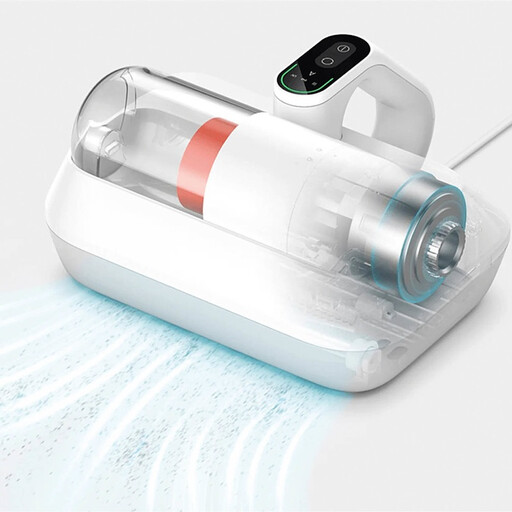
Why it suits this profile: This model combines 14 kPa suction power with Smart, low and high settings. It is suitable for mattresses, sofas, cushions and bedding when you are looking for one appliance to use on several fabric surfaces.
The smart display shows the operating status, and the model has a four-stage filtration system. According to the product information, the UV lamp switches off automatically when the appliance is lifted more than 5 cm.
14 kPa suction power, 0.5-litre dust container, 55 °C hot air and washable accessories.
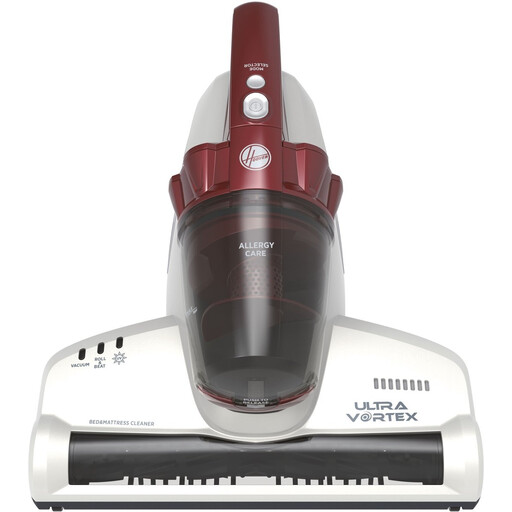
Why it suits this profile: The combination of a 500W motor, UV-C lamp and Roll & Beat brush is aimed at anyone who wants to treat mattresses, cushions, sofas and duvets regularly with one dedicated appliance.
The Roll & Beat function provides mechanical brush action alongside the UV-C light. According to Hoover, the UV-C technology helps reduce bacteria, allergens and mites; this claim comes from the brand’s product information.
500W power, cyclone filter, UV-C and a weight of 2.3 kg according to the product specifications.
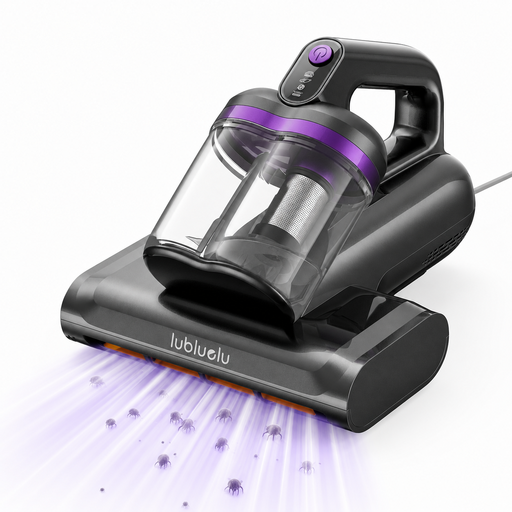
Why it suits this profile: With a 650 ml dust container, 4-metre cable and 55 °C hot air, this model is well suited to households that want to treat several mattresses, sofas or other upholstered surfaces one after another.
The combination of 15 kPa suction power and a large container helps limit interruptions during longer cleaning sessions. The hot air is a separate drying function and does not replace normal ventilation.
15 kPa, 650 ml dust cup, 55 °C hot air and a stated maximum noise level of 72 dB.
We have put together a complete, up-to-date list of products that fully meet these strict selection criteria and the applicable European safety regulations.
A mattress vacuum cleaner is an addition to regular washing, ventilation and reducing moisture. It does not replace professional cleaning or medical advice.
A mattress vacuum cleaner can pick up dust, skin flakes, hair and other loose dirt from fabric. Some brands also claim that UV-C, vibrations or hot air help reduce mites. According to the brand’s own research or product information, such percentages do not automatically apply to every mattress or usage situation. So, focus mainly on the combination of suction nozzle, brush, filter and correct use.
This depends on the household. If you have pets, lots of fabric surfaces or a sensitivity to dust, regular use may be practical. A set routine, such as when changing the bed, is easier to maintain than carrying out a very long cleaning session occasionally. Clean the filter according to the instructions, as a dirty filter can reduce airflow.
For corded models, the running costs mainly consist of electricity and replacement filters. With cordless appliances, battery life is also a factor. Before buying, check the price and availability of filters, the recommended replacement period and the power rating. A lower wattage does not automatically mean less suction power; to assess this, you need to consider the stated suction pressure and the design together.
