
Vandaag of morgen in huis

Kwaliteit gegarandeerd

Welkomstaanbiedingen ontgrendelen: GRATIS bezorging | Tot 80% korting | Gratis 30 dagen JoyPlus-proefperiode
Download de app
A massage gun can come in handy after exercise, during a day spent sitting at work or when your muscles feel tense. Yet the options can often seem much the same: multiple speeds, different massage heads and terms such as “deep tissue” or “professional”. These words only mean something when you know which specifications lie behind them.
As Joybuy’s Product Recommendation Officer, I focus on the product details that matter in everyday use. That way, you can avoid paying for features you won’t use or choosing a device that turns out to be awkward after a few weeks.
A massage gun with nine settings isn’t automatically more versatile than one with four. What matters more is whether the lowest setting feels comfortable and the intensity increases in a sensible way. A gentle setting is useful if your muscles are sensitive or you’re trying a massage gun for the first time. You may want more power for larger muscle groups.
Check whether the manufacturer lists the amplitude, too. This is the distance the massage head travels back and forth. A greater amplitude can make the massage feel firmer, but it isn’t suitable for every part of the body.
A massage gun with a heat function may sound appealing, but heat or cooling doesn’t automatically make the device suitable for every situation. According to Beurer’s product information, the MG195 can provide heat and cooling without a massage. That’s handy, but always follow the instructions and avoid using it on damaged, swollen or sensitive skin.
Claims about recovery, circulation or reducing inflammation aren’t guaranteed product results. When a brand makes these claims, they reflect the brand’s own information. Don’t use a massage gun as a substitute for medical advice.
A mini massage gun is easy to carry around, but it generally has less room for a large motor, wide handle or extensive controls. A heavy model may feel powerful, but can be less comfortable to use when treating your own back, shoulders or calves.
So pay attention to weight, handle, charging method and storage case. A portable massage gun with a USB-C connection, for example, is handy for the gym or when you’re out and about, as long as the battery life suits the way you plan to use it.
An electric massage gun works by moving a massage head rapidly and repeatedly. Manufacturers sometimes list this in RPM, or movements per minute, and sometimes in terms of amplitude or massage force.
Extra massage heads are only useful if you’ll actually use them. Four well-chosen heads may be more practical than seven accessories left loose in a drawer.
A quiet massage gun is more comfortable to use in a shared home, at the office or in the changing room. If possible, look for a stated noise level in decibels. For example, the Torq Mini is listed as producing less than 35 dB, according to the product information. Other models may only be described as “quiet” or “low noise”, which makes them harder to compare.
A brushless motor is found in various models. Also check whether information is available on stall force, maximum pressure or amplitude. These figures provide more context than a marketing term such as “professional” on its own.
Check how long the device is specified to run for and how long it takes to charge fully. The RENPHO Power+ is listed as offering around three to four hours of use and taking approximately three to four hours to charge. The Beurer MG195 is listed as offering up to 4.5 hours of use. Actual battery life depends on the intensity and features you choose, such as heat.
Remember to charge it safely, too: use the supplied cable or recommended charger, don’t operate the device while it’s charging, and keep it away from water.
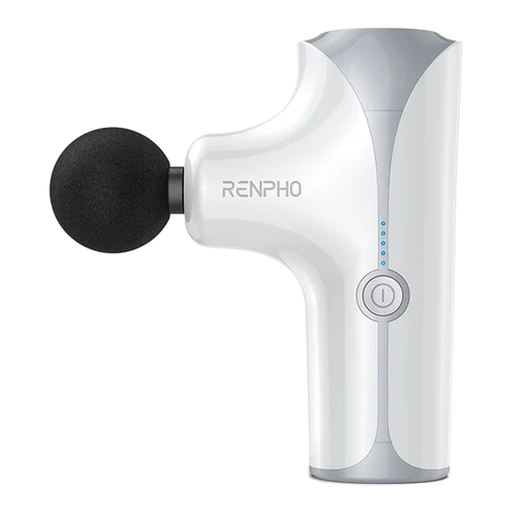
Why it suits this profile: This compact model has 5 speeds and is easy to take to work, the gym or on a trip. According to the product information, a maximum usage time of 15 minutes per session is recommended.
The key features are straightforward: five settings and four heads, without an emphasis on unnecessary extras.
Compact design, 5 speeds and 4 interchangeable massage heads.
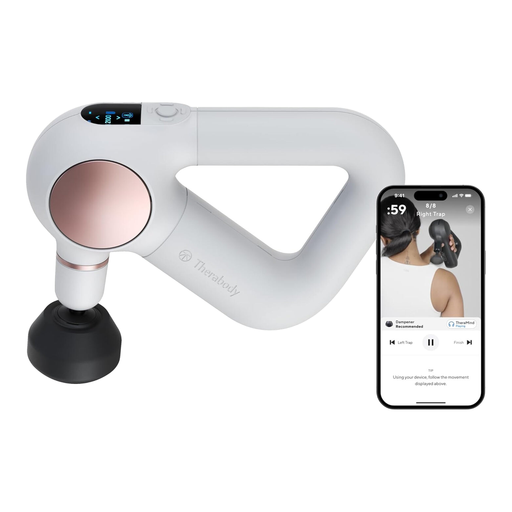
Why it suits this profile: The triangular handle, biometric sensor and connection to the Therabody app suit users who value guidance and a consistent routine.
The app offers guided routines, so you don’t have to rely on the number of speeds alone.
4 included heads, a Bluetooth app and an ergonomic triangular handle.
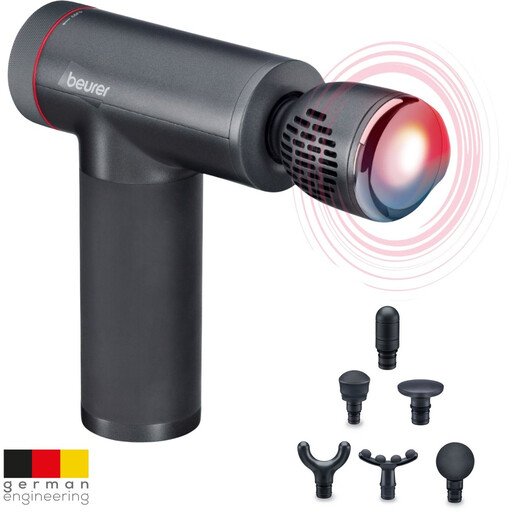
Why it suits this profile: This model combines 9 intensity levels with heat and cooling functions. According to the product information, it has 3 heat settings and 3 cooling settings.
The controls show the selected intensity and battery status. This makes the settings easier to check than on models with just one button.
9 intensity levels, 7 massage heads, an LED display and a stated battery life of up to 4.5 hours.
We’ve put together a complete, up-to-date list of products that meet these strict selection criteria and current European safety requirements.
Always start on the lowest setting and move the massage head gently over the muscle. Avoid:
Don’t use the device while it’s charging or near water. If you’re pregnant, have a pacemaker, vascular problems or another medical condition, it’s sensible to speak to a doctor first. Stop immediately if you feel pain, tingling or an unusual reaction.
Keep each session short. Many product manuals recommend around 30 to 90 seconds per muscle group and a maximum of 15 to 20 minutes per session in total. Start gently and avoid staying in one place for too long.
It varies by model and intensity. Stated battery life in product information ranges from a few hours to a maximum of 4.5 hours. Heat, cooling and higher speeds can drain the battery faster. So check both the battery life and charging time.
After purchase, running costs are generally limited to charging the battery. Power consumption depends on how often you charge it and the battery capacity. Pay particular attention to the supplied cable, replaceable accessories and warranty terms. In the European Union, many consumer products come with a minimum of two years’ statutory conformity protection; additional terms may vary by product.
