
Vandaag of morgen in huis

Kwaliteit gegarandeerd

Welkomstaanbiedingen ontgrendelen: GRATIS bezorging | Tot 80% korting | Gratis 30 dagen JoyPlus-proefperiode
Download de app
A massage gun can come in handy after exercise, during a day at your desk or when your muscles feel tense. However, there can be a big difference between models. A high speed, for example, doesn’t automatically mean a device will feel comfortable or suit your needs. A large number of attachments may simply mean extra accessories you’re unlikely to use.
As Joybuy Product Recommendation Officer, I filter through the key product specifications and turn them into practical buying criteria. That way, you can avoid paying extra just for marketing terms.
A high rpm figure may sound appealing, but it doesn’t tell you everything about the massage experience. Also look at the amplitude: this is the distance the massage head travels back and forth. A model with a moderate speed and sufficient amplitude may feel different from a compact device with a higher speed.
Also check whether there are several speed settings. For first-time use or sensitive muscle groups, a low setting is more practical than going straight to the highest intensity.
A heavy electric massage gun can be difficult to position, especially around your shoulders, back or calves. An extended handle can help you reach awkward areas on your own. A mini massage gun, on the other hand, is easier to take to the office, gym or on a trip.
Don’t just consider the weight: look at the handle shape, non-slip material and controls, too. A device that’s difficult to hold securely often ends up unused in a cupboard.
A massage gun with attachments gives you more options, but each head is designed for a different use. A round head is generally intended for larger muscle groups, according to the product description, while a bullet-shaped head is often offered for more targeted pressure. Don’t use an attachment directly on bones, joints, your spine or irritated skin.
Heat functions aren’t necessary for everyone either. A massage gun with heat can feel relaxing, but check the temperature settings, usage time and safety instructions. Some brands’ product information says that heat can be used before activity; treat this as a product claim, not medical advice.
For massage focused on larger muscle groups, amplitude and adjustable intensity are worth considering. For example, the RENPHO R-C004 lists an amplitude of 8 mm, a maximum massage force of 14 kg and four speeds. These figures can be checked, but the right choice depends on your comfort and what you want to use it for.
If you’re mainly looking for gentle muscle relaxation, you don’t necessarily need a powerful model. For athletes looking for a firmer percussive massage, a higher amplitude, multiple settings and a motor with sufficient torque may be more appealing.
A portable massage gun should be easy to charge and offer enough battery life. Check whether the model charges via USB-C, how long the battery lasts and whether a charger is included. The RENPHO Mini Massage Gun lists a runtime of around 4 to 5 hours, while the Beurer MG79 specifies a battery life of up to 3 hours.
Long battery life is especially useful for gym bags and travel. For home use, a shorter runtime is often enough, as long as charging is straightforward.
Choose the number of massage heads to suit your routine. Three well-chosen heads may be more practical than seven accessories you don’t recognise or use. According to its specifications, the Beurer MG195 has seven attachments, nine intensity levels, and separate heat and cold functions. The Breo Sport-M0500 lists six heads, four speeds and a heated head.
Also consider the controls: a clear display, physical buttons or a dial make it easier to adjust the intensity in a controlled way. Bluetooth and app routines can provide extra features, but they aren’t essential for a simple muscle massage.
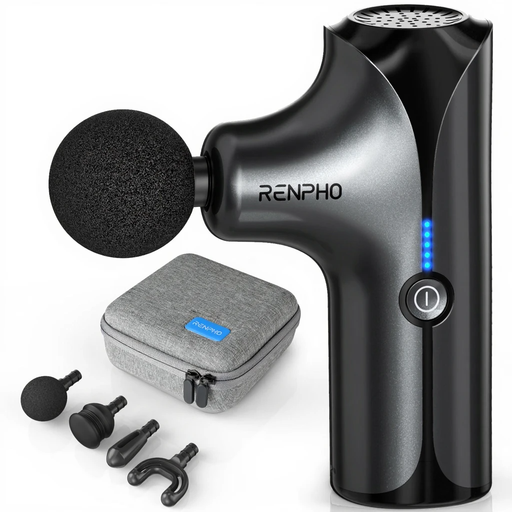
Why it suits this user profile: This compact model is a good choice if you’d like to try a massage gun at home and take it with you when you’re out and about.
The five speeds mean you’re not limited to one fixed, high intensity. The product information also lists a weight of around 0.45 kg and an LED indicator.
Four massage heads, five speeds and a stated battery life of 4 to 5 hours.
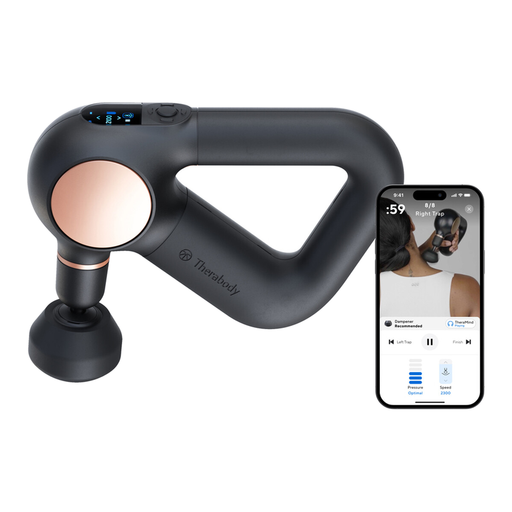
Why it suits this user profile: The ergonomic triangular handle, four attachments and app connectivity make this a good fit for users who value guidance and extra control.
The different grip options and guided routines offer more control than a model with just one button and one massage head.
Bluetooth, four included attachments, a built-in sensor and a stated weight of 1.65 kg.
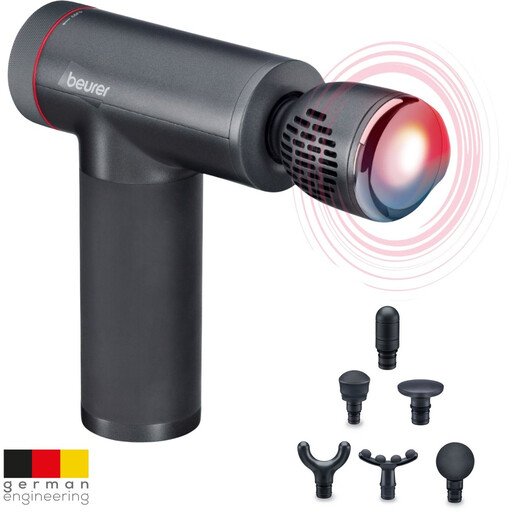
Why it suits this user profile: This model is designed for users who want to combine heat, cooling and multiple settings in one device.
The nine speeds let you increase the intensity gradually. According to the specifications, heat and cooling can also be used separately from the massage function.
Seven attachments, three heat settings, three cooling settings and a stated runtime of up to 4.5 hours.
We’ve put together a complete, up-to-date list of products that meet these strict selection criteria and the applicable European safety requirements.
Start with around 30 to 60 seconds per muscle group. Avoid using it on one spot for too long. The right duration depends on the device, the intensity and your personal comfort. Always follow the manual for your chosen model.
A massage gun is intended for personal relaxation and can be used around sporting activities. According to various brands’ own product information, percussive massage may contribute to relaxation or the feeling of recovery. This isn’t a medical claim, and the device is not a substitute for advice or treatment from a healthcare professional.
Most models run on a rechargeable battery, so their electricity use while charging is limited. It depends on the battery capacity, how often you use the device and how long it takes to charge. A USB-C model is handy if you already have a suitable adapter, but always check that the charging voltage matches the product manual.
