
Vandaag of morgen in huis

Kwaliteit gegarandeerd

Welkomstaanbiedingen ontgrendelen: GRATIS bezorging | Tot 80% korting | Gratis 30 dagen JoyPlus-proefperiode
Download de app
A set of markers or highlighters may seem easy to choose. Yet many shoppers are swayed by attractive colours, large sets or claims about long-lasting performance without checking what the pen is actually suitable for. As a result, you may end up with smudges on thin paper, unreadable text or a marker that is not right for the surface you want to work on.
This buying guide helps you compare markers and highlighters based on verifiable features. From pastel highlighters and neon highlighters to felt-tip pens, acrylic markers and brush markers, the right type mainly depends on how you intend to use it.
A highlighter set with lots of colours may look appealing, but four to eight clear colours are often more practical for school or the office. With a very extensive marker set, you may otherwise end up paying for shades you rarely use. So look at the colour selection: does the set include both basic colours and shades that suit your notes, planner or creative project?
Neon highlighters really stand out and are useful when you need to find important information quickly. Pastel highlighters are more subtle and can be more comfortable to use in planners, summaries and hand lettering. Do check beforehand that the contrast is sufficient on your paper. A soft shade may be less visible on cream-coloured or thin paper.
Water-based ink is generally a practical choice for paper and may be easier to remove than permanent ink. That does not mean every mark will disappear completely from every fabric or surface. According to some manufacturers’ product descriptions, certain felt-tip pens are washable from hands and textiles, but the result depends on the fabric, drying time and washing method. When using markers with children or for craft projects, test them first on an inconspicuous area.
The tip determines how much control you have:
A dual tip is versatile, but it also increases the chance that one end will wear out sooner if you use it frequently.
For highlighting text and drawing on paper, water-based ink and standard felt-tip pens are usually sufficient. If you want to work on glass, wood, ceramics, metal or plastic, you will need a different type of product.
Acrylic markers often contain opaque, water-based acrylic ink. According to the product description, the Faber-Castell Shake & Paint sets are suitable for paper, metal, ceramics, plastic, glass, textiles, stone, canvas and wood, among other surfaces. The marker must be shaken before use, and pressing the tip activates the ink. Always test it first on the chosen surface.
Alcohol markers are another option for sketching. According to the product specification, the Faber-Castell Goldfaber Sketch Marker Set uses alcohol-based ink, a brush tip of approximately 1 to 5 mm and a 0.6 mm fineliner tip. This ink can bleed through thin paper. Use suitable marker paper or place a protective sheet underneath your work.
A cap that closes securely is more important than an eye-catching design. Do not leave markers uncapped after use and store them according to the manufacturer’s product information. For the STABILO swing cool and STABILO BOSS ORIGINAL, STABILO states in its own product information that the pen can be left without a cap for up to four hours without drying out. Treat this as a product specification under certain conditions, not as a guarantee for every situation.
Also look for:
The CE marking indicates that the manufacturer declares compliance with certain European requirements. EN 71 relates to toy safety. Neither marking on its own means that a marker will write well on every surface.
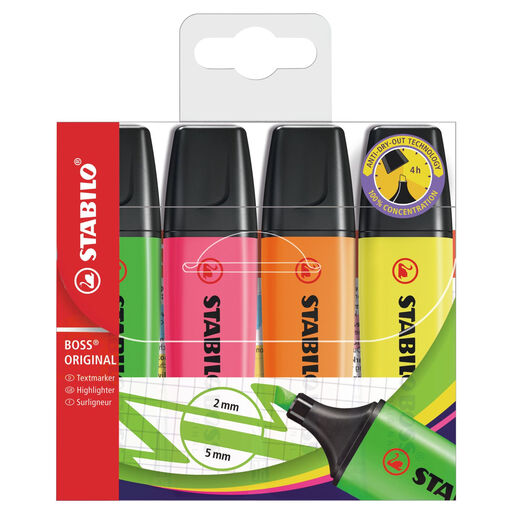
Why it suits this profile: A compact set with yellow, orange, green and pink for school, diaries, the office or home study.
The set limits the choice to four easy-to-recognise colours, so you do not buy a large collection for occasional use.
Water-based ink and a chisel tip with writing widths of 2 and 5 mm.
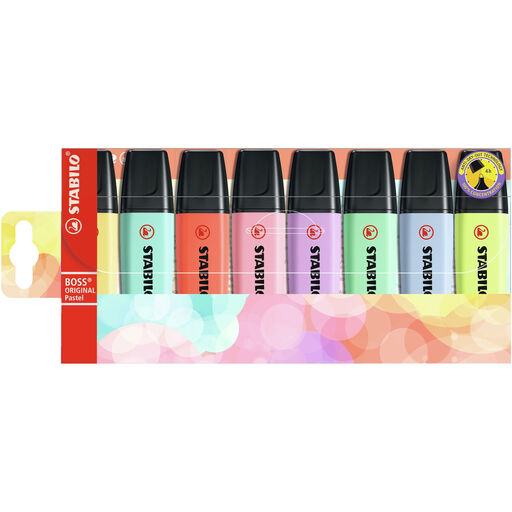
Why it suits this profile: For students, homeworkers and creative people who want to combine subtle colour coding with hand lettering.
The pastel colours are intended as an alternative to bright neon ink; however, check on a test sheet that the contrast suits your paper.
Eight pastel colours, water-based ink and a chisel tip for 2 and 5 mm lines.

Why it suits this profile: For crafting and decorating on various materials, such as canvas, wood, glass and ceramics.
The product specification lists several suitable surfaces, so you do not have to limit this type of marker to paper.
Six metallic colours, two writing tips of 1 and 3 mm, and a shake-and-pump system.
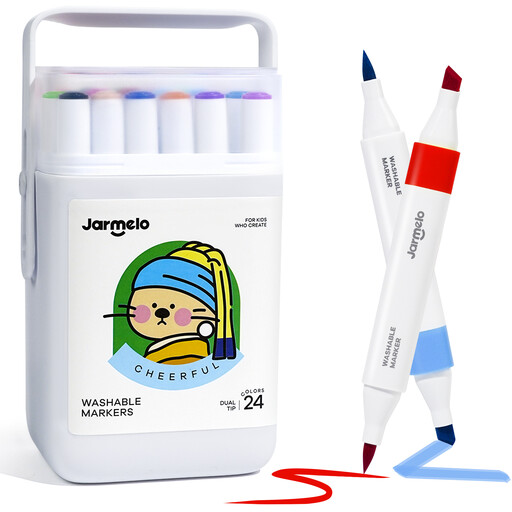
Why it suits this profile: This set is designed for colouring, drawing and lettering at home, and comes with a storage case with a handle.
The water-based ink is described as washable in the product description; however, remove marks as quickly as possible and test on textiles beforehand.
24 markers with brush and chisel tips, a water-based formula and ventilated caps.
We have put together a complete, up-to-date list of products that fully meet these strict selection criteria and the applicable European safety regulations.
Choose a highlighter with water-based ink, a cap that closes securely and two writing widths. A chisel tip of around 2 to 5 mm is practical for both highlighting and underlining. A compact set of four to eight colours is often enough for texts, diaries and summaries.
Replace the cap immediately after use and check that it is fully closed. Store markers away from direct sunlight and extreme temperatures. With sets featuring two tips, it is important to close both caps securely. Claims about extended use without a cap, such as the four hours stated by STABILO, come from the brand’s product information and depend on the conditions.
Felt-tip pens are mainly intended for colouring and drawing on paper or card. Drawing markers can use different types of ink and feature different tip shapes, such as a brush tip or fineliner. Acrylic markers contain opaque acrylic ink and, according to the product description of certain models, are suitable for a wider range of surfaces. Always check the product specification before working on glass, wood, textiles or plastic.
