
Vandaag of morgen in huis

Kwaliteit gegarandeerd

Welkomstaanbiedingen ontgrendelen: GRATIS bezorging | Tot 80% korting | Gratis 30 dagen JoyPlus-proefperiode
Download de app
Markers and highlighters may seem simple to buy. Yet the wrong choice can lead to bleed-through, tips that dry out quickly, or a set of colours you barely use. For school pupils, university students, office professionals, parents and creative hobbyists, the right choice isn’t just about the number of colours.
The key question is: what are you going to use the pens for? A highlighter for a textbook needs different features from an acrylic marker for glass, an alcohol marker for illustrations, or a dot marker for young children.
A marker set with lots of colours can look appealing, but first check what you’ll be using it for. For everyday highlighting, four to eight clearly distinguishable colours are often more practical than a large collection. For drawing or hand lettering, a broader palette can be useful though.
Also pay attention to the colour naming. “Pastel” usually means a softer shade with less visual contrast than neon. That’s nice for summaries and diaries, but possibly less suitable when text needs to stand out immediately.
A broad chisel tip is handy for highlighting text, while a fine tip works better for underlining and details. Some highlighters combine both functions. So check the stated line widths, such as 1 and 4 mm or 2 and 5 mm.
For drawing pens, the shape of the tip is also important. A brush tip gives more variation in line thickness. A fineliner tip of, for example, 0.6 mm is more suitable for outlines and small details.
Water-based ink is generally suitable for paper and is often used in highlighters, watercolour pens and child-friendly markers. Alcohol markers dry quickly and are intended for illustrations, but can bleed through paper. Acrylic markers are designed for surfaces such as wood, glass, ceramic, metal and canvas; always let the ink dry and follow the product instructions.
A marker that writes on glass isn’t automatically suitable for an overhead transparency or plastic. So check whether the product has permanent or erasable ink.
For school and office, two line widths are practical. A narrow line helps with underlining; a broad side highlights a block of text evenly. With acrylic markers, two tips, for example 1 mm and 3 mm, offer flexibility for details and thicker lines.
Test new markers first on a loose page of the same paper as your notebook or textbook. Look out for:
Claims about drying time, washability or opacity come from the brand’s product information. So treat them as product specifications and, if in doubt, test them on an inconspicuous spot.
The cap is often key to the lifespan. Close every marker immediately after use. Store pens according to the manufacturer’s instructions, for example lying flat or upright. A clip, sturdy casing and a well-sealing cap are useful for school pupils and commuters who take their highlighters with them every day.
For markers with a pump or shake mechanism, you need to follow the activation steps. For Faber-Castell acrylic markers, according to the product information, this includes shaking 20 to 30 times and pressing the tip repeatedly until the ink flows.
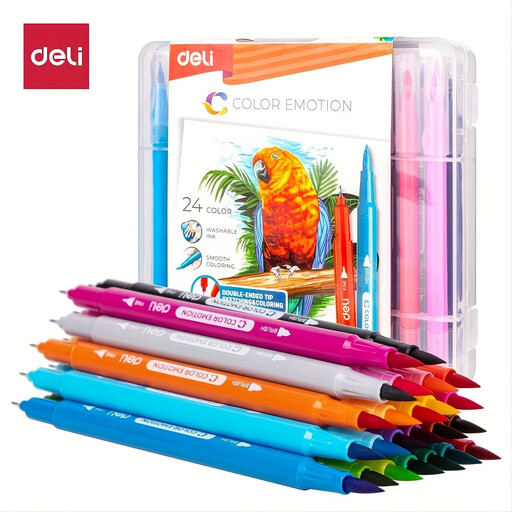
Why this fits the profile: A set with 24 colours and two ends offers room to write, colour and try out simple watercolour techniques without having to buy several types of pens straight away.
The product name clearly states the number of colours and the double tip. Do check beforehand whether the watercolour style suits your paper.
24 colours; double-ended design; suitable for creative projects.
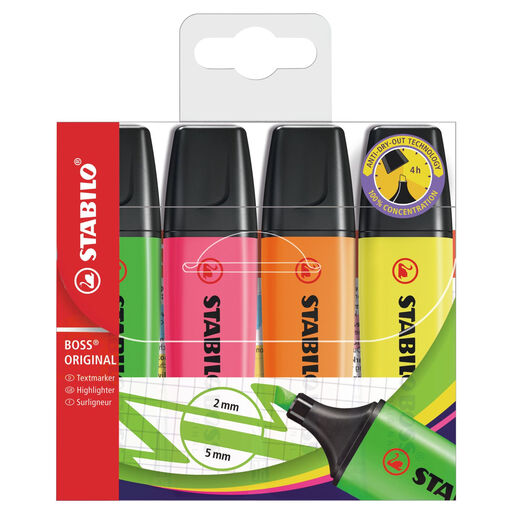
Why this fits the profile: For daily use in a diary, planner, textbook or office, this compact set offers four recognisable colours and a chisel tip for two line widths.
The product specification mentions water-based ink, a tip of 2 to 5 mm and a set of four. This makes the function clearer than with a random multicolour set.
Water-based; chisel tip; lines from 2 to 5 mm; CE marking in the product information.

Why this fits the profile: These acrylic markers are aimed at creative projects where paper, wood, glass, ceramic, plastic, metal, stone or canvas is used as the surface.
The marker isn’t selected on colour alone: the product information states the suitable surfaces, two tips and an ink level indicator.
6 colours; water-based acrylic ink; tips of 1 and 3 mm; suitable for multiple surfaces.

Why this fits the profile: The combination of a flexible brush tip and a metal fineliner tip is designed for sketching, colour blocks, outlines and detail work.
The product specification mentions alcohol ink, a brush tip of 1 to 5 mm and a fineliner tip of 0.6 mm. Use suitable paper to limit bleed-through.
24 colours; brush tip; 0.6 mm fineliner; alcohol ink according to the product information.
We’ve put together a full, up-to-date list of products that fully meet these strict selection criteria and current European safety regulations.
That depends on the ink and the paper. Water-based highlighters often bleed through less than alcohol markers, but thin paper can still show through. Test the pen first on a page behind and choose paper with a sufficient weight.
Put the cap back on immediately after use and check that it closes fully. Store the set according to the product instructions. Some STABILO models state a limited cap-off time according to their own product information, but that doesn’t mean leaving them open for a long time has no effect.
Not automatically. Check the recommended minimum age, warnings and surface. For young children, specially designed, water-based and washable dot markers are a more logical choice. Always use markers under supervision when small parts or non-washable ink are present.
