
Vandaag of morgen in huis

Kwaliteit gegarandeerd

Welkomstaanbiedingen ontgrendelen: GRATIS bezorging | Tot 80% korting | Gratis 30 dagen JoyPlus-proefperiode
Download de app
If you want to buy pens and pencils for school, the office, drawing or journalling, you’ll soon come across dozens of similar-looking sets. But a large range of colours or eye-catching packaging doesn’t tell you everything about how easy they are to use. The right choice depends above all on the nib, ink, refill, paper and how many items you actually need.
A set with 50 or 80 colours may look appealing, but it isn’t always practical for everyday use. For revision notes, you’re more likely to need a few reliable highlighters. For illustrations, a larger set of coloured pencils or an assortment of brush pens may make more sense.
So, check:
A fine nib is useful for detail, but may be less comfortable to write with on rough paper. A broad nib covers a large area quickly, but may bleed through thin exercise-book paper. So, when choosing pastel highlighters, black gel pens and drawing pens, always check the nib size and recommended surface.
Terms such as “water-resistant”, “quick-drying” or “washable” can be useful, but what they mean in practice depends on the surface. According to Faber-Castell’s product description, for example, its brush pens use food colouring and are washable. That doesn’t automatically mean every stain will come out completely from every type of fabric.
So, check the product specifications, instructions and safety information. For products aimed at children, the stated age recommendation and any reference to standards are particularly relevant.
A chisel nib often offers two line widths. The STABILO BOSS ORIGINAL Pastel, for example, has a stated line width of 2 and 5 mm. This makes one marker suitable for both fine lines and broader highlighting.
A brush nib works differently: vary the pressure and you can create thicker or thinner lines. This is useful for hand lettering, cards and creative projects, but less suitable if you always need the same line width.
For technical drawings and fine sketches, mechanical pencils with a fixed lead size are easier to choose. A 0.5 mm pencil is designed for fine lines, while a model with 1.8 mm 2B lead gives a softer, broader line for sketching.
When choosing pens, consider how the ink works with the paper:
According to the product information, the WRITECH gel pens have a 0.7 mm nib, black gel ink and a retractable mechanism. They’re suited to notes, journalling and longer writing sessions. Retracting the nib after use helps prevent the ink from drying out unnecessarily.
When choosing pencils, hardness, wood type and shape all play a part. According to the product description, the Faber-Castell Black Edition has B-grade lead, a triangular grip and a core with special bonding. The STABILO Original coloured pencils have a 2.5 mm core and are designed for fine lines and outlines.
For children, the age recommendation is important. The Faber-Castell Brush Pen Set states a recommended minimum age of 10 years and refers to EN 71. Small parts, such as caps or accessories, should not be treated as toys for young children.
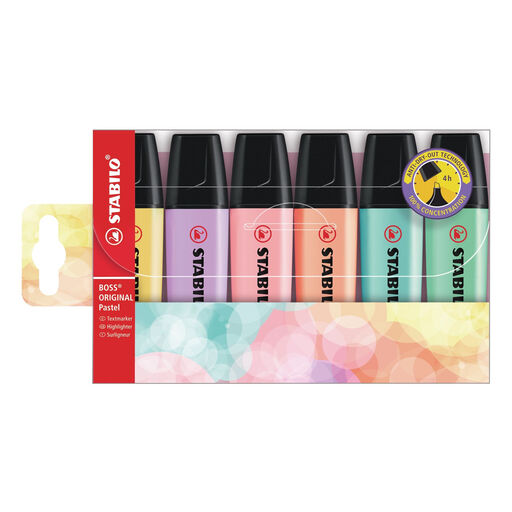
Why it suits this profile: This set contains six pastel colours, making it a straightforward choice for school, studying and the office without having to buy a large stationery set.
The number of colours is limited and clearly stated. The chisel nib has two specified line widths, so you can choose this marker for its practical use as well as its colour.
Water-based ink, a 2 and 5 mm chisel nib and a set of six pastel colours. The product listing also states that it can be left uncapped for up to four hours.
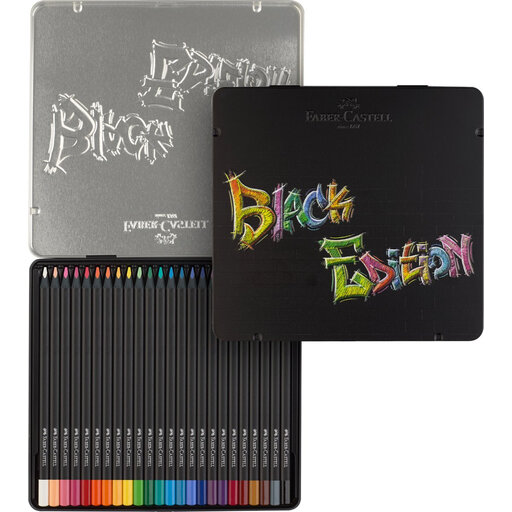
Why it suits this profile: The set combines 24 colours with a triangular grip and a metal tin. It’s a good choice for drawing enthusiasts who like to keep their supplies organised.
The product information specifies the lead hardness, core thickness and shape. This lets you check in advance whether the pencils are suitable for soft blocks of colour and the way you hold a pencil.
24 coloured pencils, B-grade lead, a 5 mm core and an ergonomic triangular shape. The product description mentions special bonding of the core.
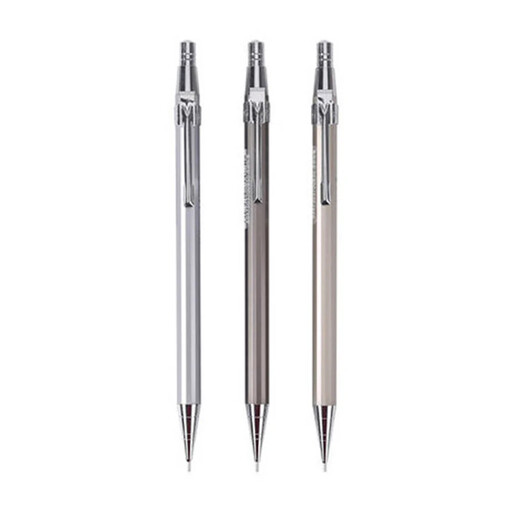
Why it suits this profile: The fixed 0.5 mm lead size is designed for precise writing, sketching and note-taking. The three-pack is handy for your desk, school bag or workplace.
The lead size is clearly stated, so you’re less likely to choose lead that’s too thick for detailed work. Replace the lead according to the instructions and don’t force the mechanism.
Metal barrel, 0.5 mm black lead, push-button mechanism and three finishes: black, white and gold.
We’ve put together a complete, up-to-date list of products that meet these strict selection criteria and the applicable European safety requirements.
A practical starter set doesn’t have to be large. For school or studying, for example, a few black gel pens, some pastel highlighters and a mechanical pencil with spare lead will do the job. For journalling, you can add brush pens and a fineliner.
For drawing, a combination of sketching pencils, a set of coloured pencils and drawing pens is more useful than one general-purpose set. Above all, check whether the coloured pencils are suitable for light or dark paper. For example, the Faber-Castell Brush Pen Set is listed as suitable for light paper, but not black paper.
Want to give creative writing supplies as a gift? Check the recommended age, the number of pieces and how everything is stored. A compact stationery set is easier to carry than loose pens and markers.
A basic set-up includes black gel pens, a mechanical pencil, an eraser and a few highlighters. You can add coloured pencils or drawing pens for art. It’s better to choose based on your subjects and everyday use than simply on the number of items.
That depends on how often you use them, how you store them and whether you replace the cap properly. Follow the manufacturer’s storage instructions where possible, keep them away from heat and direct sunlight, and put the cap back on straight after use. A stated uncapped drying time doesn’t guarantee an unlimited shelf life.
Yes, but you’ll need some control over the pressure you apply to the nib. Brush pens are suitable for hand lettering, small drawings and adding pops of colour. If you mainly want to draw even lines, you may find it easier to start with a fineliner, gel pen or marker with a fixed nib.
