
Vandaag of morgen in huis

Kwaliteit gegarandeerd

Welkomstaanbiedingen ontgrendelen: GRATIS bezorging | Tot 80% korting | Gratis 30 dagen JoyPlus-proefperiode
Download de app
Anyone looking to buy markers and felt-tip pens will soon come across dozens of sets with eye-catching colours and promising features. However, a large set is not automatically suitable for every application. A permanent marker for metal works differently from a highlighter for textbooks, while a brush pen is designed for hand lettering and illustrations.
The biggest buying mistakes usually come down to three things:
So start by considering what you want to use the pens for. Are you looking for highlighters for school and the office, colouring pens for children, or markers for paper and other surfaces? You can then compare the ink, nib shape and set size.
Water-based ink is a sensible choice for many school and craft projects. Water-based felt-tip pens and brush pens are generally suitable for paper and, according to the product information for some models, can be washed off skin or fabric. Always check the packaging, though: ‘washable’ does not mean that every stain will disappear from every material.
Highlighters, pastel highlighters and neon highlighters are designed for documents. A chisel nib allows you to make both broad marks and narrower underlines. For example, the product description for the WRITECH markers states a line width of 1 to 4 mm and a retractable nib. This can be useful if you often work on the go or do not want to lose a cap.
Alcohol markers dry quickly and are suitable for sketches and illustrations. According to the product specifications for the Faber-Castell Goldfaber set, the ink is permanent once dry, water-resistant and designed for blending. With alcohol ink, it is best to use marker paper or place a protective sheet underneath, as the ink may bleed through.
Acrylic markers contain opaque, water-based acrylic ink. According to the product information, the Faber-Castell Shake & Paint sets are suitable for paper, metal, ceramics, plastic, glass, fabric, stone, canvas and wood, among other surfaces. Adhesion and durability may vary depending on the surface, so test the marker on an inconspicuous area first.
The nib determines how accurately and quickly you can work:
A 12-colour marker set is often enough for children or basic use. A set of 20, 24 or 50 colours offers more variety, but also takes up more space and may include colours you rarely use.
Also check the recommended age and safety marks. The Faber-Castell felt-tip pen set for children states a recommended minimum age of 4 years and carries an EN 71 quality label. The brush pens also mention EN 71 and a minimum age of 10 years. According to the product information, a permanent marker from the Sharpie Minecraft set is not suitable for children under 3 because it contains small parts; supervision remains important when using it.
Close markers carefully after use. Store them in a dry place away from direct sunlight. With acrylic markers, activate the nib according to the product instructions by shaking the marker 20 to 30 times and repeatedly pressing the nib until the ink starts to flow.
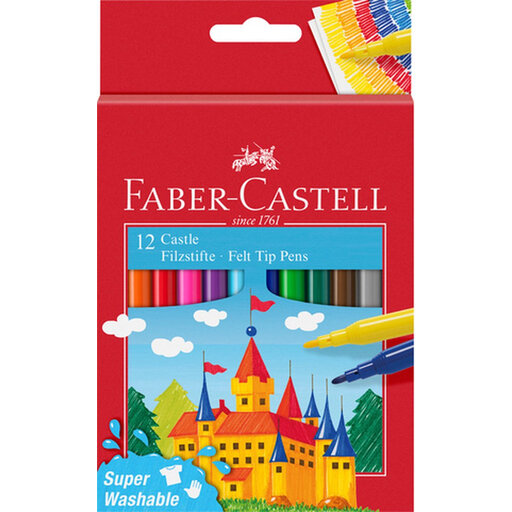
Why it suits this profile: A straightforward set for colouring, drawing and crafting on paper, card and wood. The set contains 12 different colours and, according to the product information, is aimed at children.
The product specifications mention a durable nib and ink that is washable from most fabrics at 30 degrees. Nevertheless, check the care label and test it first.
12 colours, a sturdy nib, EN 71 certification and cardboard packaging.

Why it suits this profile: Designed for students, illustrators and hobbyists who work with colour gradients and details. The set combines a brush nib with a fineliner nib.
The specifications describe the ink as alcohol-based, fast-drying and permanent once dry. Use suitable paper to help prevent bleed-through.
24 colours, a 1 to 5 mm brush nib and a 0.6 mm fineliner nib.

Why it suits this profile: For creative projects on a range of materials, such as canvas, wood, ceramics or glass. The six standard colours provide a useful foundation for decoration and marking.
The product information lists multiple surfaces and provides an activation procedure. Shaking the marker first and pressing the nib prevents uneven ink flow during initial use.
Six opaque colours, 1 and 3 mm nibs, an ink-level indicator and a shake-and-pump system.
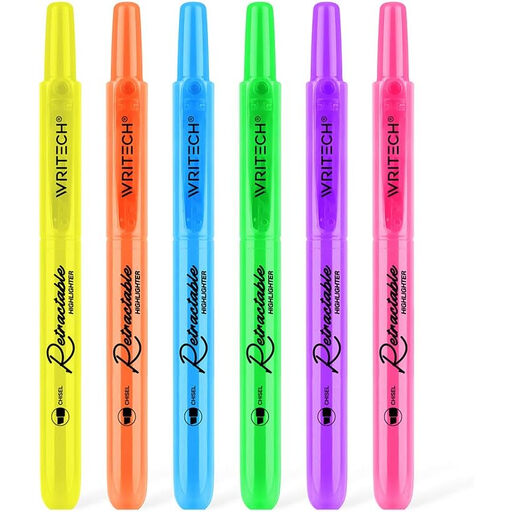
Why it suits this profile: The click mechanism is practical for lectures, meetings, planners and bullet journals. According to the product description, the set contains neon colours and has a chisel nib.
The retractable nib reduces the risk of stains in a bag when the marker is stored correctly. Always test the ink on your type of paper.
Click mechanism, 1 to 4 mm chisel nib and an assortment of neon and pastel colours.
We have put together a complete, up-to-date list of products that fully meet these strict selection criteria and the applicable European safety regulations.
For young children, water-based felt-tip pens with a sturdy nib and clear age information are a practical choice. Look for safety marks such as EN 71 when these are shown on the product page or packaging. Washable felt-tip pens for children can help reduce stains, but always test washability on the relevant fabric.
Highlighters are designed to make text on paper stand out, usually in fluorescent or pastel colours. Permanent markers are designed for long-lasting marks on paper, plastic and metal, among other materials. According to the product description, the Sharpie set contains fast-drying black ink that is water-resistant and fade-resistant. Use permanent markers in a well-ventilated area and not on materials for which they are not intended.
Replace the cap immediately after use or retract the nib. Store markers according to the product instructions, away from extreme heat and direct sunlight. A properly sealed cap is particularly important for brush pens and alcohol markers. It is better to choose a set that matches how you actually use it than a large pack in which several colours remain unused.
